ph-instruments ION Check Vacuum Gauge Calibration System
| Brand | ph-instruments |
|---|---|
| Origin | Germany |
| Model | ION Check |
| Measurement Principle | Spinning Rotor Gauge (SRG) |
| Range | 5 × 10⁻⁷ mbar to 1 × 10⁻² mbar (up to 1 mbar max) |
| Vacuum Interface | KF25 (adapters available for other standards) |
| Accuracy | ±1% of reading from 0.1 mbar to 1 × 10⁻⁶ mbar |
| Long-term Stability | <1% per year |
| Calibration Channels | Dual parallel |
| Pumping System | Oil-free turbomolecular pump + diaphragm backing pump |
| Data Interfaces | USB-C, LAN, RS-485, optional Bluetooth |
| Control Interface | 10-inch touchscreen, Windows 10, dedicated ION Check software |
| Power Supply | 230 VAC, 50 Hz, <2 A |
| Operating Temperature | 10–40 °C |
| Dimensions | 610 × 610 × 1200 mm |
| Weight | 90.8 kg |
Overview
The ph-instruments ION Check Vacuum Gauge Calibration System is a metrologically traceable, high-precision calibration platform engineered for the verification and intercomparison of vacuum gauges operating in the high and ultra-high vacuum (UHV) regimes. At its core, the system employs the Spinning Rotor Gauge (SRG) principle — a primary standard method based on the measurement of rotational drag torque exerted on a magnetically levitated, rotating steel sphere within a rarefied gas environment. This physical principle enables absolute pressure determination independent of gas species (within kinetic theory limits), eliminating calibration dependencies on gas composition, ionization cross-sections, or electron emission characteristics inherent to ionization gauges. The ION Check is designed for both in-situ and ex-situ calibration workflows, supporting rigorous quality assurance protocols in semiconductor fabrication, thin-film deposition, particle accelerator beamlines, and fundamental physics laboratories where vacuum integrity directly impacts process yield and measurement fidelity.
Key Features
- Primary Standard Traceability: SRG-based measurement provides direct linkage to SI units via fundamental gas kinetic parameters, fulfilling ISO/IEC 17025 requirements for accredited calibration laboratories.
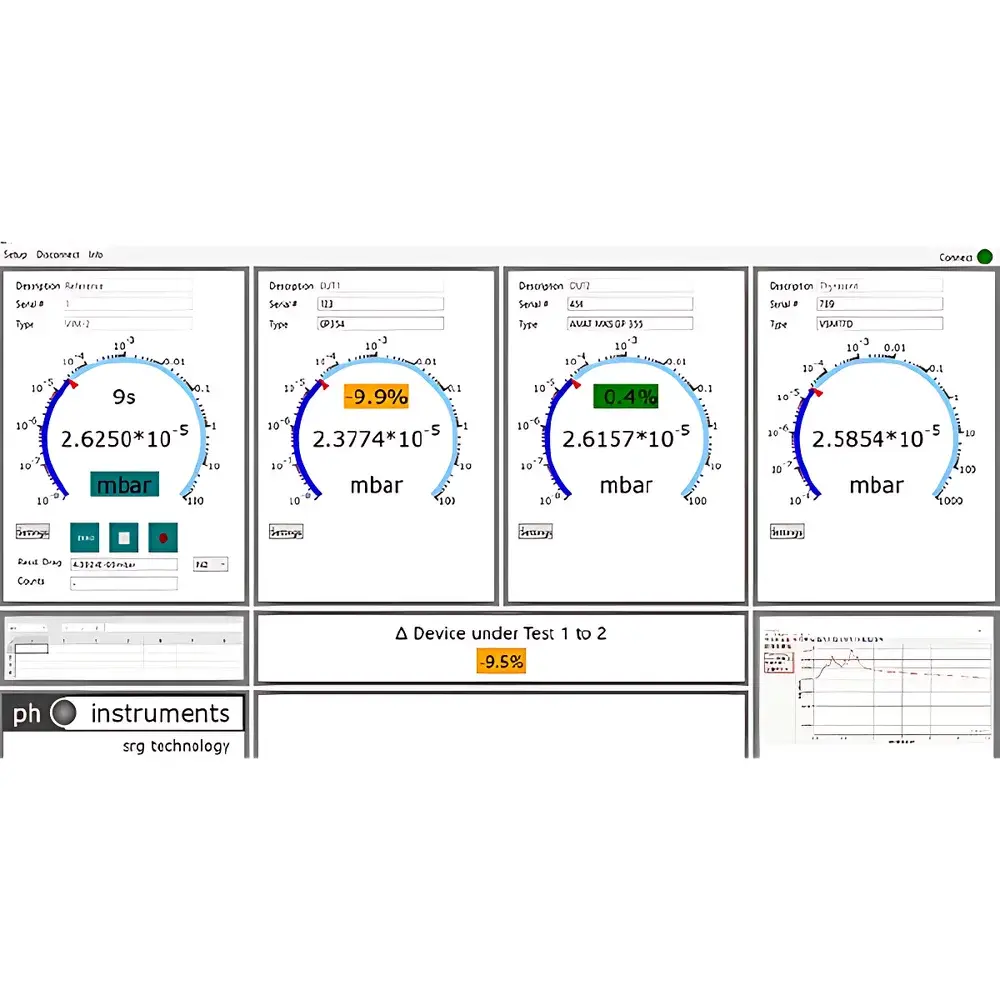
- Dual-Channel Parallel Calibration: Simultaneous connection and real-time comparison of two devices under test (DUTs), enabling rapid bias analysis, cross-calibration, and drift assessment without sequential measurement delays.
- Non-Intrusive Operation: No thermal load, no electron emission, no surface sputtering, and no gettering effects — preserving vacuum chamber integrity and avoiding perturbation of sensitive processes during calibration.
- Integrated Oil-Free Vacuum Architecture: Combines a turbomolecular pump with a chemically inert diaphragm backing pump, ensuring clean, hydrocarbon-free base pressure (<1 × 10⁻⁸ mbar typical) and compliance with UHV cleanliness standards (e.g., ASTM E1933, ISO 20483).
- Automated Workflow Execution: Touchscreen-driven interface with preconfigured calibration sequences, automatic pump-down ramping, stabilization monitoring, and pass/fail evaluation against user-defined tolerances.
- Full Audit Trail Support: Timestamped raw data logging with operator ID, environmental conditions (temperature, humidity), and system status flags — essential for GLP/GMP environments and FDA 21 CFR Part 11-compliant validation.
Sample Compatibility & Compliance
The ION Check accommodates a broad range of vacuum gauges including hot cathode ionization gauges (Bayard-Alpert, extractor types), cold cathode gauges (Penning, inverted magnetron), capacitance manometers (with appropriate adapter kits), and residual gas analyzers (RGAs) used as secondary pressure indicators. All calibrations are performed in accordance with established international standards including ISO 3567 (vacuum technology — calibration of vacuum gauges by comparison methods), ISO 20483 (vacuum technology — calibration of ionization vacuum gauges), and ASTM E1933 (standard practice for calibration of vacuum gauges). The system’s KF25 flange interface ensures compatibility with standard UHV components; optional CF, ISO-K, or DN16 adapters extend integration flexibility across legacy and OEM tooling platforms.
Software & Data Management
Control and data acquisition are managed through the embedded ION Check software suite running on Windows 10. The application supports full instrument configuration, real-time pressure trend visualization, multi-point calibration curve generation (linear, polynomial, or custom mapping), and automated report generation compliant with ISO/IEC 17025 Annex A.2 documentation requirements. Export formats include CSV (for Excel, MATLAB, or LabVIEW integration), PDF (with digital signature support), and XML (for LIMS ingestion). Remote access via LAN enables centralized fleet management and scheduled calibration campaigns across distributed facilities. Data encryption at rest and role-based user authentication align with cybersecurity best practices for regulated laboratory environments.
Applications
- Periodic performance verification of ionization gauges in semiconductor process chambers (CVD, PVD, etch tools)
- Validation of vacuum insulation systems in high-voltage equipment and fusion research infrastructure
- Interlaboratory comparison studies for national metrology institutes (NMIs) and calibration service providers
- Qualification of new vacuum gauge models prior to production deployment
- Root-cause analysis of pressure measurement discrepancies in R&D vacuum systems
- Supporting ISO 9001, IATF 16949, and AS9100 quality system audits requiring documented metrological traceability
FAQ
What vacuum gauge types can be calibrated using the ION Check?
The system is optimized for ionization gauges (hot and cold cathode), but with appropriate adapters and signal conditioning, it supports capacitance manometers, Pirani gauges, and piezoresistive sensors in overlapping pressure ranges.
Is the SRG measurement gas-dependent?
No — the SRG operates on kinetic theory principles and delivers absolute pressure values traceable to fundamental constants; minor corrections may apply for non-monoatomic gases below 1 × 10⁻⁴ mbar, and these are implemented in firmware per ISO 20483 Annex B.
Can the ION Check perform automated multi-point calibrations?
Yes — users define pressure setpoints across the target range; the system autonomously controls pumping speed, stabilizes each point, acquires DUT readings, and computes deviation statistics.
Does the system meet regulatory requirements for pharmaceutical or medical device manufacturing?
Fully — with optional 21 CFR Part 11 module (electronic signatures, audit trail, user access control), it satisfies FDA, EMA, and PMDA validation expectations for critical vacuum process monitoring.
What maintenance is required for long-term SRG accuracy?
Annual verification of rotor spin-down time and magnetic levitation stability is recommended; no consumables or routine recalibration of the SRG sensor itself is needed due to its passive mechanical design and <1% annual drift specification.