
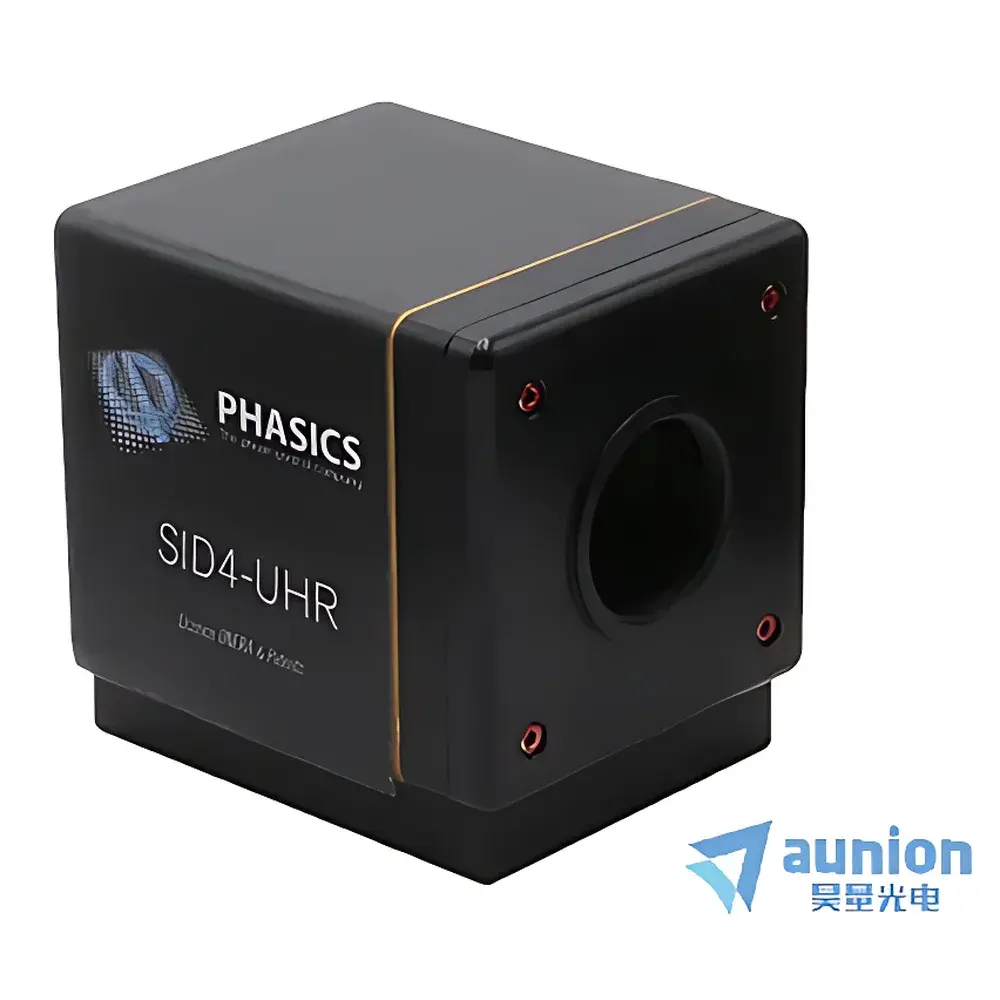
Phasics SID4-UHR Large-Aperture Ultra-High-Resolution Wavefront Sensor
| Brand | Phasics |
|---|---|
| Model | SID4-UHR |
| Wavelength Range | 400–1100 nm |
| Active Aperture | 15 × 15 mm² |
| Spatial Resolution | 29.6 µm |
| Phase Sampling Resolution | 512 × 512 (optional up to 666 × 666) |
| Phase Resolution | 2 nm RMS |
| Absolute Accuracy | 15 nm RMS |
| Frame Rate | 8 fps (raw data), 1 fps (full-resolution real-time processing) |
| Chromatic Correction | Achromatic, non-collimated beam compatible |
Overview
The Phasics SID4-UHR is an ultra-high-resolution, large-aperture wavefront sensor engineered for precision optical metrology in research and industrial environments requiring quantitative phase measurement at nanometer-level fidelity. Based on Phasics’ proprietary four-wave lateral shearing interferometry (4W-LSI), the SID4-UHR operates without reliance on reference beams or precise collimation—enabling robust, alignment-insensitive wavefront acquisition across broadband visible to near-infrared spectra (400–1100 nm). Its monolithic, achromatic design eliminates chromatic dispersion artifacts, allowing direct measurement of polychromatic or femtosecond laser pulses without spectral filtering or recalibration. With a 15 × 15 mm² active sensing area and native 512 × 512 spatial sampling (expandable to 666 × 666), the SID4-UHR captures full-aperture wavefronts in a single shot—making it uniquely suited for characterizing high-NA optics, freeform surfaces, and extended-source laser systems where conventional Shack-Hartmann sensors suffer from dynamic range or resolution limitations.
Key Features
- Ultra-high phase resolution: 2 nm RMS, enabling detection of sub-nanometer surface topography deviations and high-spatial-frequency wavefront errors.
- Large unvignetted aperture: 15 × 15 mm² active area supports full-field characterization of lenses, mirrors, and optical assemblies without scanning or stitching.
- Achromatic, non-collimated operation: Measures divergent, convergent, or collimated beams directly—no beam expanders or wavelength-specific calibration required.
- High-fidelity phase reconstruction: Proprietary 4W-LSI algorithm delivers absolute wavefront maps with 15 nm RMS absolute accuracy traceable to NIST-traceable standards.
- Real-time capability: 8 fps raw frame capture with on-board FPGA-accelerated processing; full-resolution wavefront reconstruction at 1 fps for closed-loop adaptive optics integration.
- Compact, vibration-resistant architecture: Monolithic sensor head with integrated thermal stabilization—designed for integration into vacuum chambers, EUV beamlines, and free-electron laser (FEL) endstations.
Sample Compatibility & Compliance
The SID4-UHR is compatible with a broad class of optical components and light sources, including aspheric lenses, off-axis paraboloids, diffractive optical elements (DOEs), micro-optics arrays, and high-power pulsed lasers (e.g., Ti:sapphire, Yb:fiber, FELs). Its non-contact, non-destructive measurement principle ensures compatibility with delicate coatings, soft optics, and vacuum-compatible substrates. The system meets essential requirements for ISO 10110-5 (surface irregularity), ISO 14999-3 (interferometric testing of optical components), and ASTM E2847 (standard practice for wavefront sensing). For regulated environments—including GxP-compliant optical manufacturing and DOE-funded laser facility QA—the firmware supports audit-ready logging, user access control, and time-stamped metadata export aligned with FDA 21 CFR Part 11 principles.
Software & Data Management
The SID4-UHR ships with QWLSI™ software—a modular, API-accessible platform supporting Windows and Linux. Core functionalities include real-time Zernike and Legendre polynomial decomposition, PV/RMS wavefront error reporting, MTF/PSF synthesis, and automated pass/fail grading against user-defined tolerances. Raw phase data is exported in HDF5 and TIFF formats with embedded calibration metadata (wavelength, pixel scale, temperature, exposure time). A Python SDK and LabVIEW VI library enable seamless integration into custom automation workflows (e.g., optical alignment robots, multi-axis stage synchronization). All processing pipelines are deterministic and reproducible—supporting GLP/GMP documentation workflows through configurable electronic lab notebook (ELN) export.
Applications
- Laser Beam Characterization: Quantitative M², BPP, and Strehl ratio analysis for high-brightness sources—including ultrashort-pulse lasers and free-electron laser (FEL) beamlines where temporal coherence limits interferometric methods.
- Adaptive Optics Calibration: High-bandwidth wavefront sensing for deformable mirror control loops in astronomy, ophthalmology, and inertial confinement fusion diagnostics.
- Optical Component Metrology: Surface figure verification of aspheres, freeforms, and segmented mirrors—complementing null-test interferometry with faster turnaround and no null optics requirement.
- Plasma & EUV Optics Diagnostics: In-situ wavefront monitoring of grazing-incidence optics under thermal load or plasma-induced distortion in fusion and lithography R&D.
- Microstructure & Thin-Film Analysis: Non-contact thickness mapping and stress-induced birefringence assessment via polarization-resolved wavefront differential mode (available with optional polarimetric module).
FAQ
What beam diameters can the SID4-UHR measure without relay optics?
The native 15 × 15 mm² aperture supports direct measurement of beams up to ~12 mm in diameter; larger beams require telecentric relays—custom optical interfaces are available upon request.
Is the SID4-UHR compatible with vacuum environments?
Yes—the sensor head is rated for UHV compatibility (<10⁻⁷ mbar); feedthroughs and mounting flanges conform to CF100 or KF40 standards per customer specification.
Does the system support real-time feedback for adaptive optics?
Yes—low-latency hardware triggering and FPGA-based centroiding enable closed-loop correction at up to 100 Hz when operating at reduced resolution modes (e.g., 256 × 256 subregion extraction).
Can the SID4-UHR measure pulsed lasers with low repetition rates?
Yes—single-shot acquisition mode supports pulse energies down to 10 nJ at 1 kHz PRF; synchronization via TTL trigger input ensures phase capture synchronized to laser timing jitter <100 ps.
How is calibration maintained over time and temperature?
The sensor includes in situ reference-beam-free self-calibration using built-in thermal drift compensation algorithms and factory-characterized pixel response uniformity maps updated during each warm-up cycle.






