
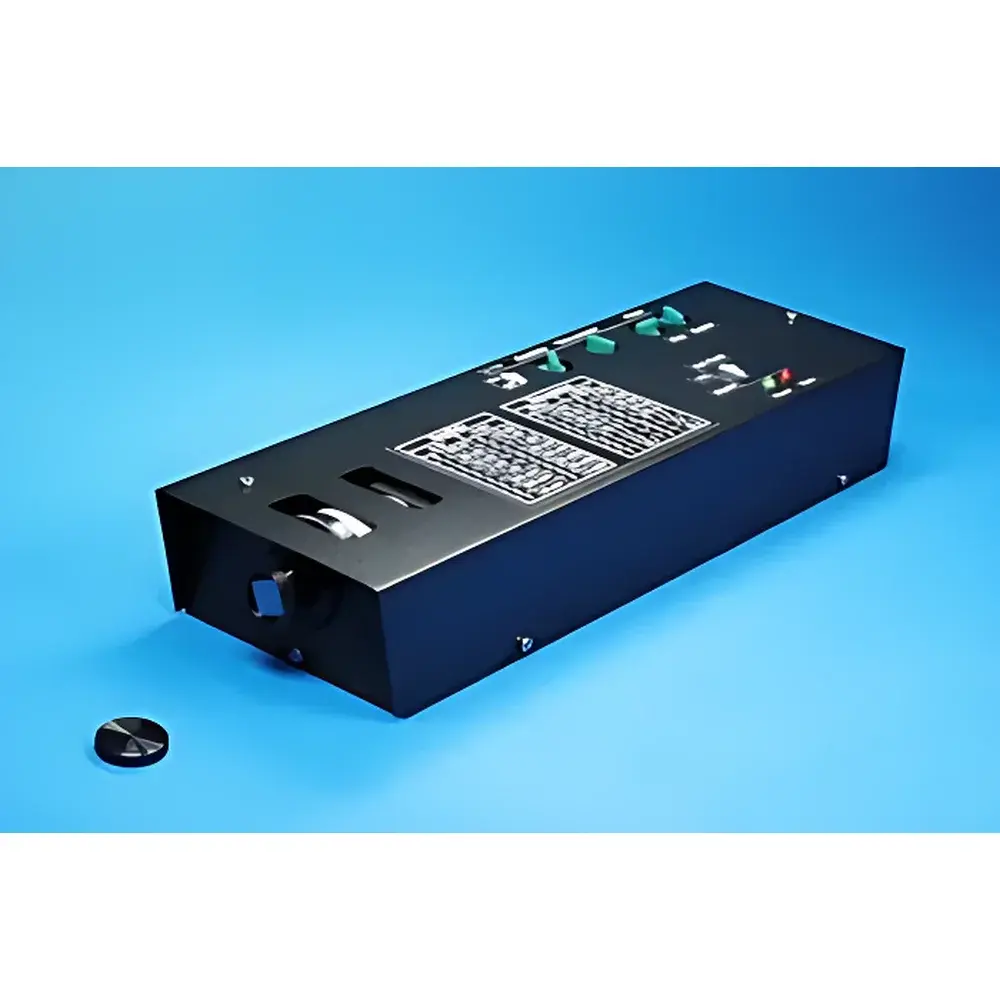
Tydex EOD-NIR Terahertz Electro-Optic Detector
| Brand | Tydex |
|---|---|
| Origin | Russia |
| Model | EOD-NIR |
| Detection Principle | Electro-Optic Sampling (EOS) with ZnTe or GaP Crystal |
| Optical Input | NIR (780–850 nm) Pump/Probe Beams |
| THz Bandwidth | 0.1–4 THz (typ.) |
| Delay Line Compatibility | Motorized or Manual Optical Delay Stage |
| Interface | USB 2.0 |
| Software OS Support | Windows XP, Vista, Windows 7 |
| Compliance | CE-marked for laboratory use |
| Dimensions | 120 × 85 × 60 mm |
| Weight | ~0.8 kg |
Overview
The Tydex EOD-NIR is a compact, turnkey electro-optic terahertz (THz) detector engineered for time-domain spectroscopy (TDS) systems operating in the near-infrared (NIR) pump-probe regime. It implements electro-optic sampling (EOS) — a coherent, phase-sensitive detection technique — wherein ultrashort NIR laser pulses (typically 800 nm, <100 fs) gate a THz-induced birefringence change in a nonlinear crystal (e.g., ZnTe or GaP). The EOD-NIR integrates a balanced photodiode pair, an internal optical delay line, and a digital lock-in amplifier into a single mechanically stable housing. This architecture eliminates external alignment of probe beam polarization analyzers and enables direct, real-time acquisition of THz electric field transients with high phase fidelity and sub-picosecond temporal resolution. Unlike bolometric or pyroelectric detectors, the EOD-NIR preserves both amplitude and phase information of broadband THz pulses, making it indispensable for quantitative dielectric property extraction, carrier dynamics studies, and coherent control experiments.
Key Features
- Integrated electro-optic sampling module with calibrated ZnTe or GaP sensing crystal (user-selectable)
- On-board balanced photodetector with common-mode noise rejection >40 dB
- Digital lock-in amplifier with adjustable time constant (10 µs – 10 s), reference frequency input, and RMS/peak output modes
- Internal motorized or manual optical delay stage (optional) synchronized with data acquisition
- Real-time waveform display and point-by-point THz field reconstruction via native software interface
- USB 2.0 interface with low-latency data streaming and hardware-trigger support for synchronization with femtosecond laser systems
- Compact, vibration-damped aluminum chassis optimized for integration into ultrafast optics tables and vacuum-compatible enclosures
Sample Compatibility & Compliance
The EOD-NIR is compatible with standard Ti:sapphire and Yb-fiber femtosecond laser systems delivering 780–850 nm pulses at repetition rates from 1 kHz to 80 MHz. It supports both free-space and fiber-coupled NIR beam delivery configurations. As a measurement instrument intended for research-grade THz-TDS, it complies with IEC 61000-6-3 (EMC emission) and IEC 61000-6-2 (immunity) standards, and bears the CE marking for laboratory use within the European Economic Area. While not certified for GMP or FDA-regulated environments, its design adheres to GLP-aligned principles: traceable signal chain calibration, audit-ready software logging (timestamped raw and processed datasets), and deterministic response under controlled ambient conditions (20–25 °C, <60% RH). No hazardous materials are used in construction; RoHS compliance is verified per Directive 2011/65/EU.
Software & Data Management
The included Windows-native control software (v3.x) provides full instrument orchestration without third-party dependencies. It supports real-time oscilloscope-style waveform visualization, automated delay scan acquisition, and export of time-domain electric field traces (E(t)) in ASCII, CSV, and HDF5 formats. Built-in FFT routines enable immediate frequency-domain analysis (E(ω)), while baseline correction, zero-padding, and phase compensation tools facilitate quantitative spectral fitting. All acquisitions include embedded metadata: laser repetition rate, delay step size, lock-in time constant, and system temperature (via onboard sensor). Software logs retain full audit trails — including user ID, timestamp, parameter changes, and file save events — satisfying basic 21 CFR Part 11 requirements for non-clinical research documentation. No cloud connectivity or telemetry is implemented; all data remain local and under user control.
Applications
- Coherent THz time-domain spectroscopy (THz-TDS) for complex permittivity extraction of semiconductors, polymers, pharmaceuticals, and biomaterials
- Ultrafast carrier relaxation and mobility mapping in 2D materials (e.g., graphene, TMDCs) and perovskite thin films
- In-situ monitoring of hydration dynamics and molecular conformational changes in protein crystals
- Non-destructive evaluation (NDE) of multilayer packaging integrity and coating thickness uniformity
- Phase-resolved THz imaging for security screening and cultural heritage analysis
- Calibration reference for THz source power and pulse shape characterization in metrology labs
FAQ
What laser specifications are required to operate the EOD-NIR?
The detector requires a mode-locked femtosecond laser emitting at 780–850 nm, pulse duration <150 fs, average power ≥10 mW per beam (pump and probe), and repetition rate between 1 kHz and 80 MHz.
Can the EOD-NIR be used with fiber-coupled laser systems?
Yes — optional free-space-to-fiber coupling adapters and collimation modules are available; alignment stability must be maintained within ±2 µrad angular drift over acquisition time.
Is crystal replacement possible by the end user?
Crystal exchange is supported via standardized kinematic mounts; however, re-calibration using a certified THz reference source is mandatory post-replacement and must be performed by authorized Tydex service personnel.
Does the device support external triggering for pump-probe delay scans?
Yes — TTL-compatible trigger input accepts sync signals from motorized delay stages or arbitrary waveform generators for precise inter-pulse timing control.
What is the typical dynamic range and NEP of the EOD-NIR?
Measured dynamic range exceeds 60 dB (1 kHz bandwidth); noise-equivalent power (NEP) is ≤10 pW/√Hz at 1 THz when paired with a 100-fs, 80-MHz Ti:sapphire oscillator and optimized optical path.





