
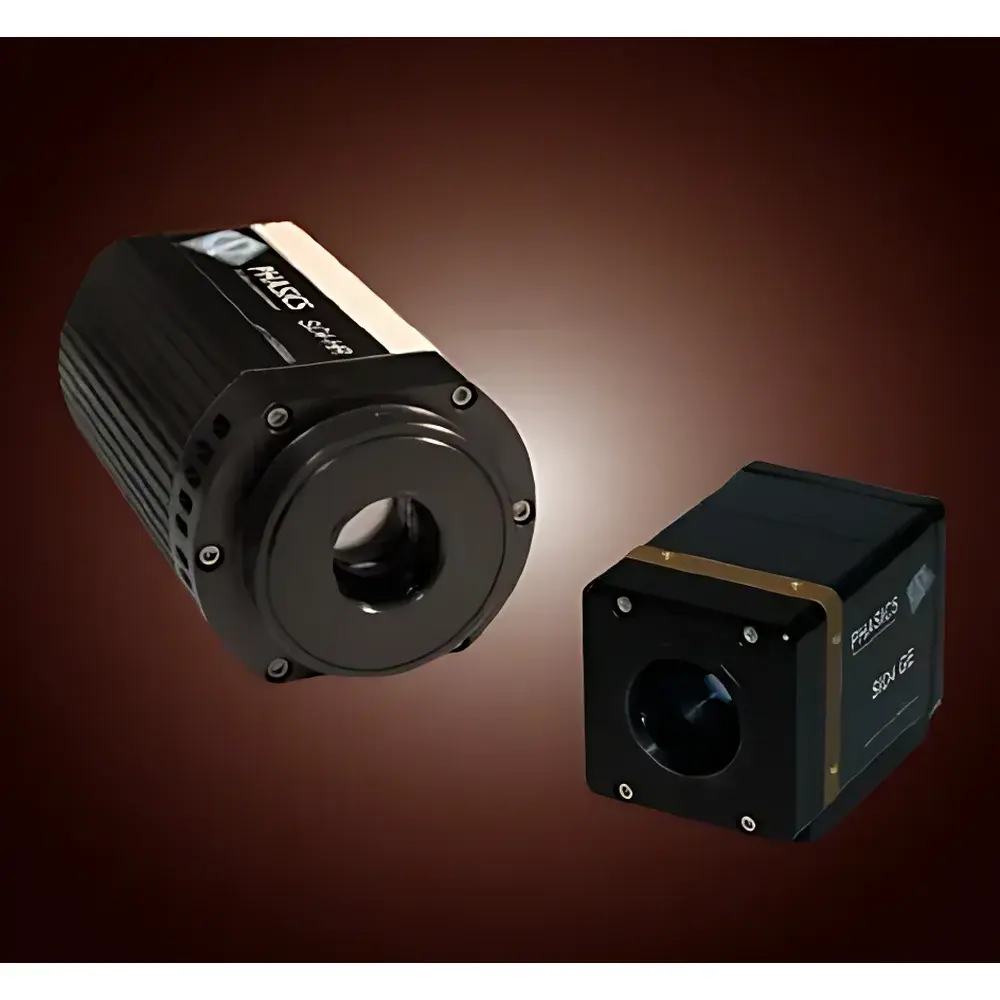
Phasics SID4 Wavefront Sensor
| Brand | Phasics |
|---|---|
| Origin | France |
| Model | SID4 |
| Wavelength Range | 190–1100 nm (model-dependent) |
| Aperture Size | up to 13.44 × 10.08 mm² |
| Spatial Resolution | down to 29.6 µm |
| Sampling Points | up to 400 × 300 |
| Dynamic Range | >100 µm (up to >500 µm in HR variants) |
| Accuracy | as low as 10 nm RMS |
| Sensitivity | down to 0.5 nm RMS @ 250 nm |
| Frame Rate | up to >60 fps |
| Processing Frequency | up to 20 Hz |
| Dimensions | 44 × 33 × 57.5 mm (SID4-NIR) to 85 × 116 × 179 mm (SID4-DWIR) |
| Weight | 250 g to 1.6 kg |
Overview
The Phasics SID4 Wavefront Sensor is a high-precision, compact interferometric wavefront measurement instrument engineered for real-time quantitative phase imaging and optical aberration analysis. Based on the patented QuadriWave Lateral Shearing Interferometry (QWLSI) principle, the SID4 eliminates reliance on reference beams or moving parts—enabling direct, single-shot wavefront reconstruction with sub-nanometer sensitivity. Unlike traditional Shack-Hartmann sensors, QWLSI delivers intrinsic achromatic performance across broad spectral bands without recalibration, making it uniquely suited for multi-wavelength laser systems, broadband sources, and demanding metrology applications in research and industrial environments.
Key Features
- Achromatic operation across UV (190 nm), visible, NIR, SWIR, and MWIR/DWIR spectral ranges—validated per ISO 10110-5 and compliant with spectral responsivity standards for radiometric traceability.
- High spatial sampling density: up to 400 × 300 measurement points (SID4-HR), supporting diffraction-limited resolution of optical systems with NA > 0.5.
- Single-shot acquisition with no mechanical scanning or temporal averaging—critical for dynamic beam characterization, pulsed laser diagnostics, and adaptive optics loop closure.
- Integrated thermal stabilization and vibration-damped housing (aluminum alloy chassis with passive heat dissipation) ensure long-term stability under laboratory and cleanroom conditions (ISO Class 5 compatible).
- Real-time processing engine embedded in FPGA hardware enables on-device Zernike decomposition, Strehl ratio calculation, and RMS/PV wavefront error reporting at user-configurable update rates (up to 20 Hz for full-resolution data streams).
- Modular optical interface: C-mount, SM1-threaded, or custom kinematic flange options; optional fiber-coupled adapters (FC/PC, FC/APC) available for OEM integration.
Sample Compatibility & Compliance
The SID4 series supports collimated and highly divergent beams (up to ±15° full angle without auxiliary optics), enabling direct characterization of laser diodes, VCSEL arrays, fiber outputs, and uncorrected telescope pupils. Each model meets CE marking requirements and conforms to IEC 61000-6-3 (EMC emission) and IEC 61000-6-2 (immunity). Data integrity protocols align with GLP/GMP documentation workflows: timestamped metadata (including temperature, exposure time, gain setting, and sensor ID) are embedded in every HDF5 output file. For regulated environments, optional audit-trail logging and user-access controls comply with FDA 21 CFR Part 11 requirements when deployed with Phasics’ certified software suite.
Software & Data Management
Phasics’ WFS Software Suite v5.x provides native support for Windows/Linux/macOS and integrates seamlessly via TCP/IP, USB 3.2 Gen1, or GigE Vision (GenICam-compliant). The API includes Python (pySID4), MATLAB, LabVIEW, and C/C++ SDKs with full documentation and example scripts. All raw interferograms and reconstructed phase maps are stored in vendor-neutral HDF5 format (HDF5-1.12+), preserving SI-traceable units and metadata per FAIR data principles. Batch processing pipelines support automated Zernike fitting (Z0–Z36), MTF/PSF synthesis, and ISO 10110-5 surface irregularity reporting. Optional cloud synchronization and RESTful webhooks enable integration into centralized lab information management systems (LIMS).
Applications
- Laser beam quality analysis: M² measurement, BPP validation, and modal decomposition for CO₂, excimer, ultrafast Ti:sapphire, and high-power fiber lasers per ISO 11146-1/2.
- Adaptive optics systems: Closed-loop control feedback for deformable mirrors (DMs) and liquid crystal spatial light modulators (LC-SLMs) in astronomy, ophthalmology, and microscopy.
- Optical component testing: Surface figure error mapping of lenses, mirrors, and aspheres; transmission wavefront error assessment of windows and filters.
- Biomedical imaging: Quantitative phase contrast (QPC) in digital holographic microscopy (DHM), label-free cell morphology tracking, and refractive index tomography.
- Plasma & combustion diagnostics: Real-time wavefront distortion monitoring in high-energy laser–plasma interactions and turbulent flame front characterization.
FAQ
Does the SID4 require external calibration for different wavelengths?
No. Its QuadriWave Lateral Shearing Interferometry architecture is inherently achromatic; no wavelength-specific recalibration is needed across its specified spectral range.
Can the SID4 measure wavefronts from highly divergent or convergent beams?
Yes. With appropriate relay optics (e.g., afocal telescopes or collimation lenses), the SID4 accommodates beam divergence angles up to ±15°, enabling direct characterization of bare laser diodes and multimode fiber outputs.
Is real-time Zernike coefficient extraction supported onboard?
Yes. The embedded FPGA performs full Zernike decomposition (up to radial order 6) in real time, with configurable output of coefficients, RMS error, and Strehl ratio.
What data formats are exported for post-processing?
All measurements export natively to HDF5 (with embedded metadata), TIFF (phase/irradiance), and CSV (Zernike coefficients, error metrics); MATLAB .mat and Python .npz are also supported.
How is traceability maintained for metrology-grade use?
Each unit ships with NIST-traceable calibration certificate (valid for 12 months), including uncertainty budget per ISO/IEC 17025, and factory verification against a reference flat mirror calibrated by interferometric null testing.



