PhenoTron-SR Plant Phenotyping Imaging System
| Origin | Beijing, China |
|---|---|
| Manufacturer Type | Authorized Distributor |
| Origin Category | Domestic (China) |
| Model | PhenoTron-SR |
| Pricing | Upon Request |
Overview
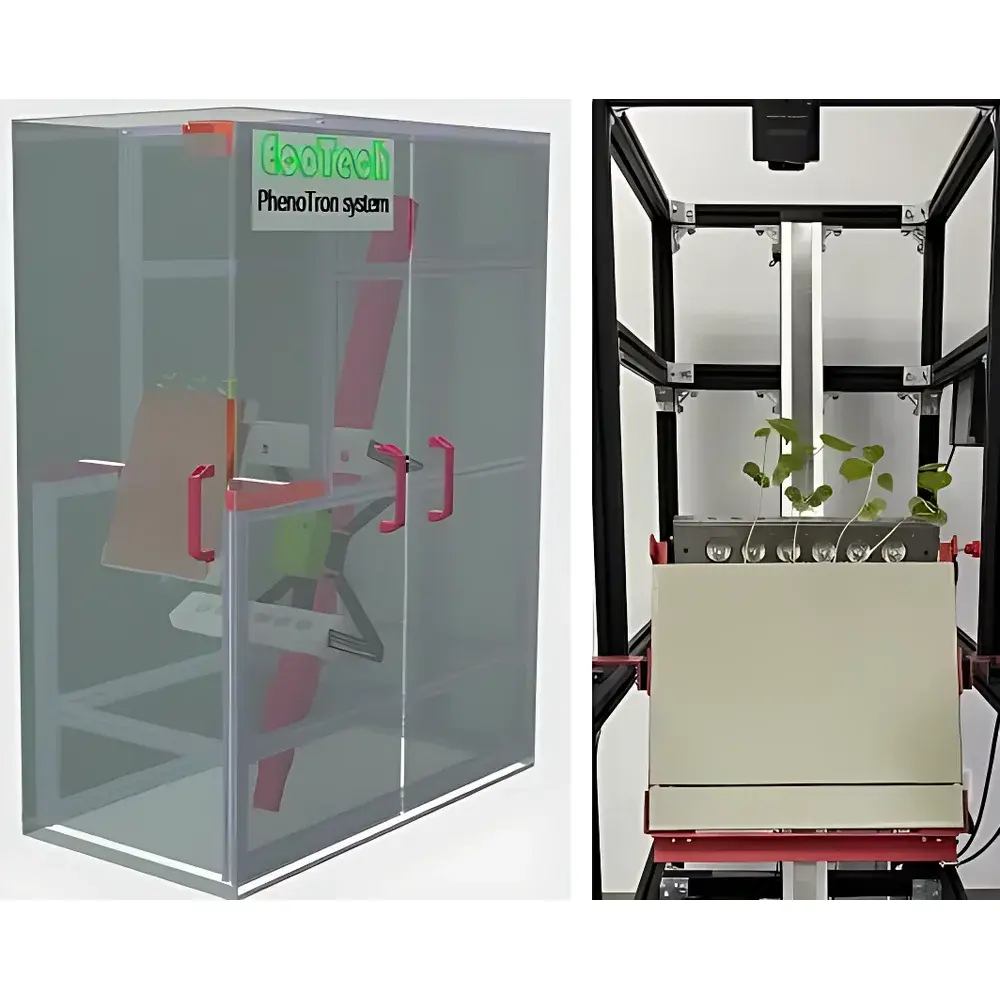
The PhenoTron-SR Plant Phenotyping Imaging System is a modular, high-precision platform engineered for non-invasive, multi-modal phenotypic characterization of whole plants—from shoot architecture and canopy physiology to root system morphology and function. It operates on the principle of spatially resolved spectral imaging combined with synchronized environmental monitoring and automated positional control. The system integrates visible–near-infrared (VNIR) and short-wave infrared (SWIR) hyperspectral imaging, RGB color imaging, optional infrared thermography, and chlorophyll fluorescence imaging—each calibrated and geometrically registered to a common coordinate frame. Designed for controlled-environment phenotyping labs, growth chambers, and greenhouse modules, the PhenoTron-SR enables quantitative, time-series acquisition of morphological, biochemical, and physiological traits under reproducible conditions. Its dual-axis scanning architecture supports both oblique (standard 60°) and vertical (90°) acquisition geometries, minimizing soil disturbance during root imaging while maintaining optical fidelity across heterogeneous sample volumes.
Key Features
- Shoot-to-root phenotyping capability: Simultaneous imaging of aboveground canopy and belowground root systems using RhizoBox root observation chambers or iPOT digital cultivation pots
- Modular imaging suite: Standard VNIR (400–1000 nm, 224 bands, FWHM ≤5.5 nm) and SWIR (900–1700 nm, 224 bands, FWHM ≤8 nm) hyperspectral sensors with ≥1024×1024 (VNIR) and ≥640×640 (SWIR) spatial resolution
- High-fidelity RGB imaging: 18-megapixel sensor with 10× optical zoom, optimized for morphometric analysis of leaves, stems, and root architecture
- Optional infrared thermography: Uncooled microbolometer (640×512 pixels), calibrated temperature range −25°C to +150°C, thermal sensitivity ≤30 mK at 30°C, spectral response 7.5–13.5 µm
- Optional chlorophyll fluorescence imaging: High-sensitivity CCD (720×560 px, 8.6×8.3 µm pixel size), 50 fps frame rate, programmable actinic and saturating light intensities (up to 3900 µmol·m⁻²·s⁻¹)
- Automated scanning stage: Precision linear axis with adjustable speed (1–90 mm/s) and positional accuracy ±1 mm; standard 60° tilt configuration minimizes substrate displacement during root imaging
- Integrated environmental monitoring: Real-time logging of soil moisture, temperature, weight, stem flow, photosynthetic efficiency (PI), and nutrient leachate composition via optional analytical modules
- Fully remote operation: Embedded Linux-based controller with touchscreen UI; PC-based GUI supports TCP/IP and serial communication, scriptable command sequences (up to 10 commands per protocol), and scheduled unattended acquisition
Sample Compatibility & Compliance
The PhenoTron-SR accommodates diverse plant growth configurations through interchangeable sample carriers—including standardized RhizoBox root chambers (40 cm width, up to 100 cm height), iPOT smart pots, and custom trays for single large or multiple small containers. All optical modules comply with ISO 11228-2 (ergonomic design of workstations) and IEC 61000-6-3 (EMC emission standards). Hyperspectral data acquisition adheres to ASTM E1777-22 (Standard Guide for Spectral Data Acquisition in Reflectance Mode), and fluorescence protocols align with OJIP test recommendations (Strasser et al., 2004). Software audit trails, user access controls, and data integrity logs support GLP-compliant workflows. While not FDA 21 CFR Part 11 certified out-of-the-box, the system architecture permits integration with validated LIMS environments requiring electronic signature and change-control functionality.
Software & Data Management
The PhenoTron-SR is operated via a bilingual (English/Chinese) GUI that provides full instrument control, protocol definition, real-time preview, and batch processing. Image analysis modules include ENVI-compatible spectral libraries, PCA-based dimensionality reduction, supervised classification (e.g., SVM, Random Forest), and trait extraction pipelines for NDVI, NDWI, NDNI, MSI, Fv/Fm, Y(II), NPQ, ETR, and over 20 additional physiological indices. Thermal analysis includes isotherm mapping, line-profile temperature extraction, region-of-interest statistics, and time-series delta-T visualization. All raw and processed datasets are stored in HDF5 format with embedded metadata (acquisition timestamp, sensor calibration ID, environmental context, operator ID). Export options include CSV, GeoTIFF, and MATLAB .mat files. The software supports batch reprocessing, parameter templating, and RESTful API access for integration into institutional data lakes or FAIR-aligned repositories.
Applications
- Quantitative root architecture phenotyping under drought, salinity, or nutrient stress
- Canopy-level assessment of photosynthetic performance and water-use efficiency via thermal and fluorescence imaging
- Spatiotemporal mapping of pigment distribution (chlorophyll, anthocyanin, carotenoids) and photochemical quenching dynamics
- High-throughput screening of mutant populations or breeding lines for abiotic/biotic stress resilience
- Validation of crop model inputs (e.g., LAI, canopy cover, stomatal conductance proxies)
- Long-term monitoring of soil–plant–atmosphere continuum variables in controlled-environment agriculture research
FAQ
What is the maximum sample height supported by the standard RhizoBox configuration?
The standard RhizoBox accommodates root systems up to 100 cm in height, with width adjustable from 20 cm to 40 cm.
Can VNIR and SWIR hyperspectral data be acquired simultaneously?
No—due to optical path constraints and detector cooling requirements, VNIR and SWIR acquisitions are sequential but co-registered via mechanical stage synchronization.
Is the chlorophyll fluorescence module compatible with standard growth pots?
Yes, when used with the optional shoot-oriented sample tray or iPOT adapter, the fluorescence unit can image intact plants in conventional 10–15 cm diameter pots.
Does the system support third-party sensor integration?
Yes—the embedded controller exposes GPIO, RS-232, and Ethernet interfaces, enabling synchronization with external CO₂ analyzers, PAR sensors, or custom environmental loggers.
What file formats are generated during thermal imaging acquisition?
Radiometric TIFF (with embedded calibration coefficients), CSV (pixel-wise temperature matrices), and annotated PNG previews with customizable palettes and isotherm overlays.