
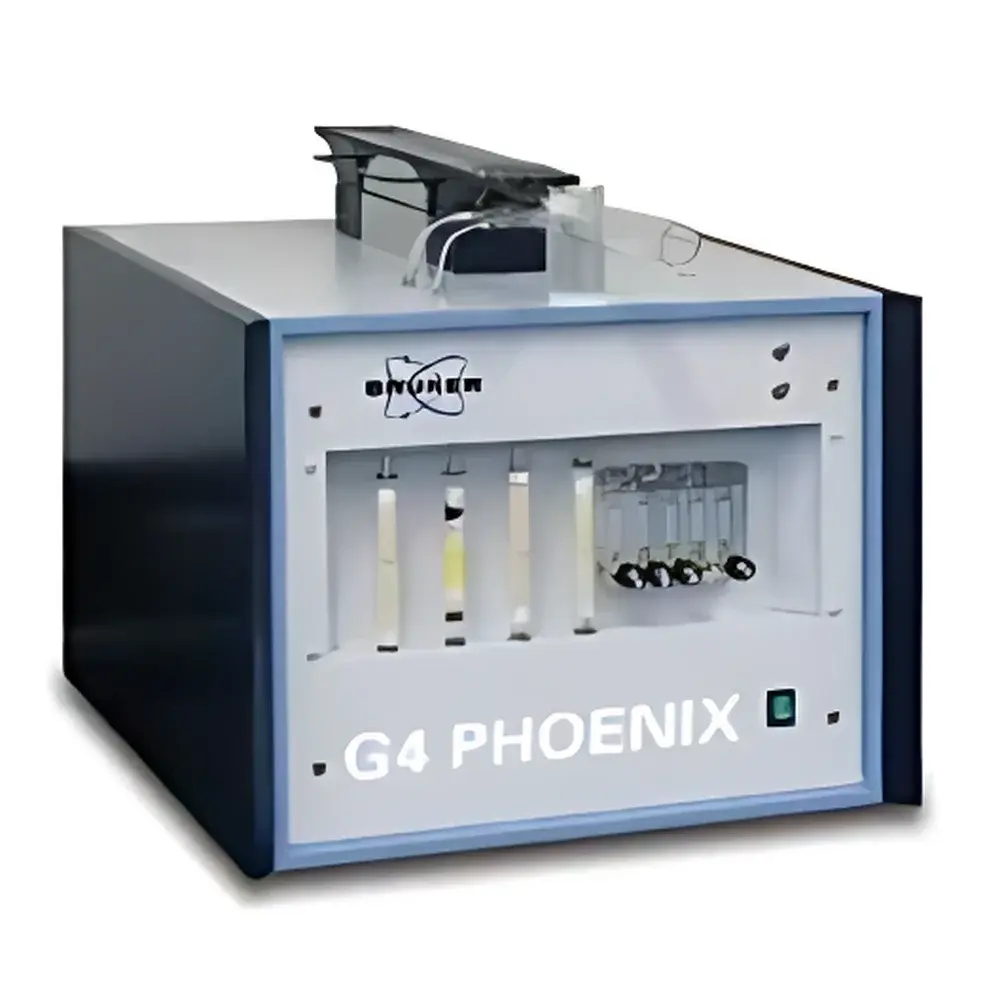
Phoenix Pheonix Diffusion Hydrogen Analyzer
| Origin | Germany |
|---|---|
| Manufacturer Type | Distributor |
| Origin Category | Imported |
| Model | Pheonix |
| Price | Upon Request |
| Measurement Range | H: 0.1–1000 ppm (mL/100 g), extendable |
| Analysis Time | ~20 min (material- and mass-dependent), adjustable up to 2 h |
| Resolution | 0.01 ppm |
| Repeatability | ±0.01 ppm or ±1% (material- and mass-dependent) |
| Power Consumption | Analyzer: 1 kVA |
| Peripherals | 300 VA |
| Carrier Gas | N₂, ≥99.999% purity, 2 bar |
| Cooling Water Flow | ~1 L/min |
| Dimensions (L×W×H) | 460 × 750 × 500 mm |
| System Requirements | Windows 98 or later, CD-ROM drive, two RS-232 ports |
Overview
The Phoenix Pheonix Diffusion Hydrogen Analyzer is a high-precision thermal extraction instrument engineered for the quantitative determination of diffusible hydrogen in metallic materials. It operates on the principle of vacuum hot extraction (VHE) coupled with highly sensitive thermal conductivity detection (TCD). In this method, a representative metal sample is heated under controlled inert gas flow (ultra-high-purity nitrogen) within a programmable infrared furnace. Diffusible hydrogen atoms—those not bound in stable hydride phases but capable of migrating through the lattice at ambient temperatures—are thermally liberated, carried by the carrier gas stream, and quantified via TCD signal calibration against certified reference standards. This technique conforms to internationally recognized test protocols including ISO 3690, ASTM E1443, and DIN EN ISO 17072-1 for weld metal and base material evaluation. The analyzer is specifically designed for quality assurance in critical structural applications where hydrogen-induced cracking (HIC) and cold cracking pose significant integrity risks—particularly in pipeline steels, pressure vessel alloys, aerospace-grade weldments, and high-strength fasteners.
Key Features
- Programmable infrared heating furnace with rapid thermal response and precise temperature control from ambient to 1000 °C (optional tubular furnace upgrade supports up to 1350 °C for refractory alloys)
- “Clamshell”-style infrared combustion chamber enabling fast sample loading/unloading and uniform thermal exposure without crucible contamination
- High-resolution thermal conductivity detector (TCD) with 0.01 ppm detection limit and dual-mode repeatability specification (±0.01 ppm absolute or ±1% relative, validated per ISO 5725-2)
- Configurable analysis duration—from standard 20-minute cycles to extended 2-hour extractions—for complete liberation of hydrogen from low-diffusivity matrices (e.g., martensitic steels, nickel-based superalloys)
- Integrated sample weight memory function: pre-registered mass values are retained across sessions and automatically applied during result calculation (ppm = mL H₂ / 100 g sample)
- Multi-point gas-volume calibration routine using certified standard gases—ensuring traceability to NIST-traceable reference materials
- Dedicated RS-232 interface for bidirectional communication with host PC; supports real-time parameter monitoring and remote start/stop commands
- Robust mechanical architecture with vibration-isolated optical path and sealed gas manifold to minimize drift and cross-contamination
Sample Compatibility & Compliance
The Pheonix analyzer accommodates a broad spectrum of metallic specimens—including rolled steel plates, drawn wire, arc-welded joints, flux-cored wire, surface-coated components (e.g., galvanized or phosphated layers), and chemically refined surfaces used in electroplating or pickling processes. Sample geometry is flexible: solid rods up to Ø25 mm × 100 mm, cut weld coupons (max. 10 g), and machined chips are routinely analyzed. All operational parameters—including ramp rates, hold times, and final extraction temperature—are fully customizable to align with material-specific diffusion kinetics. The system meets essential regulatory expectations for laboratory instrumentation: it supports audit-ready data logging compliant with FDA 21 CFR Part 11 (when paired with validated software), adheres to GLP documentation requirements, and enables full traceability of calibration events, maintenance logs, and analyst interventions.
Software & Data Management
Control and data acquisition are managed via Windows-native software compatible with Windows 98 through Windows 10 (32-/64-bit). The application provides intuitive graphical setup of multi-step temperature programs, real-time TCD signal visualization, automatic peak integration, and stoichiometric conversion to ppm H. Each analysis generates a timestamped report containing raw chromatogram, integrated area, calculated concentration, operator ID, sample ID, weight entry, and system status flags (gas pressure, furnace temp, water flow). Data files are stored in ASCII-compatible .CSV format for seamless import into LIMS environments or statistical process control (SPC) platforms. Optional modules include automated report generation (PDF/Excel), electronic signature capability, and configurable alarm thresholds for out-of-specification results.
Applications
- Pre- and post-weld hydrogen assessment in offshore structural steels per DNV-OS-F101 and API RP 2X
- Verification of baking protocols for electroplated high-strength bolts (SAE J429 Grade 8.8 and above)
- Quality release testing of filler metals and welding consumables per AWS A5.1/A5.5 specifications
- Root cause analysis of delayed cracking in heat-affected zones (HAZ) of dissimilar metal welds
- Process validation of hydrogen desorption treatments in titanium alloy forgings (ASTM F136)
- Research-level diffusion coefficient modeling using variable-temperature extraction profiles
FAQ
What types of hydrogen does this instrument measure?
It quantifies only diffusible (mobile) atomic hydrogen that can migrate under ambient conditions—excluding trapped or lattice-bound hydrogen requiring higher activation energy for release.
Is helium an acceptable carrier gas alternative to nitrogen?
No. Nitrogen is required for optimal TCD sensitivity and baseline stability; helium causes excessive thermal noise and compromises detection limits.
Can the system be integrated into an automated production line?
Yes—via RS-232 command protocol and external trigger inputs, the analyzer supports semi-automated batch processing when interfaced with robotic sample handlers.
Does the instrument require daily recalibration?
A full multi-point calibration is recommended before each analytical session or after major maintenance; zero checks and span verification may be performed hourly during continuous operation.
How is moisture interference mitigated during analysis?
The gas path incorporates a heated desiccant trap upstream of the TCD, and all internal surfaces are maintained above dew point to prevent condensation-induced signal artifacts.





