
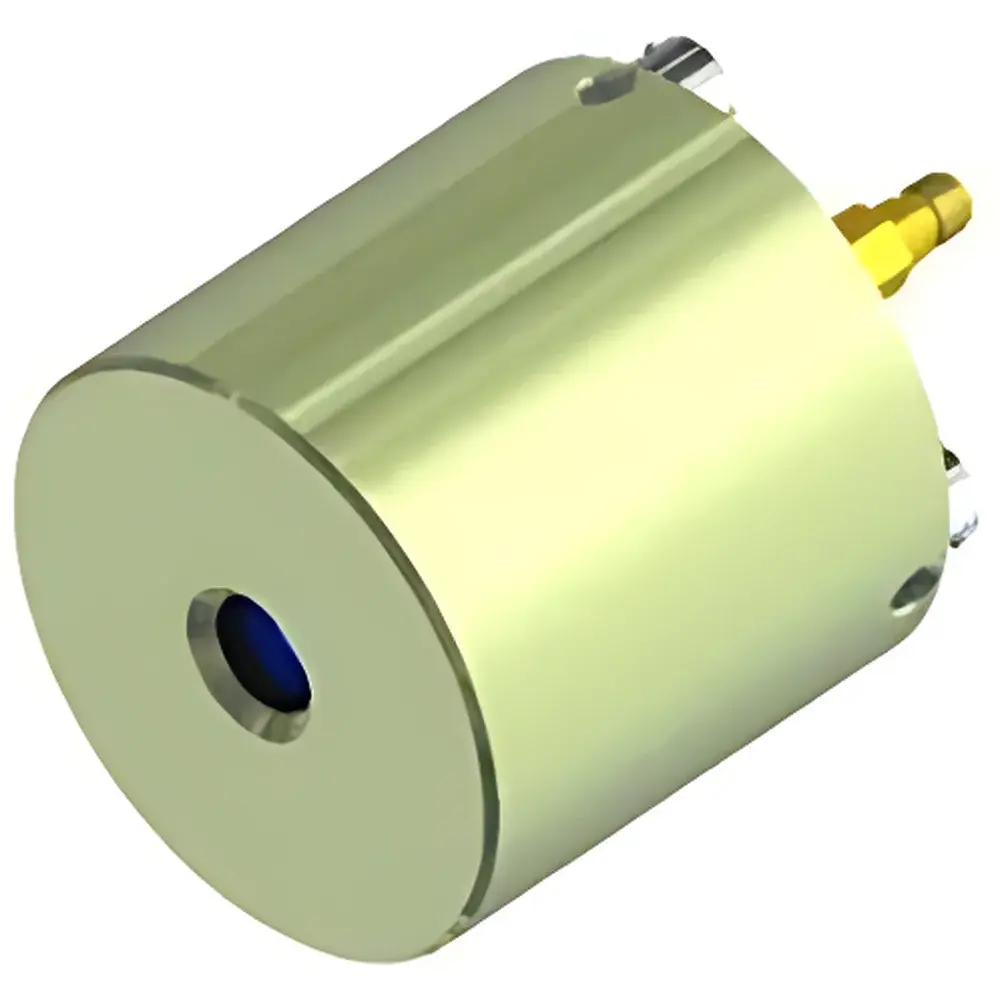
Photek MCP-Based Ultra-Fast Photomultiplier Tube (PMT)
| Brand | Photek |
|---|---|
| Origin | United Kingdom |
| Model | Photek Series (MCP-PMT) |
| Spectral Range | 100–900 nm |
| Response Time | < 100 ps (typ.) |
| Window Options | UV-fused silica, MgF₂, borosilicate glass |
| Photocathode Types | Solar-blind (Cs-Te), Bialkali (S-20), GaAsP, Multi-Anode (MA-PMT) |
| Component Category | Optical Detector |
Overview
The Photek MCP-based Ultra-Fast Photomultiplier Tube (PMT) is a high-performance vacuum photodetector engineered for time-critical optical measurement applications requiring sub-nanosecond temporal resolution and broad spectral sensitivity. Unlike conventional dynode-based PMTs, this device integrates a microchannel plate (MCP) electron multiplier, enabling single-photon detection with exceptional timing fidelity, low transit time spread (TTS), and high pulse linearity. Its photocathode is deposited directly on the entrance window, minimizing electron path dispersion and optimizing quantum efficiency across the deep ultraviolet (100 nm) to near-infrared (900 nm) range. The MCP architecture supports gain stability under pulsed operation and exhibits negligible afterpulsing—critical for time-correlated single-photon counting (TCSPC), laser-induced fluorescence lifetime imaging (FLIM), and time-of-flight (ToF) measurements in scientific and industrial environments.
Key Features
- Sub-100 ps rise time and < 30 ps FWHM transit time spread—enabling picosecond-level photon arrival timing.
- Wide spectral response from 100 nm (deep UV) to 900 nm (NIR), configurable via matched window and photocathode material combinations.
- Solar-blind variants (Cs-Te photocathode on MgF₂ window) provide intrinsic rejection of visible and NIR background radiation—ideal for UV flame detection and space-based UV astronomy.
- Multi-anode (MA-PMT) configurations support spatially resolved photon detection with independent anode readout, facilitating photon imaging and position-sensitive spectroscopy.
- Hermetically sealed ceramic/metal package ensures long-term vacuum integrity and mechanical robustness under thermal cycling and vibration stress.
- Low dark count rate ( 10 mA) support both ultra-low-light and high-flux operational modes.
Sample Compatibility & Compliance
The Photek MCP-PMT is compatible with standard 1-inch or 2-inch diameter optical mounts and integrates seamlessly into vacuum-compatible optical benches, laser characterization setups, and radiation-hardened detector systems. All models comply with RoHS 2011/65/EU directives and meet IEC 61000-4 electromagnetic immunity standards. For regulated laboratory use—including pharmaceutical QC, nuclear instrumentation, and aerospace sensor qualification—the devices are supplied with full traceable calibration documentation (NIST-traceable spectral responsivity curves) and optional GLP-compliant test reports. When deployed in TCSPC systems, the PMT satisfies the timing accuracy requirements of ISO/IEC 17025-accredited laboratories and supports audit-ready data provenance when paired with compliant acquisition hardware.
Software & Data Management
Photek provides native LabVIEW™ VI libraries and ASCII-based serial command protocols (RS-232/USB) for integration with third-party DAQ platforms (e.g., National Instruments PXI, Keysight U1000 series). Timing parameters—including gain voltage mapping, pulse height discrimination thresholds, and gate delay settings—are programmable via digital interface. For TCSPC applications, the PMT is fully compatible with industry-standard software suites such as PicoQuant SymPhoTime 64, Becker & Hickl SPCImage, and ID Quantique ID900, supporting histogram-based lifetime analysis, multi-exponential decay fitting, and cross-correlation functionality. All firmware updates and configuration logs adhere to FDA 21 CFR Part 11 requirements when used within validated instrument control environments.
Applications
- Laser radar (LIDAR) and optical time-domain reflectometry (OTDR) requiring precise photon time-of-arrival measurement.
- Fluorescence lifetime spectroscopy (FLS) and time-resolved photoluminescence (TRPL) in semiconductor and biomolecular research.
- Particle and ionizing radiation detection in scintillation-based spectrometers (e.g., coupled to LYSO, BaF₂, or plastic scintillators).
- Ultrafast laser diagnostics—including pulse duration measurement via autocorrelation and second-harmonic generation monitoring.
- Single-photon quantum optics experiments, including Hong-Ou-Mandel interference and quantum key distribution (QKD) receiver modules.
- UV solar-blind monitoring for combustion diagnostics, corona discharge detection, and stratospheric ozone sensing.
FAQ
What is the typical transit time spread (TTS) for the Photek MCP-PMT?
Typical TTS is < 30 ps FWHM under optimal bias conditions, measured with 405 nm laser pulses of < 50 ps duration.
Can the PMT be operated in gated mode?
Yes—integrated gating electrodes allow nanosecond-scale optical shuttering with extinction ratios > 10⁶, suitable for background suppression in time-gated Raman or LIBS applications.
Is vacuum maintenance required by the end user?
No—the tube is permanently sealed during manufacture and requires no periodic pumping or getter activation.
Which photocathode/window combination is recommended for deep-UV (115–200 nm) detection?
MgF₂ window with Cs-Te photocathode provides peak QE above 15% in the 120–200 nm band and is intrinsically solar-blind.
Are custom anode geometries available?
Yes—Photek offers tailored multi-anode layouts (e.g., 8×8, 16-channel linear, hexagonal tiling) with matched preamplifier boards for OEM integration.




