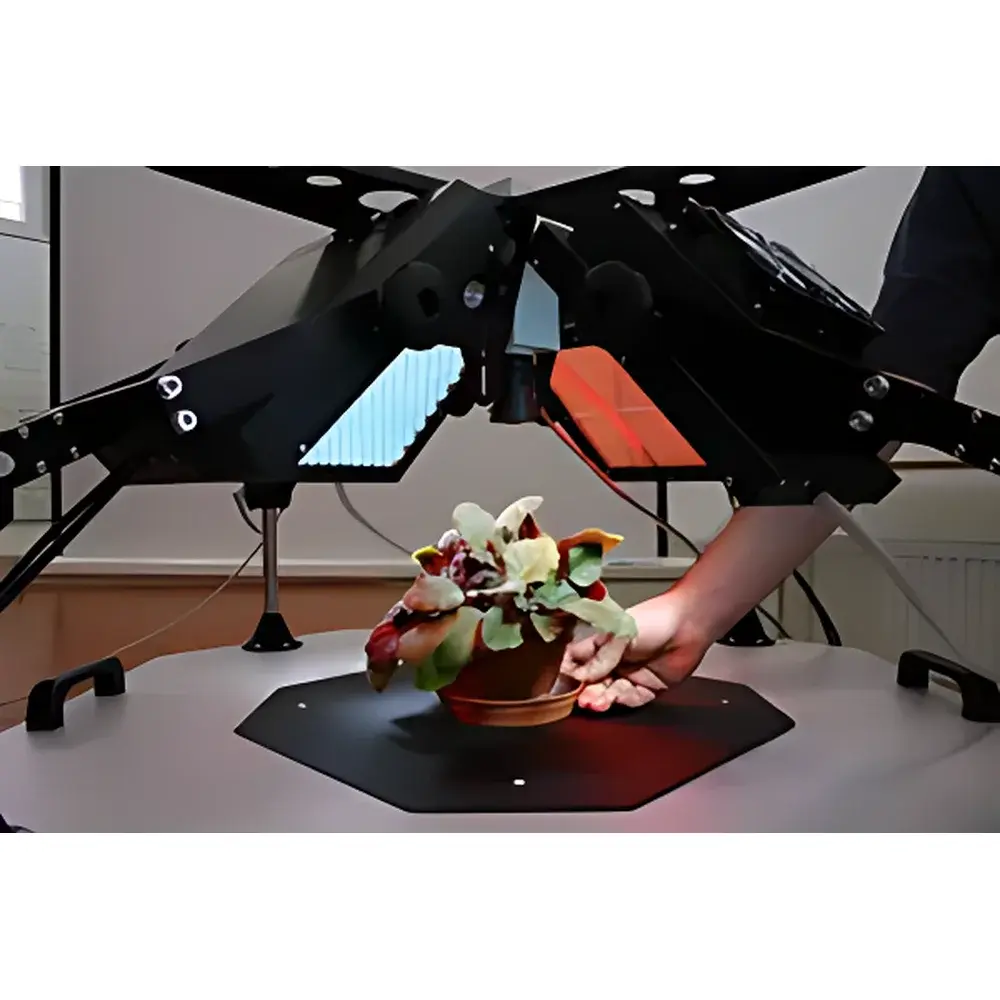
Photon Systems Instruments FC800-O Open-Design Plant Fluorescence Imaging System
| Origin | Europe |
|---|---|
| Manufacturer Type | Authorized Distributor |
| Category | Imported Instrument |
| Model | FC800-O |
| Pricing | Upon Request |
Overview
The Photon Systems Instruments FC800-O Open-Design Plant Fluorescence Imaging System is a research-grade, modular platform engineered for quantitative two-dimensional (2D) spatial mapping of chlorophyll a fluorescence and exogenous fluorescent probes in intact plants and plant tissues. It operates on the principle of pulse-amplitude modulated (PAM) fluorometry combined with high-sensitivity CCD detection, enabling non-invasive, time-resolved acquisition of fluorescence transients—including Kautsky induction kinetics, non-photochemical quenching (NPQ), photochemical quenching (qP), QA reoxidation, and far-red–induced relaxation—under precisely controlled actinic, saturating, and measuring light regimes. The open mechanical architecture allows full customization of LED source geometry, sample-to-source distance, and detector positioning to accommodate diverse experimental setups—from single leaves to large-scale canopy segments (up to 200 × 100 cm via modular expansion). Designed for reproducible physiological phenotyping, the system supports rigorous quantification of over 50 biophysically grounded parameters, including F0, FM, FV/FM, ΦPSII, NPQ, ETR, PAR absorptivity, and RFd—each rendered as spatially resolved false-color parameter maps.
Key Features
- Modular open-frame design enabling flexible LED panel arrangement, variable source–sample distances, and adjustable CCD positioning for optimal signal-to-noise ratio and spatial calibration.
- Configurable illumination system: Measuring light at 618 nm (10–100 µs pulse width); actinic light up to 2,500 µmol·m−2·s−1 (standard), extendable to 5,000 µmol·m−2·s−1; saturating pulses up to 10,000 µmol·m−2·s−1 (standard) or 120,000 µmol·m−2·s−1 (STF mode, 100 µs).
- Multi-wavelength capability: Standard blue (455 nm), red (618 nm), white, and far-red (735 nm) sources; optional UV (390 nm), cyan (505 nm), yellow (570 nm), orange (605 nm), and deep red (630 nm) auxiliary LEDs.
- 8-position motorized filter wheel supporting chlorophyll fluorescence (695 nm high-pass/780 nm low-pass), GFP (495 nm high-pass/660 nm low-pass, 505/560 nm bandpass), YFP, CY3, CY5, PAR transmission, and custom spectral bands.
- High-performance scientific CCD: 512 × 512 pixels (standard), optionally 640 × 480 or 1392 × 1040 (micro-imaging); 12-bit A/D resolution; quantum efficiency >70% at 540 nm; read noise <12 e− RMS; full-well capacity >70,000 e−; frame rate up to 50 fps.
- Firmware-upgradable BIOS and USB 2.0 interface for stable, low-latency data acquisition and synchronization with external environmental controls.
Sample Compatibility & Compliance
The FC800-O accommodates specimens ranging from detached leaves and seedlings to whole potted plants (up to 1 m height), hydroponic trays, and multi-plant arrays. Its open configuration permits integration with climate-controlled growth chambers, robotic handling systems, and custom-stage translation modules (e.g., XY-Plane, Transect, Arch, and Rover FluorCam configurations). All measurement protocols adhere to established photobiological standards for chlorophyll fluorescence analysis, including recommendations from the International Society of Photosynthesis Research (ISPR) and ASTM E2939–14 (Standard Guide for Chlorophyll Fluorescence Measurements in Plants). Data acquisition and storage support audit-trail functionality compatible with GLP-compliant workflows; raw image stacks and metadata are timestamped and structured for traceability in regulated environments.
Software & Data Management
The FluorCam software suite (Windows-compatible, ≥Windows 2000) provides an intuitive graphical interface for experiment design, real-time visualization, and post-acquisition analysis. It includes preconfigured protocols for standard assays (e.g., dark adaptation, light response curves, NPQ relaxation), as well as fully customizable measurement sequences with programmable light intensity ramps, pulse timing, and multi-step saturation protocols. Automated ROI detection enables batch processing of multiple samples per frame using barcode scanning. Advanced image processing tools include background subtraction, pixel-wise kinetic fitting, false-color mapping, statistical overlay, and temporal averaging. Export options include CSV, Excel (.xlsx), TIFF (16-bit), and HDF5 formats—ensuring interoperability with MATLAB, Python (NumPy/HDF5), R, and third-party statistical platforms. Software updates are distributed via secure firmware channels and maintain backward compatibility with legacy datasets.
Applications
- Quantitative screening of photosynthetic performance across genetic populations under controlled or field-simulated stress conditions (drought, salinity, heat, cold, heavy metals).
- Spatial assessment of stomatal heterogeneity and its correlation with local electron transport efficiency and CO2 assimilation capacity.
- Non-destructive monitoring of pathogen infection progression, senescence dynamics, and metabolic perturbations (e.g., ROS accumulation, redox imbalance) via fluorescence lifetime and quenching signatures.
- Functional validation of transgenic lines expressing GFP, eGFP, YFP, BFP, CY3, or CY5—enabling co-localization studies of protein expression with photosynthetic activity.
- Phenotypic characterization of plant–microbe and plant–protist interactions, including symbiotic nitrogen fixation, mycorrhizal colonization, and parasitic infestation responses.
- Yield-predictive modeling based on early-season fluorescence-derived vigor indices (e.g., ΦPSII homogeneity, FV/FM stability, NPQ induction kinetics).
FAQ
What is the maximum imaging area supported by the FC800-O without modification?
The standard configuration supports up to 13 × 13 cm; this can be extended to 20 × 20 cm by selecting larger LED panels.
Can the system perform simultaneous dual-channel imaging (e.g., chlorophyll + GFP)?
Yes—using the 8-position filter wheel and synchronized LED excitation, users can acquire spectrally separated images in rapid succession or implement sequential multi-probe protocols.
Is the FC800-O compliant with FDA 21 CFR Part 11 requirements?
While the base system does not include electronic signature or role-based access control out-of-the-box, FluorCam software supports configurable user accounts, audit logs, and exportable metadata required for Part 11 alignment when deployed within validated laboratory information management systems (LIMS).
What are the electrical specifications and cooling requirements?
Rated input: 90–240 V AC, 50/60 Hz; peak power draw ~1100 W; no active cooling required—designed for ambient lab operation with passive thermal management.
How is calibration maintained across long-term experiments?
The system includes built-in reference LEDs and dark-current correction routines; routine verification is performed using standardized neutral-density filters and certified fluorescent reference standards traceable to NIST.
Related Products