
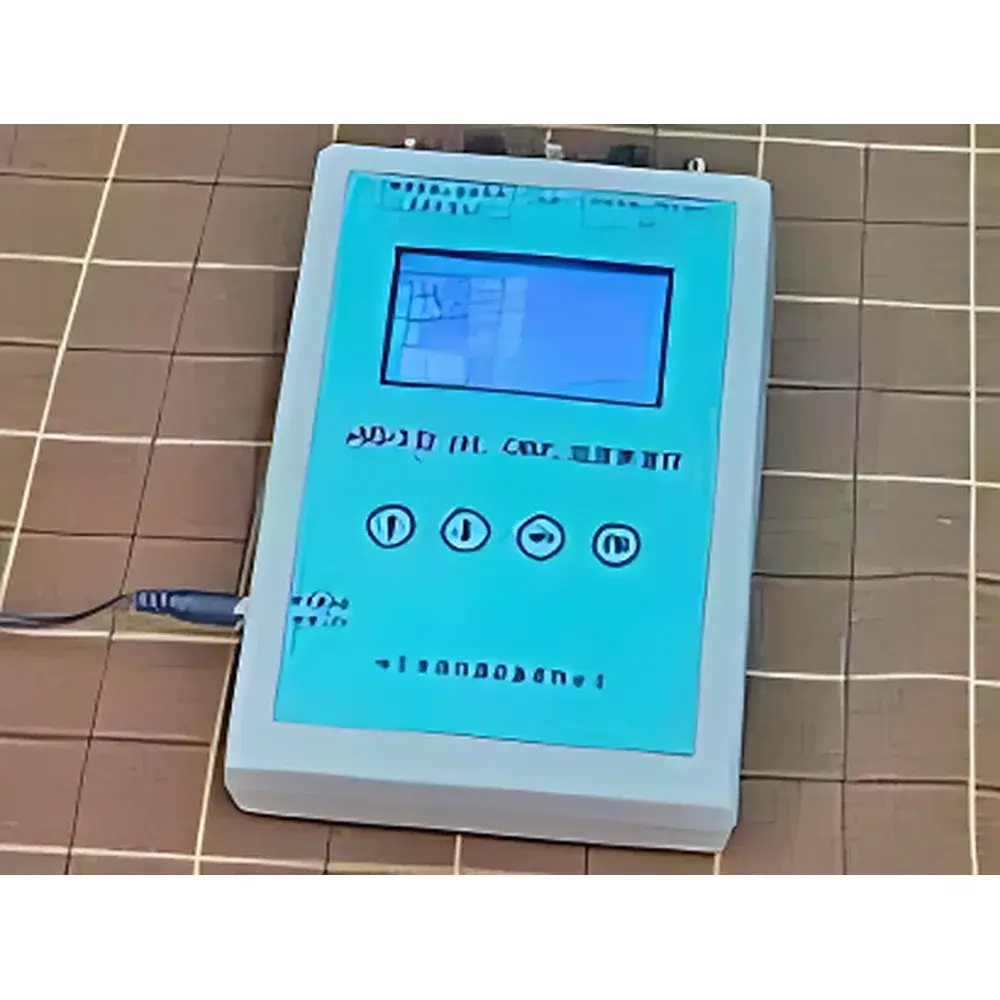
pHS-5 Benchtop pH/ORP/Temperature Meter
| Origin | Jiangsu, China |
|---|---|
| Manufacturer Type | Authorized Distributor |
| Origin Category | Domestic (China) |
| Model | PHS-5 |
| Price Range | USD 280–420 |
| Instrument Type | Benchtop |
| pH Range | 0.00–14.00 pH |
| pH Resolution | 0.01 pH |
| pH Accuracy | ±0.02 pH ±1 digit |
| ORP Range | −1999.9 to +1999.9 mV |
| ORP Resolution | 0.1 mV |
| Temperature Range | −20.0 to +100.0 °C |
| Temperature Resolution | 0.1 °C |
| Input Impedance | ≥3 × 10¹² Ω |
| Measurement Update Rate | 0.5 s |
| Auto-Save Calibration & State | Yes |
| Dimensions (W×H×D) | 200 × 128 × 60 mm |
| Weight | <1.0 kg |
| Power Supply | DC 12 V |
| Power Consumption | <0.5 W |
| Operating Environment | 5–45 °C, RH <85% (non-condensing) |
Overview
The pHS-5 Benchtop pH/ORP/Temperature Meter is a microprocessor-controlled electrochemical analyzer engineered for routine laboratory use in quality control, environmental monitoring, education, and industrial process support. It operates on the fundamental principles of potentiometric measurement governed by the Nernst equation, where the potential difference between a pH-sensitive glass electrode (or inert platinum electrode for ORP) and a stable reference electrode—immersed in the same test solution—correlates directly with hydrogen ion activity (pH) or redox couple equilibrium (ORP). Integrated temperature sensing enables automatic temperature compensation (ATC) during pH measurement, ensuring thermally corrected readings without manual adjustment. Designed as a single-channel, three-parameter benchtop instrument, the pHS-5 delivers reliable, repeatable measurements across standard aqueous matrices without requiring complex setup or external software dependencies.
Key Features
- Simultaneous or independent measurement of pH, ORP (mV), and temperature—each parameter selectable via intuitive front-panel navigation.
- High-input-impedance circuitry (≥3 × 10¹² Ω) minimizes loading effects on high-impedance pH electrodes, preserving signal integrity and measurement stability.
- Two-point pH calibration (e.g., pH 4.01 and pH 7.00 or pH 7.00 and pH 10.01) with automatic slope and offset calculation; calibration data—including date, buffer values, and electrode response—persist through power cycles.
- Real-time display with high-brightness LCD showing primary parameter, secondary parameter (e.g., temperature during pH mode), and status indicators (e.g., CAL, STAB, ATC).
- Fast measurement update rate of 0.5 seconds ensures responsive observation of dynamic equilibration, particularly useful during titration endpoint verification or batch consistency checks.
- Compact benchtop form factor (200 × 128 × 60 mm) and low mass (<1.0 kg) facilitate integration into constrained lab spaces or mobile field labs equipped with DC power sources.
- Low-power DC 12 V operation (<0.5 W) supports extended deployment in off-grid or battery-backed environments when paired with compatible power adapters or portable power stations.
Sample Compatibility & Compliance
The pHS-5 is validated for use with standard aqueous solutions commonly encountered in academic teaching labs, municipal water testing, food & beverage QC, and basic pharmaceutical manufacturing support. It accepts conventional combination pH electrodes (with integrated reference and temperature sensors) as well as separate pH glass electrodes paired with Ag/AgCl or calomel reference electrodes and Pt or redox-specific electrodes for ORP. While not certified for GMP-regulated production environments, its design aligns with foundational metrological practices outlined in ISO 7027 (for turbidity-related validation context), ASTM D1293 (Standard Test Method for pH of Water), and USP (pH Measurement). The instrument supports GLP-aligned workflows through persistent calibration memory and traceable measurement conditions—though full 21 CFR Part 11 compliance requires external audit-trail software integration, which is outside the device’s native scope.
Software & Data Management
The pHS-5 operates as a standalone hardware unit with no embedded data logging or USB/Bluetooth connectivity. All operational parameters—including calibration coefficients, measurement mode, and temperature units—are retained in non-volatile memory. Users record results manually or interface the analog output (if equipped with optional analog module) to external chart recorders or SCADA systems. For laboratories requiring digital traceability, third-party serial-to-USB adapters may be used to capture real-time RS-232 output (where available on upgraded variants), enabling integration with LIMS or Excel-based logging tools under user-defined protocols. No proprietary drivers or cloud services are required or supported.
Applications
- Academic instruction: Demonstrating Nernstian behavior, electrode kinetics, and buffer capacity in undergraduate chemistry and environmental science curricula.
- Water quality assessment: Monitoring pH and ORP in drinking water distribution systems, wastewater treatment influent/effluent streams, and aquaculture ponds.
- Food processing: Verifying acidification steps in fermentation (e.g., yogurt, sauerkraut), checking rinse water neutrality post-CIP, and validating sanitizer concentration via ORP thresholds.
- Electroplating and metal finishing: Tracking bath stability through ORP trends and maintaining optimal pH for deposition efficiency and coating adhesion.
- Soil extract analysis: Measuring pH and redox potential of saturated paste extracts to assess nutrient availability and anaerobic conditions in agronomic studies.
- Basic pharmaceutical excipient testing: Confirming pH conformity of diluents, buffers, and vehicle solutions prior to formulation development.
FAQ
Does the pHS-5 support automatic temperature compensation (ATC) during pH measurement?
Yes—the built-in temperature sensor provides real-time ATC using the standard NIST-recommended slope (−0.1984 mV/pH/°C at 25 °C), eliminating manual correction when measuring samples at non-standard temperatures.
Can I use a single electrode for both pH and ORP measurements?
No—pH measurement requires a pH-sensitive glass membrane electrode, while ORP requires an inert noble metal electrode (typically platinum or gold). Some combination electrodes integrate both functions, but the pHS-5 does not support dual-sensor configurations natively.
What calibration buffers are recommended for routine use?
For general-purpose calibration, use traceable NIST-certified buffers at pH 4.01, 7.00, and 10.01; two-point calibration (e.g., pH 4.01 and 7.00) is sufficient for most applications within 0–10 pH range.
Is the instrument suitable for non-aqueous or high-ionic-strength samples?
It is optimized for aqueous solutions with conductivity >100 µS/cm. Measurements in organic solvents, viscous media, or low-conductivity deionized water may yield unstable readings and require specialized electrodes and procedural adaptations beyond the instrument’s default configuration.
How often should I recalibrate the instrument?
Recalibration is recommended before each analytical session, after electrode replacement, following prolonged storage, or when measurement drift exceeds ±0.03 pH under controlled reference conditions.
Related Products




