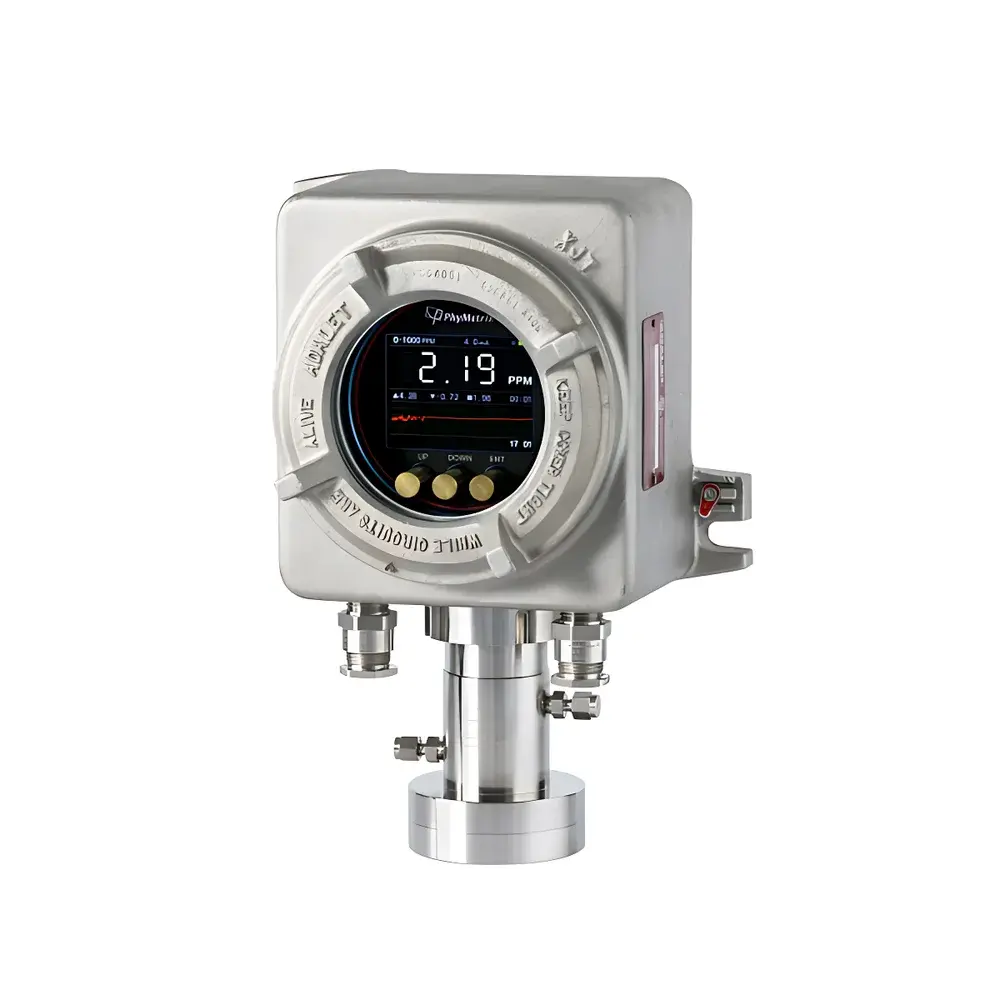
PhyMetrix PGA500-Ex Intrinsically Safe Oxygen Analyzer
| Brand | PhyMetrix |
|---|---|
| Origin | USA |
| Model | PGA500-Ex |
| Measurement Principle | Electrochemical Sensor |
| Range Options | 0–10 ppm, 0–100 ppm, 0–1,000 ppm, 0–1% O₂ (auto-ranging) |
| Resolution | 0.01 ppmv |
| Accuracy | ≤ ±2% FS |
| Repeatability | ±1% FS |
| Response Time (T90) | <180 s (10,000 → 1,000 ppm) |
| Operating Temperature | −20 to +60 °C |
| IP Rating | IP65 |
| Ingress Pressure | Max. 1 bar (gauge) |
| Sample Flow Rate | >1 NL/min |
| Display | 3.5″ color LCD |
| Power Supply | 176–264 VAC / 47–63 Hz or 15–28 VDC |
| Power Consumption | 5 W |
| Output Signals | 4–20 mA (HART-enabled), 0–20 mA, 0–24 mA (Rₗ < 500 Ω) |
| Alarm Outputs | 2 × programmable SPDT relays (250 VAC/5 A, 30 VDC/5 A, resistive load) |
| Communication | RS-485, Modbus RTU |
| Enclosure Certification | Ex d IIC T4 |
| Dimensions | 355 × 224 × 172 mm (H × W × D) |
| Weight | 10.95 kg |
| Inlet/Outlet Fitting | 316 stainless steel 1/4″ compression |
Overview
The PhyMetrix PGA500-Ex Intrinsically Safe Oxygen Analyzer is an industrial-grade, continuous online oxygen monitoring system engineered for hazardous environments where flammability, explosivity, or moisture sensitivity preclude conventional instrumentation. It employs a high-stability electrochemical oxygen sensor—certified for long-term drift resistance and calibrated traceably to NIST standards—to deliver precise, real-time measurement of oxygen concentration across four selectable ranges (0–10 ppm, 0–100 ppm, 0–1,000 ppm, and 0–1% O₂). The analyzer operates on the principle of diffusion-limited amperometric detection: molecular oxygen diffuses through a selective membrane into an electrolyte-filled cell, generating a current proportional to partial pressure. This signal is conditioned by a 24-bit low-power analog-to-digital converter and processed by a 32-bit embedded microcontroller with full-temperature-range compensation algorithms, ensuring consistent accuracy from −20 °C to +60 °C without manual recalibration.
Key Features
- Explosion-proof enclosure certified to Ex d IIC T4 per IEC 60079-1, UL 1203, and CSA C22.2 No. 30, enabling safe deployment in Zone 1/Division 1 classified areas (Class I Groups B, C, D; Class II Groups E, F, G; Class III).
- True intrinsically safe operation achieved via galvanic isolation between the sensor module (housed within the sampling chamber) and the electronics unit (encapsulated in the Exd-rated housing), eliminating risk of spark propagation.
- 3.5″ color LCD with intuitive, icon-driven UI supporting English and Chinese language selection—operable entirely through the sealed front window using a tactile rotary control interface.
- Dual redundant output architecture: one user-configurable analog channel (4–20 mA with HART FSK modulation, or voltage options) plus two independently programmable SPDT alarm relays rated for 250 VAC/5 A and 30 VDC/5 A (resistive load).
- Industrial communication compliance: RS-485 interface fully compliant with Modbus RTU protocol for integration into DCS, SCADA, or PLC-based process control systems.
- Robust mechanical design: IP65-rated housing, 316 stainless steel 1/4″ compression fittings, and internal data logging capacity for up to 10,000 timestamped records—supporting audit-ready traceability under GLP/GMP frameworks.
Sample Compatibility & Compliance
The PGA500-Ex is validated for continuous monitoring of dry or low-humidity gas streams in demanding applications including inert gas blanketing, cryogenic storage (LNG, liquid nitrogen), hydrogen production purge loops, pharmaceutical nitrogen generators, and offshore marine cargo tank atmospheres. Its electrochemical sensor exhibits minimal cross-sensitivity to CO₂, CO, H₂, and hydrocarbons—critical when measuring trace O₂ in hydrogen-rich or hydrocarbon-laden process streams. All calibration procedures follow ASTM D6299 and ISO 8573-1 guidelines for gas purity verification. The instrument meets requirements for FDA 21 CFR Part 11-compliant data integrity when paired with validated third-party SCADA platforms, and its firmware supports configurable audit trails, user access levels, and electronic signature protocols.
Software & Data Management
While the PGA500-Ex operates autonomously without external software, its HART-enabled analog output permits configuration and diagnostics via standard handheld or PC-based HART communicators (e.g., Emerson DeltaV, FieldCare). The onboard memory stores time-stamped O₂ readings, temperature, pressure, relay status, and calibration history—exportable via Modbus RTU polling for trend analysis in historian systems such as OSIsoft PI or Ignition SCADA. Firmware updates are performed via secure USB interface during maintenance windows; all versions are digitally signed and version-locked to prevent unauthorized modification. Configuration parameters—including alarm thresholds, damping filters, range switching logic, and relay hysteresis—are stored in non-volatile EEPROM with write-cycle protection.
Applications
- Chemical & petrochemical: Monitoring O₂ ingress in ethylene oxide reactors, catalyst regeneration off-gas, and flare gas recovery systems.
- Power generation: Ensuring sub-ppm oxygen levels in turbine lube oil purge lines and hydrogen-cooled generator housings.
- Food & beverage: Validating nitrogen flush integrity in modified atmosphere packaging (MAP) lines and bulk grain silos.
- Pharmaceutical manufacturing: Verifying inert conditions during lyophilization chamber purging and API drying cycles per USP & EP monographs.
- Marine & offshore: Continuous O₂ surveillance in double-hull ballast tanks and LNG carrier containment spaces per IMO MSC.98(73) and SOLAS Chapter II-2.
FAQ
Is the PGA500-Ex suitable for measuring oxygen in hydrogen-rich environments?
Yes—the electrochemical sensor’s selectivity profile and built-in compensation algorithms minimize interference from H₂, making it appropriate for PEM electrolyzer purge monitoring and hydrogen pipeline quality assurance.
Does the analyzer support automatic zero/span calibration?
No—it requires manual calibration using certified span gases; however, its NIST-traceable baseline stability enables extended calibration intervals (typically 6–12 months) under controlled operating conditions.
Can the device operate at negative gauge pressure (vacuum)?
The inlet is rated for up to 1 bar(g) positive pressure only; operation under vacuum requires an external sample pump and pressure regulation stage.
What is the expected service life of the electrochemical sensor?
Under typical industrial conditions (ambient temperature, <5 ppm H₂O), the sensor maintains specification for ≥24 months; replacement is field-serviceable without tools.
Is Modbus RTU communication electrically isolated?
Yes—the RS-485 port incorporates 1500 VDC galvanic isolation to prevent ground-loop interference in multi-node plant networks.