
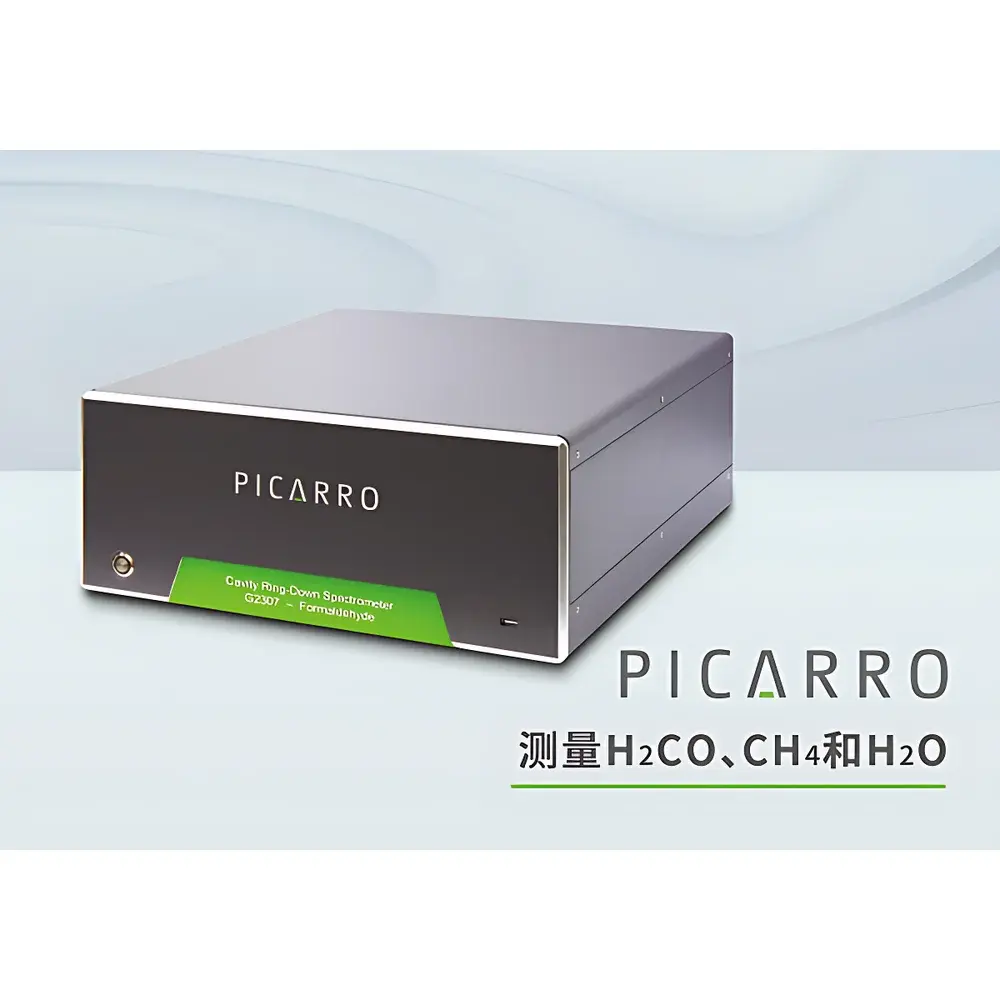
Picarro G2307 Multicomponent Gas Analyzer for Formaldehyde (H₂CO), Methane (CH₄), and Water Vapor (H₂O)
| Brand | Picarro |
|---|---|
| Origin | USA |
| Model | G2307 |
| Portability | Portable |
| Response Time | < 5 s |
| Repeatability | H₂CO, CH₄, and H₂O |
| Measurement Principle | Cavity Ring-Down Spectroscopy (CRDS) |
| Detection Limits (3σ, 300 s) | 0.18 ppb (H₂CO), 0.3 ppb (CH₄) |
| Long-Term Drift (24 h, STP) | 1.5 ppb (H₂CO) |
| Temperature Control Stability | ±0.005 °C |
| Pressure Control Stability | ±0.0002 atm |
| Sample Flow Rate | ~400 sccm at 760 Torr |
| Operating Temperature Range | 10–35 °C |
| Dimensions (Analyzer) | 43.2 × 17.9 × 44.6 cm |
| Weight (Analyzer) | 21.3 kg |
Overview
The Picarro G2307 Multicomponent Gas Analyzer is an ultra-high-sensitivity, field-deployable instrument engineered for simultaneous, real-time quantification of formaldehyde (H₂CO), methane (CH₄), and water vapor (H₂O) in ambient air and emission streams. It employs Cavity Ring-Down Spectroscopy (CRDS), a laser-based absorption technique offering exceptional selectivity, precision, and long-term stability without reliance on consumables or zero-gas calibration. CRDS measures the decay rate of light trapped within a high-finesse optical cavity—where sample gas resides—enabling part-per-quadrillion-level detection sensitivity and immunity to laser intensity fluctuations. The G2307’s gas path incorporates proprietary surface coatings that minimize H₂CO adsorption/desorption hysteresis, directly improving temporal response and measurement fidelity for this highly reactive trace gas. Designed for atmospheric chemistry research, urban air quality monitoring, indoor environmental assessment, and source characterization (e.g., biogenic emissions, combustion plumes, and photochemical smog formation), the analyzer delivers continuous, unattended operation with minimal maintenance and no requirement for external drying or scrubbing.
Key Features
- Simultaneous, independent measurement of H₂CO, CH₄, and H₂O with sub-ppb precision and <5 s response time (10–90% rise/fall for 0–20 ppb H₂CO)
- CRDS-based architecture ensures intrinsic calibration stability; no zero-gas cylinder, span gas, or chemical reagents required for routine operation
- Automated water vapor correction algorithm reports dry-mole-fraction concentrations in real time, eliminating post-processing and reducing analytical uncertainty
- Thermally stabilized optical cavity with ±0.005 °C temperature control and ±0.0002 atm pressure regulation ensures metrological-grade reproducibility
- Compact, benchtop- or 19-inch rack-mountable form factor (43.2 × 17.9 × 44.6 cm; 21.3 kg) supports both laboratory and mobile platform deployment
- Robust environmental tolerance: operational range 10–35 °C, storage range −10–50 °C, and humidity tolerance up to 99% RH (non-condensing at ≤40 °C)
- Integrated data acquisition with Windows 10 OS, supporting Ethernet, USB, RS-232, and optional 0–10 V analog output for SCADA integration
Sample Compatibility & Compliance
The G2307 accepts untreated, humid ambient air samples across a broad dynamic range: H₂CO (0–30 ppm), CH₄ (0–30 ppm), and H₂O (0–3% v/v). Its design accommodates variable inlet pressures (300–1000 Torr) and flow rates (~400 sccm at 760 Torr), enabling direct connection to standard sampling manifolds, eddy covariance systems, or stack probes. The analyzer complies with core requirements for environmental monitoring under ISO 14001 and EPA Method TO-15–adjacent validation frameworks. While not certified as a regulatory compliance analyzer per se, its performance characteristics—including documented 72-hour zero drift (<0.33 ppb peak-to-peak for H₂CO), low calibration frequency (typically <1/month), and audit-ready digital logs—support GLP-aligned workflows and data integrity in research-grade applications. All instruments ship with a Certificate of Conformance and individual factory test report per unit.
Software & Data Management
Picarro’s proprietary Analyze software provides real-time visualization, configurable averaging intervals (2 s, 10 s, 300 s), and automated export of time-stamped concentration series in CSV or NetCDF format. The system implements timestamped metadata logging for temperature, pressure, cavity alignment status, and laser power—critical for traceability in peer-reviewed studies. Data streams support NIST-traceable time synchronization via PTP or NTP. For regulated environments, optional software modules enable 21 CFR Part 11-compliant user access controls, electronic signatures, and immutable audit trails. Raw spectral data are retained onboard for retrospective analysis, and firmware updates are delivered via secure HTTPS with cryptographic signature verification.
Applications
- Atmospheric science: Quantifying H₂CO as a key OH radical precursor and photochemical ozone driver in boundary layer studies and aircraft campaigns
- Indoor air quality (IAQ) assessment: Monitoring formaldehyde emissions from building materials, furniture, and adhesives at sub-ppb thresholds relevant to WHO and EPA guidelines
- Biogenic and anthropogenic source attribution: High-temporal-resolution CH₄/H₂CO co-measurement to distinguish microbial vs. pyrogenic emission signatures
- Process monitoring: Real-time tracking of formaldehyde slip in industrial abatement systems (e.g., thermal oxidizers, catalytic converters)
- Calibration transfer & method validation: Use of CH₄ as a spectrally proximate proxy gas for linearity verification—eliminating hazardous H₂CO standard generation
- Mobile monitoring: Integration into vehicle-mounted or drone-deployed platforms for spatial mapping of urban VOC gradients
FAQ
Does the G2307 require zero-gas or calibration gases for routine operation?
No. The CRDS physics-based measurement eliminates dependence on zero-gas cylinders or span standards. Long-term stability is maintained through internal cavity diagnostics and thermal/pressure control.
How is water vapor interference corrected for H₂CO and CH₄ measurements?
A real-time spectroscopic water correction algorithm computes dry-mole-fraction concentrations using simultaneous H₂O measurement, avoiding empirical corrections or external dryers.
Can the G2307 be deployed outdoors or in harsh environments?
Yes—when housed in a temperature-controlled enclosure (e.g., NEMA 4X cabinet), it operates reliably across −10–50 °C storage and 10–35 °C operational ranges, with full humidity tolerance up to 99% RH (non-condensing).
What is the typical calibration interval for research applications?
Under stable conditions, recalibration is recommended every 30 days; however, many users extend intervals to 60–90 days based on drift monitoring and intercomparison protocols.
Is raw spectral data accessible for advanced analysis?
Yes. The instrument records full cavity ring-down decays and stores them locally for post-acquisition spectral fitting, baseline modeling, or custom interference correction routines.







