
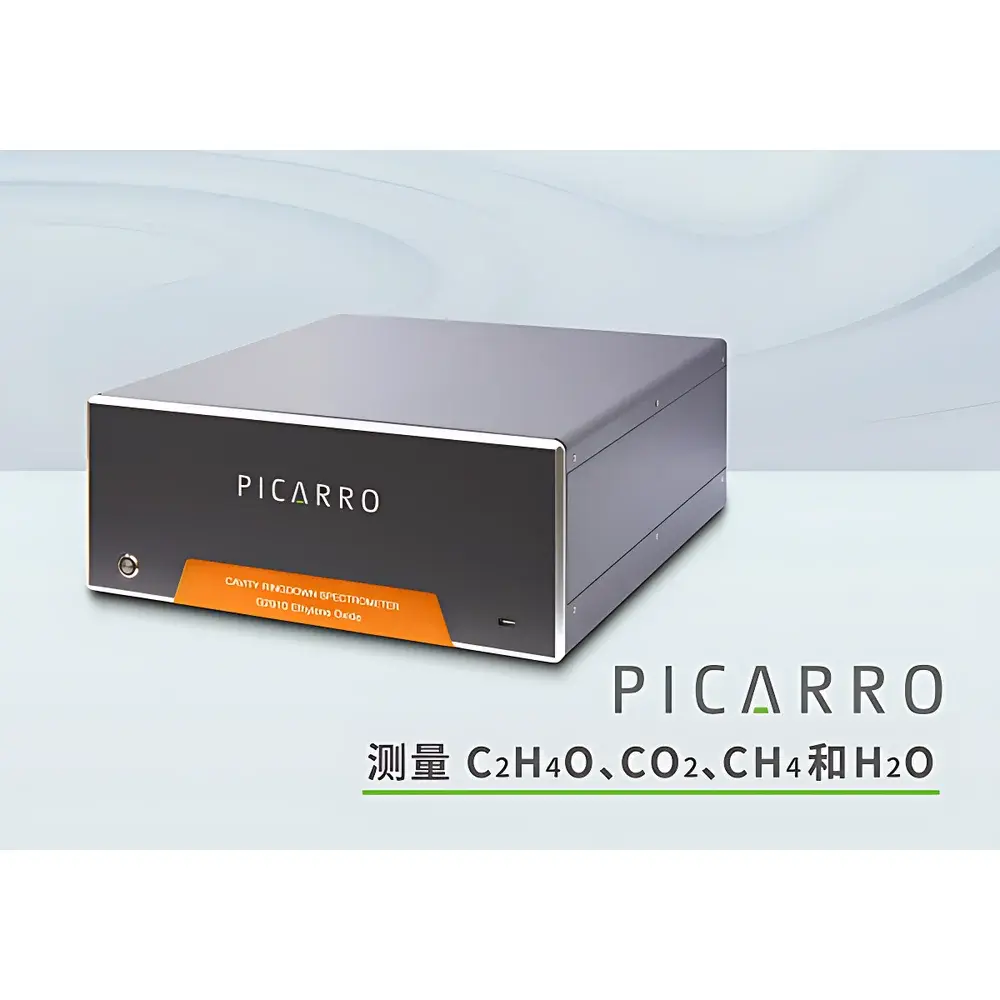
Picarro G2910 Multi-Gas Cavity Ring-Down Spectroscopy (CRDS) Analyzer for Ethylene Oxide (C₂H₄O), CO₂, CH₄, and H₂O
| Brand | Picarro |
|---|---|
| Origin | USA |
| Model | G2910 |
| Instrument Type | Portable |
| Detection Targets | Multi-component gases (C₂H₄O, CO₂, CH₄, H₂O) |
| Measurement Technology | Cavity Ring-Down Spectroscopy (CRDS) |
| Detection Limit (3σ, 300 s) | 250 ppt (C₂H₄O) |
| Zero Drift (72 h, peak-to-peak, 50-min avg) | 750 ppt |
| Accuracy (1σ, 300 s) | 70 ppt + 0.02% of reading (C₂H₄O) |
| Response Time (10–90%) | <10 s |
| Measurement Interval | <2 s |
| Operating Temperature Range | −10 to 80 °C (sample) |
| Sample Flow Rate | ~250 sccm at 760 Torr |
| Pressure Control | ±0.0002 atm |
| Temperature Control | ±0.005 °C |
| Sample Humidity | RH <99% at 40 °C (non-condensing) |
| Dimensions (Analyzer) | 43.2 × 17.9 × 44.6 cm (W×H×D) |
| Weight (Analyzer) | 21.3 kg |
| Power Requirement | 100–240 VAC, 47–63 Hz |
Overview
The Picarro G2910 is a field-deployable, high-sensitivity cavity ring-down spectroscopy (CRDS) analyzer engineered for simultaneous, real-time quantification of ethylene oxide (C₂H₄O), carbon dioxide (CO₂), methane (CH₄), and water vapor (H₂O) in complex gas matrices. Designed specifically for regulatory-grade emission monitoring—particularly at ethylene oxide sterilization facilities, fumigation chambers, exhaust stacks, and indoor air quality (IAQ) assessment points—the G2910 delivers ppt-level detection limits without chemical pre-concentration, zero-gas calibration, or consumables. Its optical architecture leverages ultra-stable, temperature- and pressure-controlled high-finesse optical cavities to achieve exceptional long-term stability (72-hour zero drift <750 ppt C₂H₄O, peak-to-peak) and measurement reproducibility. Unlike FTIR or GC-based systems, the G2910 provides continuous, second-by-second data streams with sub-10-second response time—critical for dynamic source characterization, leak detection, and process validation under EPA Method TO-15, ASTM D6348, and ISO 16000-6 compliant workflows.
Key Features
- Simultaneous, interference-free measurement of C₂H₄O (0–60 ppm), CO₂ (0–10,000 ppm), CH₄ (0–10 ppm), and H₂O (0–30,000 ppm) in a single optical path
- Ultra-low detection limit of 250 ppt (3σ, 300 s) for C₂H₄O—validated for compliance with U.S. EPA OSHA PEL (1 ppm) and NIOSH REL (0.1 ppm) monitoring requirements
- Patented stainless-steel critical-flow sample path heated to 80 °C, minimizing surface adsorption and memory effects for rapid (<10 s) rise/fall response
- No zero-gas cylinder or span gas required: intrinsic baseline stability eliminates external reference dependencies, reducing operational overhead and calibration uncertainty
- Integrated thermal and barometric control (±0.005 °C, ±0.0002 atm) ensures metrological traceability across ambient pressure and temperature fluctuations
- Portable form factor (21.3 kg analyzer) supports benchtop, rack-mounted (19″), or mobile deployment—compatible with Picarro’s optional 16-channel autosampler (A0311-S) for unattended multi-point sampling
Sample Compatibility & Compliance
The G2910 operates reliably in nitrogen-dominated background matrices containing up to 10,000 ppm CO₂, 30,000 ppm H₂O, 10 ppm NH₃, 1.5 ppm C₂H₄, and 20 ppm CH₃OH—conditions typical of sterilization off-gas, bioreactor exhaust, and building ventilation streams. Its CRDS methodology is inherently immune to cross-sensitivity from common interferents (e.g., CO, NOₓ, SO₂, VOCs), as confirmed by NIST-traceable spectral line assignment and line-shape modeling. The system meets GLP/GMP data integrity requirements via built-in audit trail logging, electronic signatures, and 21 CFR Part 11–compliant software architecture. It is routinely deployed in FDA-regulated medical device sterilization validation, EPA Title V CEMS support, and ISO 14001 environmental management system monitoring.
Software & Data Management
The G2910 runs on embedded Windows 10 with Picarro’s proprietary Analyze software, providing real-time spectral visualization, automated baseline correction, and configurable alarm thresholds. Data output is accessible via Ethernet (TCP/IP), USB, RS-232, and analog 0–10 V (optional), enabling seamless integration into SCADA, LIMS, and cloud-based environmental dashboards. All measurements are timestamped with GPS-synchronized UTC and include full metadata (cavity pressure, temperature, laser current, absorption spectra). Raw spectral files (.bin) and processed CSV exports support third-party analysis in MATLAB, Python (Picarro SDK), or R. Firmware updates and remote diagnostics are supported over secure HTTPS.
Applications
- Ethylene oxide emissions monitoring at medical device sterilizers, pharmaceutical cleanrooms, and fumigation warehouses per EPA Method 320 and California Air Resources Board (CARB) Regulation 1173
- Continuous stack testing for fugitive EtO release during aeration cycles—replacing manual grab sampling and lab analysis
- Indoor air quality profiling in hospitals and laboratories where EtO exposure risk requires real-time threshold alerts
- Multi-gas flux studies in soil-atmosphere exchange research (CH₄/CO₂/H₂O co-quantification)
- Process optimization in biogas upgrading, fermentation control, and HVAC commissioning
- Calibration transfer standard for secondary sensors in distributed sensor networks
FAQ
Does the G2910 require zero-gas cylinders or frequent calibration?
No. Its CRDS architecture achieves intrinsic zero stability through active cavity length stabilization and real-time laser frequency locking—eliminating dependence on external zero references.
Can the G2910 measure other VOCs beyond C₂H₄O, CO₂, CH₄, and H₂O?
Yes—within its near-IR spectral window (6,400–6,800 cm⁻¹), it can be configured to quantify additional species including acetaldehyde, formaldehyde, and nitrous oxide (N₂O) via firmware update and spectral reprocessing.
Is the analyzer suitable for outdoor or unconditioned environments?
It is rated for 10–35 °C operating ambient temperature and non-condensing RH <85%. For extended field use, optional environmental enclosures and heated sample lines are available.
How is data integrity ensured for regulatory reporting?
All raw spectra and processed results are cryptographically signed, with immutable timestamps, user access logs, and version-controlled firmware—fully aligned with 21 CFR Part 11 and EU Annex 11 requirements.
What maintenance is required beyond routine filter changes?
None. There are no consumables, optical alignments, or detector replacements scheduled within the 10-year design lifetime. Preventive maintenance consists solely of inlet particulate filter inspection every 6 months.







