
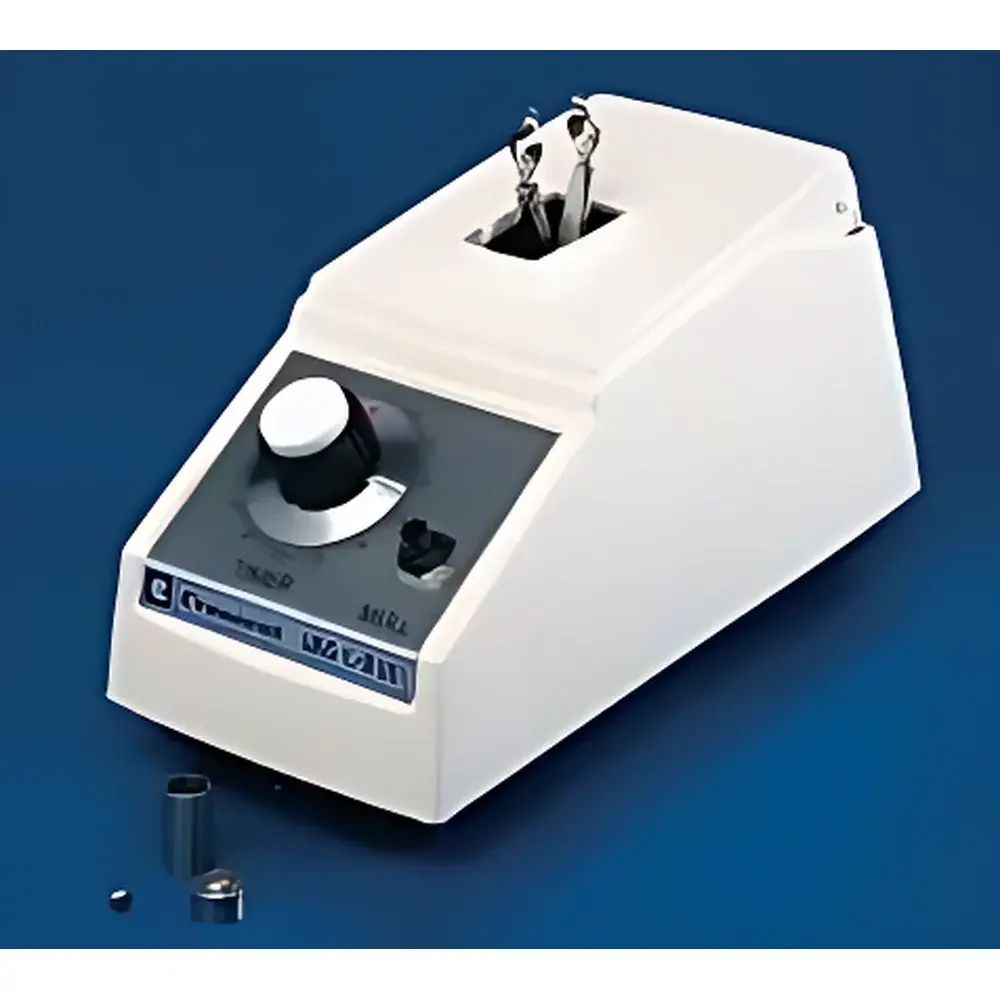
Pike BHY-MIXER Wig-L-Bug High-Energy Ball Mill
| Brand | Pike |
|---|---|
| Origin | USA |
| Model | BHY-MIXER |
| Instrument Type | High-Energy Oscillatory Ball Mill |
| Sample Suitability | Hard & Brittle Materials |
| Feed Size | <15 mm |
| Final Particle Size | <0.01 mm (10 µm) |
| Output Size (for mixing) | <1 mm |
| Batch Capacity | 2 g |
| Motion | 8-shaped reciprocating oscillation at 6.5° angle |
| Frequency | >100 Hz impact rate |
| Speed | 3200 rpm equivalent effective agitation |
| Timer | 30 min (High-Efficiency Mode) / 60 min (Standard Mode) |
Overview
The Pike BHY-MIXER Wig-L-Bug is a precision-engineered high-energy oscillatory ball mill designed specifically for the reproducible, contamination-free preparation of solid samples prior to Fourier-transform infrared (FTIR) spectroscopy—particularly KBr pellet formation—and near-infrared (NIR) diffuse reflectance analysis. Unlike conventional rotary or planetary mills, the Wig-L-Bug employs a unique 8-shaped reciprocating motion at a fixed 6.5° oscillation angle, generating rapid, high-frequency impacts (>100 Hz) between grinding media and sample within a sealed vial. This mechanism ensures efficient particle size reduction and homogeneous mixing without significant heat buildup or sample oxidation—critical for hygroscopic materials such as potassium bromide (KBr) and moisture-sensitive pharmaceutical actives. Its compact footprint and robust mechanical architecture make it suitable for routine use in QC laboratories, analytical chemistry suites, and research facilities adhering to GLP-compliant workflows.
Key Features
- High-frequency oscillatory action (3200 rpm equivalent agitation) enables rapid comminution of hard, brittle, and crystalline materials—including minerals, ceramics, pharmaceutical tablets, and inorganic salts.
- Dual-timer operation: 30-minute high-efficiency mode for aggressive grinding of refractory samples; 60-minute standard mode optimized for uniform blending and mild size reduction.
- Zero-cross-contamination design: Stainless steel, agate, and polystyrene vial options allow material-specific selection to prevent leaching, catalytic interference, or spectral artifacts in IR/NIR analysis.
- Sealed-vial processing minimizes sample exposure to ambient humidity—essential for maintaining KBr pellet integrity and avoiding deliquescence-related spectral distortion.
- Tool-free vial clamping system with precision-machined adapters ensures repeatable positioning and consistent energy transfer across batches.
- No lubricants or consumable drive belts: Fully maintenance-free operation with long-term mechanical stability and minimal calibration drift.
Sample Compatibility & Compliance
The BHY-MIXER Wig-L-Bug accommodates a broad spectrum of solid-phase samples relevant to spectroscopic sample preparation, including but not limited to: KBr, NaCl, CsI, microcrystalline cellulose, lactose monohydrate, API powders, geological specimens, and polymer blends. Vial compatibility spans stainless steel (for high-hardness inorganics), agate (for trace-metal-sensitive applications), and disposable polystyrene (for high-throughput screening or regulated bioanalytical workflows). All configurations support ASTM E1421-22 (Standard Practice for Describing and Measuring Performance of FTIR Spectrometers) and ISO 1833-1:2022 (Textiles — Quantitative chemical analysis — Part 1: General principles). When integrated into validated laboratory procedures, the instrument supports audit readiness under FDA 21 CFR Part 11 (electronic records/signatures) via time-stamped, operator-logged run protocols when paired with compliant LIMS or ELN systems.
Software & Data Management
The BHY-MIXER Wig-L-Bug operates as a standalone electromechanical device with no embedded firmware or digital interface. Timing control is managed via a calibrated analog timer with tactile feedback and audible end-of-cycle alert. For traceability in regulated environments, users are advised to document run parameters (vial type, mass, duration, operator ID) manually or via integration with electronic lab notebooks (ELNs) that comply with ALCOA+ principles (Attributable, Legible, Contemporaneous, Original, Accurate, Complete, Consistent, Enduring, Available). Optional accessories—including interchangeable clamps, voltage transformers (220 V), and certified reference vials—facilitate global deployment while maintaining metrological equivalence across sites.
Applications
- Preparation of homogeneous KBr pellets for transmission FTIR spectroscopy (per USP and Ph. Eur. 2.2.24).
- Rapid dispersion and deagglomeration of nanomaterials and pigments prior to DLS or SEM characterization.
- Homogenization of heterogeneous powder blends for content uniformity testing (USP ).
- Particle size conditioning of reference standards used in NIR method development and validation.
- Low-heat mechanical activation of catalyst precursors and MOF frameworks without thermal degradation.
- Controlled amorphization of crystalline APIs during early-stage formulation feasibility studies.
FAQ
What types of grinding vials are compatible with the BHY-MIXER Wig-L-Bug?
Stainless steel, agate, and polystyrene vials are available in multiple dimensions (e.g., 25.4 × 12.7 mm, 23.8 × 15.9 mm, 50.8 × 12.7 mm), each requiring a dedicated clamp adapter.
Is the instrument suitable for cryogenic grinding?
No—this model is not equipped for liquid nitrogen cooling or low-temperature operation; it is engineered for ambient-condition processing only.
Can the BHY-MIXER be used for wet grinding?
It is designed exclusively for dry grinding and mixing; solvent-based protocols may compromise seal integrity and motor insulation.
How is reproducibility ensured across operators and shifts?
Consistency relies on standardized vial loading (mass, ball-to-sample ratio), fixed oscillation geometry, and strict adherence to timer settings—procedures documented in SOPs aligned with ISO/IEC 17025 requirements.
Does Pike provide calibration certificates or IQ/OQ documentation?
As a Class I electromechanical device, formal calibration is not required; however, users may perform performance qualification using certified reference materials (e.g., NIST SRM 1979) and record mechanical timing accuracy per internal validation protocols.



