
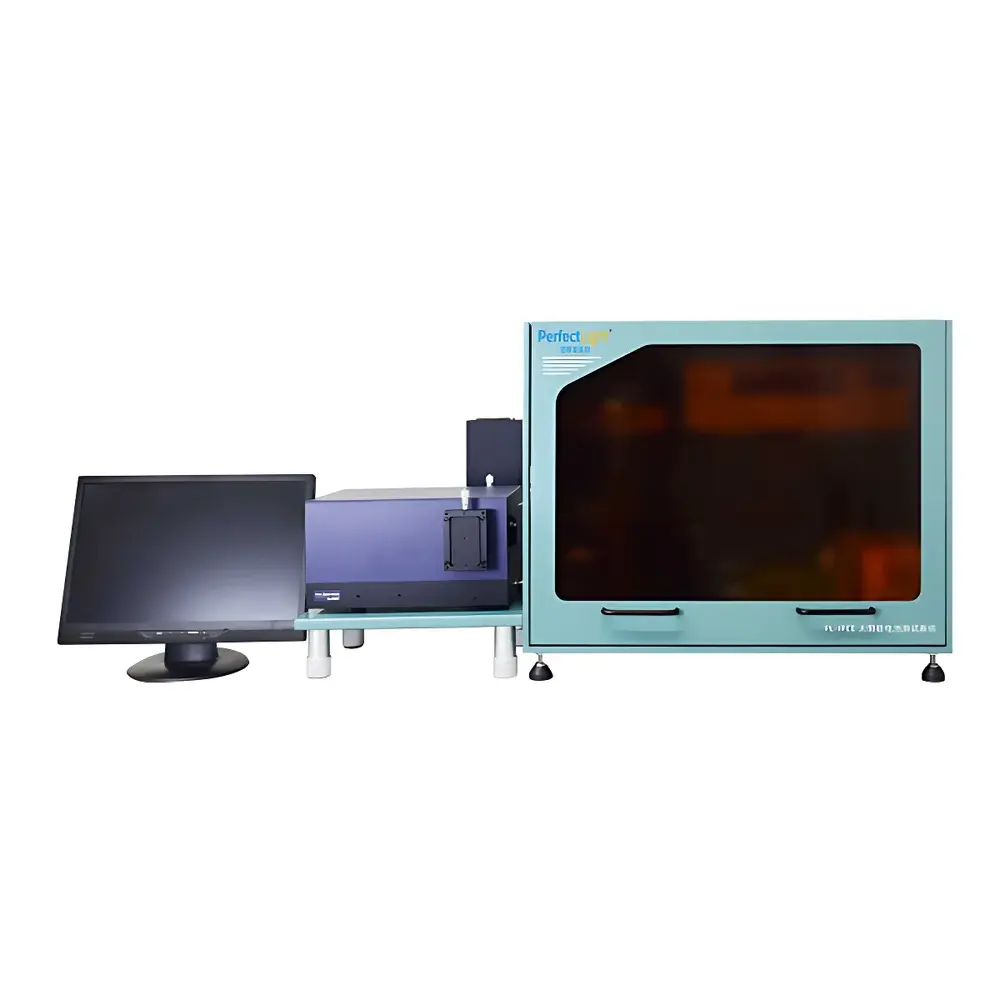
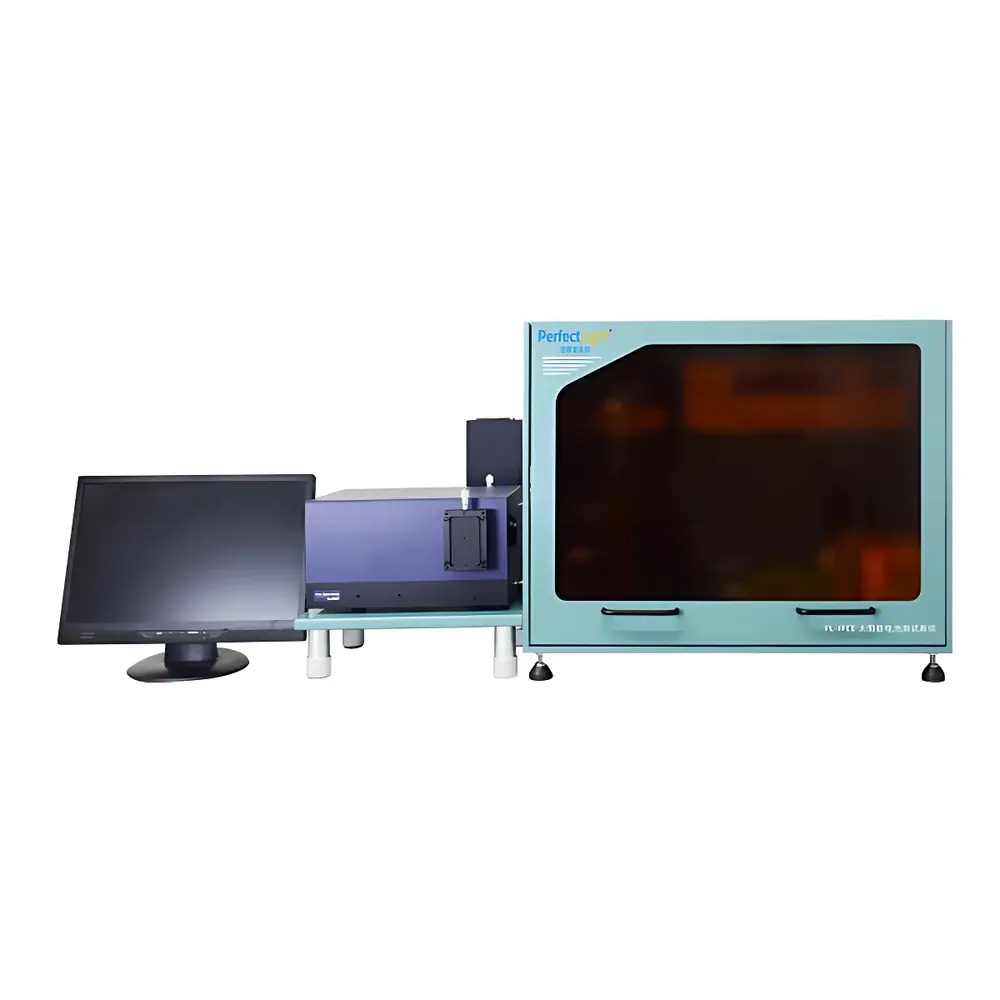
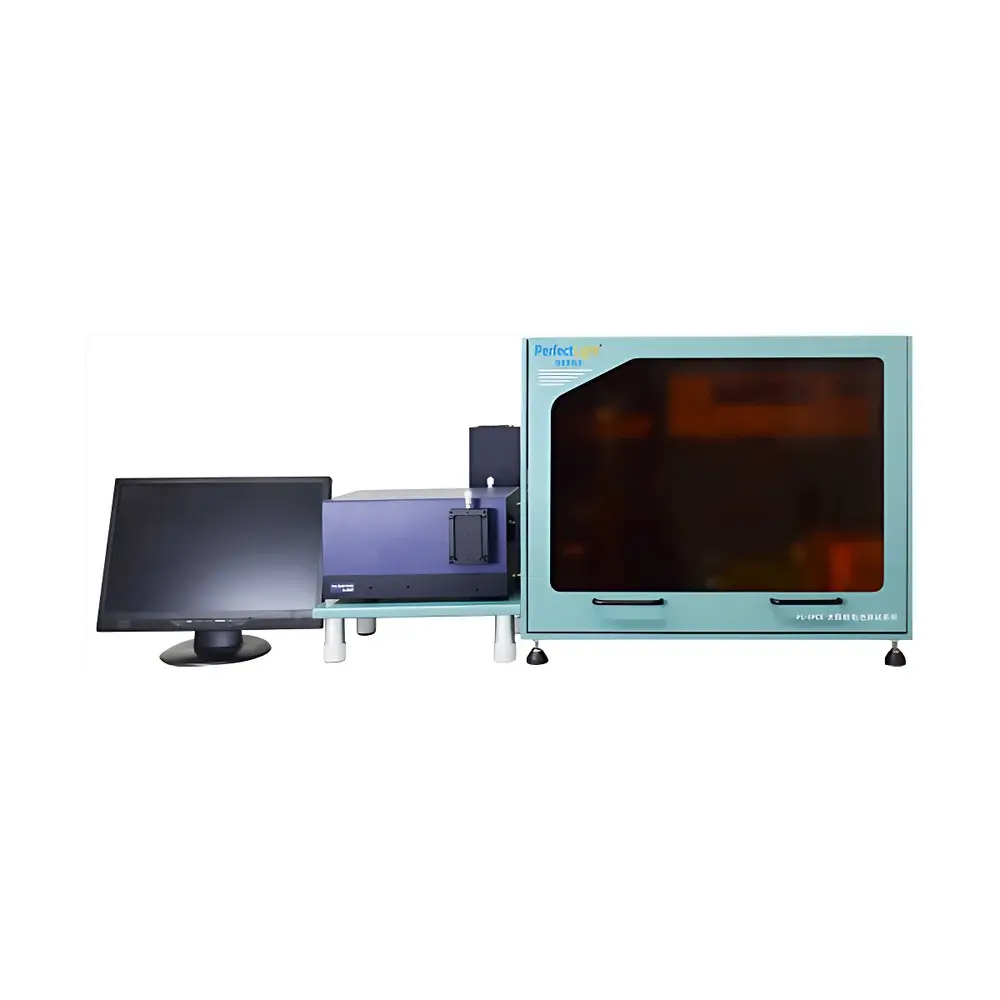
PL-IPCE Solar Cell Quantum Efficiency and Incident Photon-to-Current Efficiency Measurement System
| Brand | PerfectLight (Poelight) |
|---|---|
| Model | PL-IPCE |
| Origin | Beijing, China |
| Optical Resolution | 0.1 nm |
| Wavelength Range | 200–1100 nm |
| Chopper Frequency | 4 Hz–3.7 kHz |
| Lock-in Amplifier Frequency Range | 1 mHz–102 kHz |
| UV-Enhanced Si Photodetector Active Area | 10 × 10 mm² |
| Spectral Response | 190–1100 nm |
| Peak Responsivity | 0.5 A/W @ 960 nm |
| Dark Current | 2 × 10⁻¹⁰ A (@ 25 °C, −1 V) |
| Software-Controlled Automation | Yes |
| Traceable Calibration Standard | ISO/IEC 17025-accredited Reference Cell |
Overview
The PL-IPCE Solar Cell Quantum Efficiency and Incident Photon-to-Current Efficiency (IPCE) Measurement System is a turnkey, laboratory-grade instrumentation platform engineered for high-accuracy spectral responsivity characterization of photovoltaic devices. Built upon the principle of monochromatic photocurrent measurement under calibrated illumination, the system implements a lock-in detection architecture to isolate weak photocurrent signals from noise—enabling precise determination of external quantum efficiency (EQE) and IPCE across the ultraviolet–visible–near-infrared spectrum (190–1100 nm). Its core optical path integrates a high-fidelity 300-mm focal length monochromator with three interchangeable gratings (1200 L/mm @ 300 nm, 1200 L/mm @ 500 nm, 600 L/mm @ 1000 nm), delivering <0.1 nm optical resolution and exceptional stray-light suppression. The system operates in single-beam or dual-beam modulation configurations, with phase-stable chopper synchronization and low-jitter reference signal generation critical for reproducible sub-picoampere current measurements.
Key Features
- UV-enhanced silicon photodetector with 10 × 10 mm² active area, certified spectral responsivity traceable to national metrology institutes (NIM, NIST-equivalent calibration protocols)
- Automated software suite enabling synchronized control of monochromator wavelength scanning, chopper frequency selection, lock-in amplifier parameter configuration, and real-time data acquisition
- Dual-mode chopper supporting both voltage-controlled frequency tuning (4 Hz–3.7 kHz) and selectable reference output modes (single/dual beam, in-phase/quadrature)
- High-dynamic-range lock-in amplifier with >100 dB dynamic storage, 0.01° phase resolution, and time constants spanning 10 μs to 30 ks—optimized for low-noise EQE mapping of thin-film, perovskite, organic, and silicon solar cells
- Integrated calibration workflow using an ISO/IEC 17025-accredited reference solar cell, ensuring measurement uncertainty compliance with IEC 60904-8 and ASTM E1021 standards
- Thermally stabilized detector housing with operating range of −20 °C to +60 °C and dark current <2 × 10⁻¹⁰ A at −1 V bias (25 °C)
Sample Compatibility & Compliance
The PL-IPCE system supports planar and textured photovoltaic samples up to 50 × 50 mm² in dimension, accommodating standard TO-5 packaged detectors, lab-scale spin-coated perovskite films, evaporated organic heterojunctions, and commercial c-Si mini-modules. All optical components—including the monochromator entrance slit, collimating optics, and detector mount—are aligned and validated per ISO 10110 surface quality specifications. Data acquisition and reporting conform to GLP-compliant audit trails; software logs include timestamped instrument parameters, calibration history, environmental conditions (optional sensor integration), and user authentication metadata. The system meets electromagnetic compatibility requirements per EN 61326-1 and safety standards per IEC 61010-1 for laboratory electrical equipment.
Software & Data Management
The native control software provides a modular GUI with dedicated modules for instrument initialization, wavelength calibration (using Hg/Ar emission lines), spectral scan programming, real-time lock-in demodulation visualization, and post-acquisition EQE/IPCE conversion using the standard formula: IPCE(λ) = (1240 × Iph(λ)) / (λ × Pin(λ)), where Iph is photocurrent (A), λ is wavelength (nm), and Pin is incident monochromatic irradiance (W/m²). Raw and processed datasets export to CSV, HDF5, and MATLAB-compatible .mat formats. Audit-ready reports include full metadata headers compliant with FDA 21 CFR Part 11 requirements when configured with electronic signature modules. Optional Python API enables integration into automated testing sequences and machine learning–driven spectral modeling pipelines.
Applications
- Quantitative EQE/IPCE mapping of emerging photovoltaic absorbers (e.g., CsPbBr₃, FAPbI₃, non-fullerene acceptors) under AM1.5G-simulated illumination
- Wavelength-resolved recombination analysis via comparison of IPCE spectra before/after passivation treatments
- Validation of optical modeling outputs (e.g., transfer matrix method simulations) against empirical spectral response data
- Batch qualification of photoactive layer uniformity in roll-to-roll printed OPV devices
- Reference-cell intercomparison studies within PV calibration laboratories accredited to ISO/IEC 17025
- Photodetector spectral responsivity certification per ISO 11785 and CIE S 026/E:2019
FAQ
What calibration standards are supported for traceable IPCE measurements?
The system includes a primary reference solar cell calibrated by a national metrology institute (NIM or equivalent) with uncertainty <±1.5% (k=2) across 300–1100 nm, fully traceable to SI units via cryogenic radiometry. Secondary calibration options include NREL-certified reference cells.
Can the PL-IPCE system measure transient or time-resolved IPCE?
No—the platform is optimized for steady-state monochromatic photocurrent detection. For time-resolved variants (e.g., pump-probe IPCE), complementary ultrafast laser systems and gated detection hardware are required.
Is the software compatible with third-party data analysis tools like Origin or Igor Pro?
Yes—exported CSV and HDF5 files retain full column metadata (wavelength, current, irradiance, lock-in gain, time constant), enabling direct import and scripting-based batch processing.
How is stray light minimized in the 200–400 nm UV range?
The monochromator uses holographic gratings with optimized blaze profiles, fused silica optics with MgF₂ anti-reflection coatings, and internal baffling designed to achieve <10⁻⁵ stray light ratio at 250 nm relative to peak signal.
Does the system support bias-light-assisted IPCE measurements?
Yes—via optional integrated LED bias-light source (365 nm, 450 nm, 630 nm) with independent intensity control and synchronization to chopper reference signals.



