
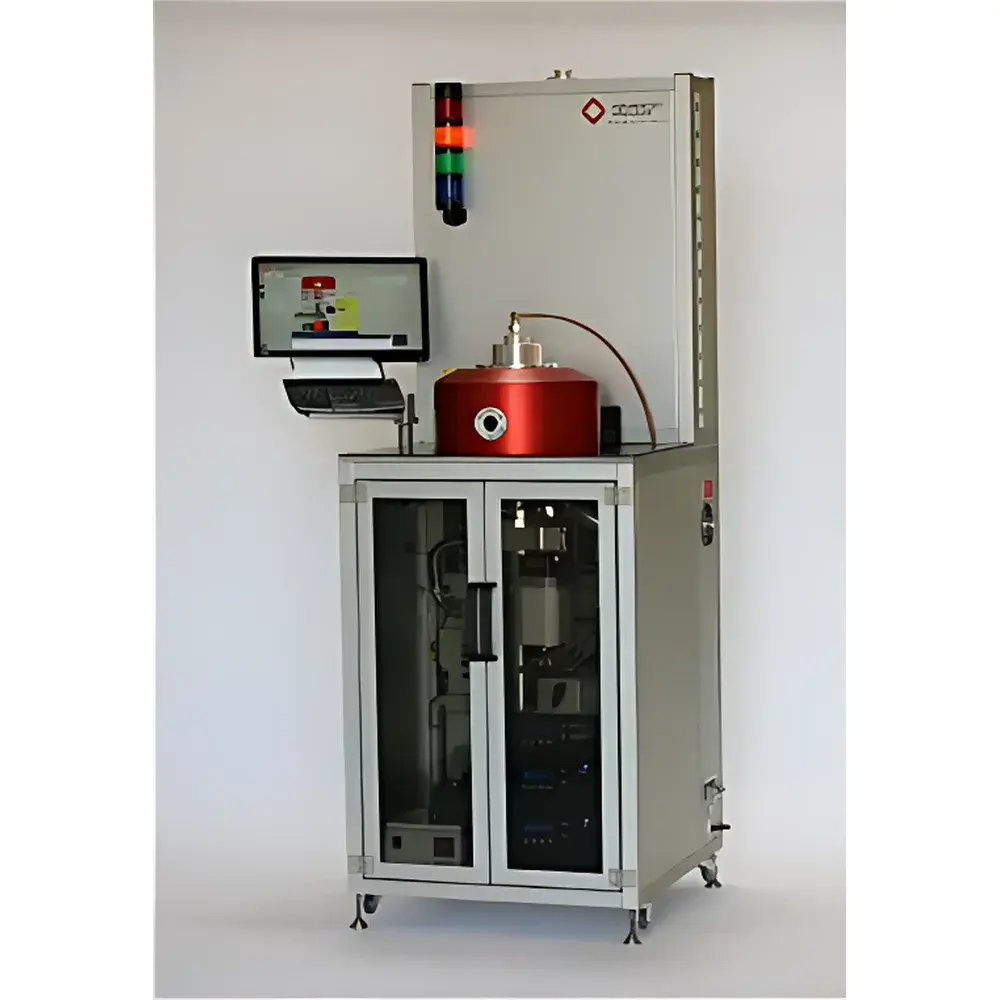
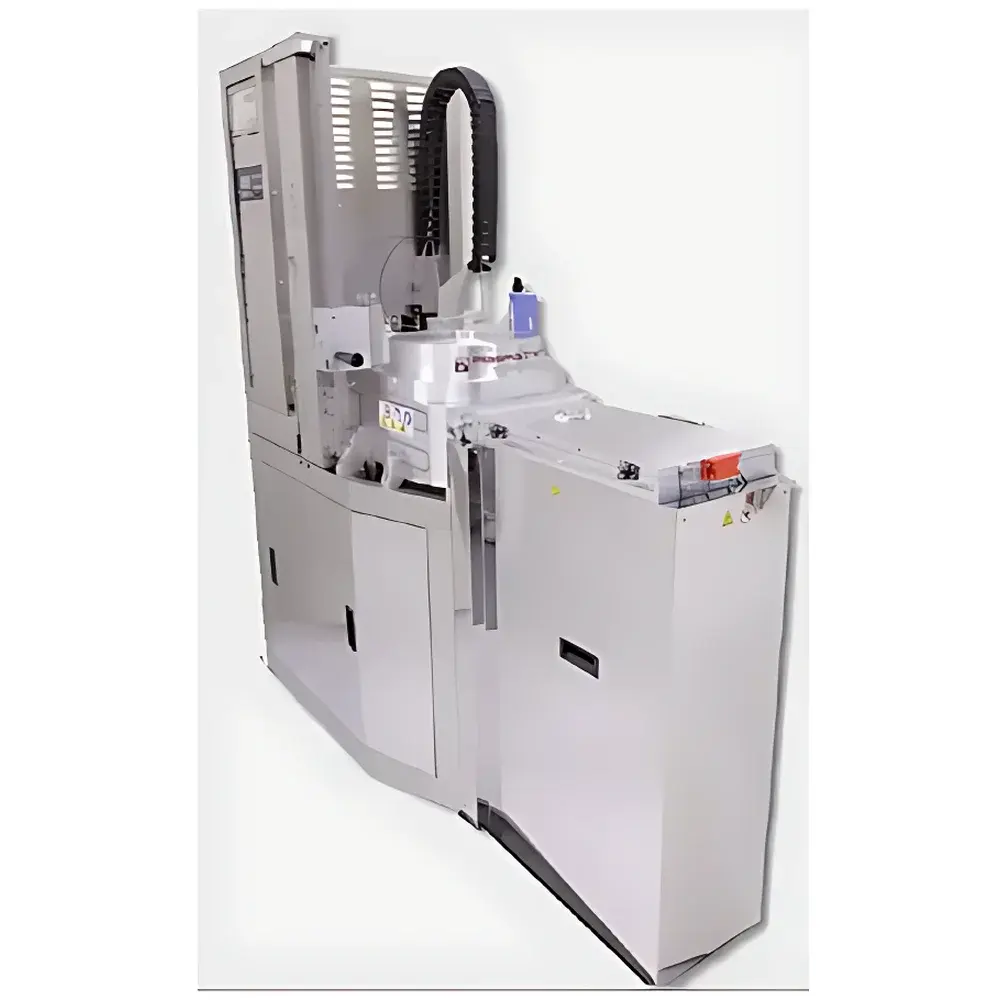
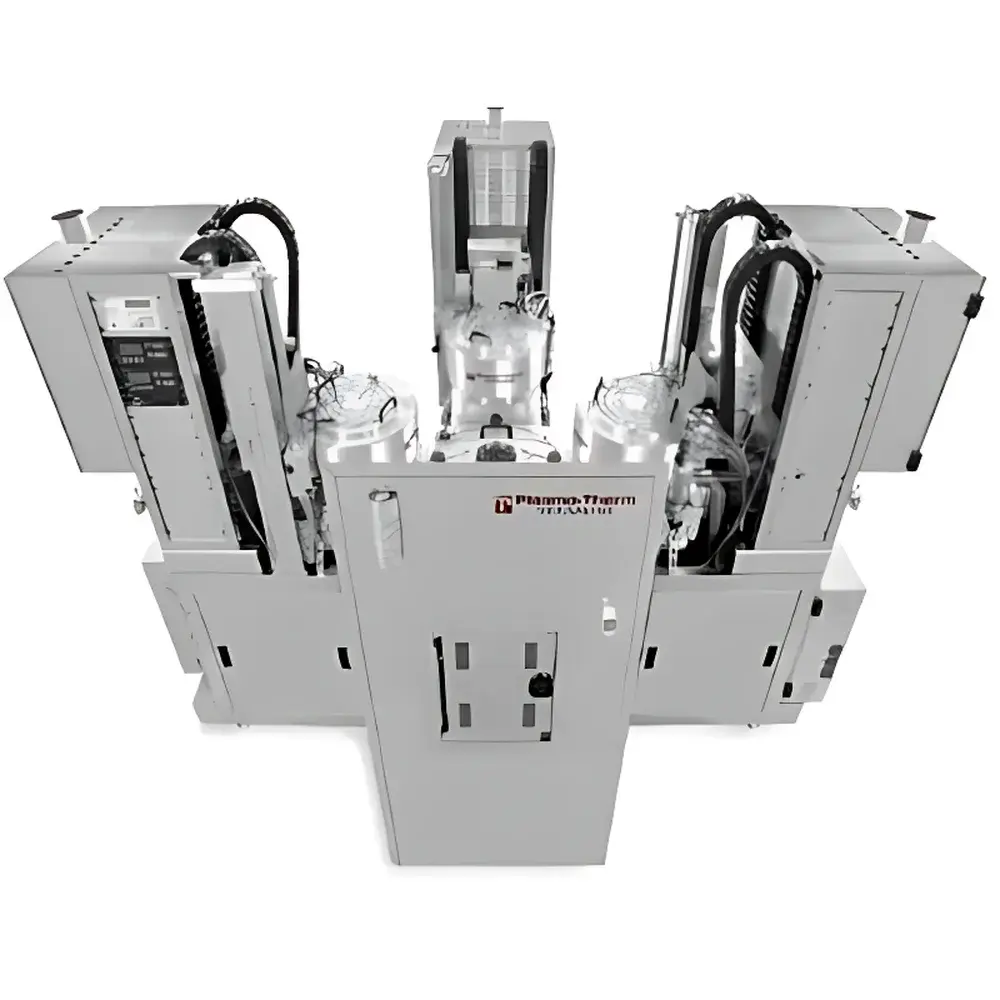
Plasma-Therm PECVD & HDPCVD Integrated Plasma Processing System
| Brand | Plasma-Therm |
|---|---|
| Origin | USA |
| Equipment Type | PECVD / HDPCVD / RIE / ICP / DSE |
| Wafer Size Support | 2″ to 12″ |
| Automation Levels | Manual / Semi-Automatic / Full Cassette-to-Cassette Automation |
| Installed Base | >1,600 Systems Worldwide |
| Uniformity (PECVD) | ≤3% (1σ, across wafer) |
| Chamber Heating | Fully Ceramic-Encapsulated Uniform Thermal Control |
| Endpoint Detection | Real-Time Optical Emission Spectroscopy (OES) with Sub-Second Response |
| Gas Switching Speed | <500 ms (Patented Rapid Valve Architecture) |
| Pressure Control Resolution | ±0.01 mTorr (Patented Closed-Loop Digital Manifold) |
Overview
The Plasma-Therm PECVD & HDPCVD Integrated Plasma Processing System is a modular, high-reliability platform engineered for precision thin-film deposition and anisotropic etching in advanced microfabrication environments. Built upon over four decades of plasma process engineering heritage, the system leverages capacitively coupled plasma (CCP) for PECVD and high-density plasma sources—including inductively coupled plasma (ICP) and dual-source enhanced (DSE) configurations—for high-aspect-ratio etching and low-damage material removal. Its core architecture supports both parallel-plate and multi-zone RF biasing schemes, enabling independent control of ion energy and flux—critical for stress-tuned SiNx, low-k SiCOH, and high-quality α-Si:H films, as well as for sub-10 nm feature transfer in MEMS, TSV, and GaAs-based photonics. The system operates under ultra-stable vacuum conditions (base pressure <5×10⁻⁸ Torr), with fully ceramic-walled process chambers designed to minimize metallic contamination and ensure long-term repeatability across >10,000 wafers per chamber lifetime.
Key Features
- Modular platform supporting five distinct process modes: Plasma-Enhanced Chemical Vapor Deposition (PECVD), High-Density Plasma CVD (HDPCVD), Reactive Ion Etching (RIE), Inductively Coupled Plasma Etching (ICP), and Dual-Source Etch (DSE)
- Ceramic-encapsulated, uniform-zone heating system providing ±0.5 °C thermal stability across full 12″ wafers—enabling precise film stoichiometry control and minimal interfacial stress
- Patented rapid gas-switching manifold (<500 ms response) and digital pressure regulation (±0.01 mTorr resolution) for reproducible profile control in high-aspect-ratio etches (up to 40:1)
- Real-time optical endpoint detection via broadband OES with configurable spectral windows and adaptive threshold algorithms compliant with SEMI E142 standards
- Multi-level automation architecture: manual load-lock, semi-automated single-wafer handling, and full cassette-to-cassette integration with SECS/GEM interface support
- Comprehensive hardware diagnostics and embedded fault-tree logging aligned with ISO 9001-certified manufacturing and GLP-compliant maintenance protocols
Sample Compatibility & Compliance
The system accommodates substrates from 50 mm (2″) to 300 mm (12″), including silicon, SOI, GaAs, SiC, sapphire, quartz, and flexible polyimide carriers. It supports standard SEMI MF-1287 carrier formats and integrates seamlessly with Class 100 cleanroom infrastructure. All plasma sources meet IEC 61000-6-3/6-4 electromagnetic compatibility requirements. Process recipes are stored with full audit trail metadata—including operator ID, timestamp, gas flow logs, RF power harmonics, and chamber wall temperature history—to satisfy FDA 21 CFR Part 11 and ISO/IEC 17025 traceability mandates. Hardware design complies with SEMI S2/S8 safety guidelines and UL 61010-1 certification for laboratory equipment.
Software & Data Management
The Plasma-Therm ProcessSuite™ software provides unified control across all module types via a deterministic real-time OS (VxWorks). It features recipe-driven operation with hierarchical parameter locking (engineering vs. operator access levels), automated calibration sequence execution (e.g., RF match tuning, OES baseline normalization), and integrated data export to CSV, HDF5, or direct SQL database push. All process events—including chamber pump-down cycles, plasma ignition attempts, and endpoint confirmation signals—are time-stamped with nanosecond-resolution hardware clocks and archived in encrypted binary logs. Remote diagnostics support TLS 1.3-secured connections for Tier-2 technical assistance, while local backup adheres to NIST SP 800-88 Rev. 1 media sanitization standards.
Applications
This platform serves as a foundational tool in R&D and pilot-line fabrication for compound semiconductor devices (GaAs HBTs, SiC MOSFETs, CPV cells), MEMS inertial sensors, LED epitaxial stack passivation, SOI-based RF switches, and through-silicon vias (TSV) with aspect ratios exceeding 20:1. In PECVD mode, it deposits stoichiometric SiNx (n=2.00±0.02), low-hydrogen SiO2, and amorphous silicon layers with thickness uniformity ≤3% (1σ) and refractive index stability <0.005 over 24-hour runs. In DSE configuration, morphing-enabled sidewall angle control (±0.5°) enables robust Bosch- and cryo-etch alternatives for deep silicon structuring without polymer residue accumulation.
FAQ
What wafer sizes does the Plasma-Therm platform support?
The system is configured for 2″, 3″, 4″, 6″, 8″, and 12″ substrates, with mechanical and thermal compensation optimized per size class.
Is the system qualified for GMP or ISO 13485 environments?
Yes—hardware documentation packages include IQ/OQ protocols, and software supports 21 CFR Part 11-compliant electronic signatures and audit trails.
Can the same chamber be reconfigured between PECVD and ICP etch modes?
Chamber reconfiguration requires hardware module swap (e.g., electrode assembly, antenna coupling structure); however, control software retains cross-mode recipe libraries and calibration maps.
What level of service and spares support is available globally?
Plasma-Therm maintains regional service centers in North America, Europe, and Asia-Pacific, with >95% critical spares availability within 72 hours under Platinum Support contracts.
Does the system support remote monitoring via industry-standard protocols?
Yes—it implements SECS/GEM HSMS over TCP/IP, Modbus TCP for facility integration, and MQTT telemetry for cloud-based analytics platforms.





