
PM-11z Plant Physiology & Ecology Monitoring System by EcoTech Israel
| [Origin | Israel |
|---|---|
| Type | Imported |
| Manufacturer Role | Authorized Distributor |
| Model | PM-11z |
| Pricing | Available Upon Request] |
Overview
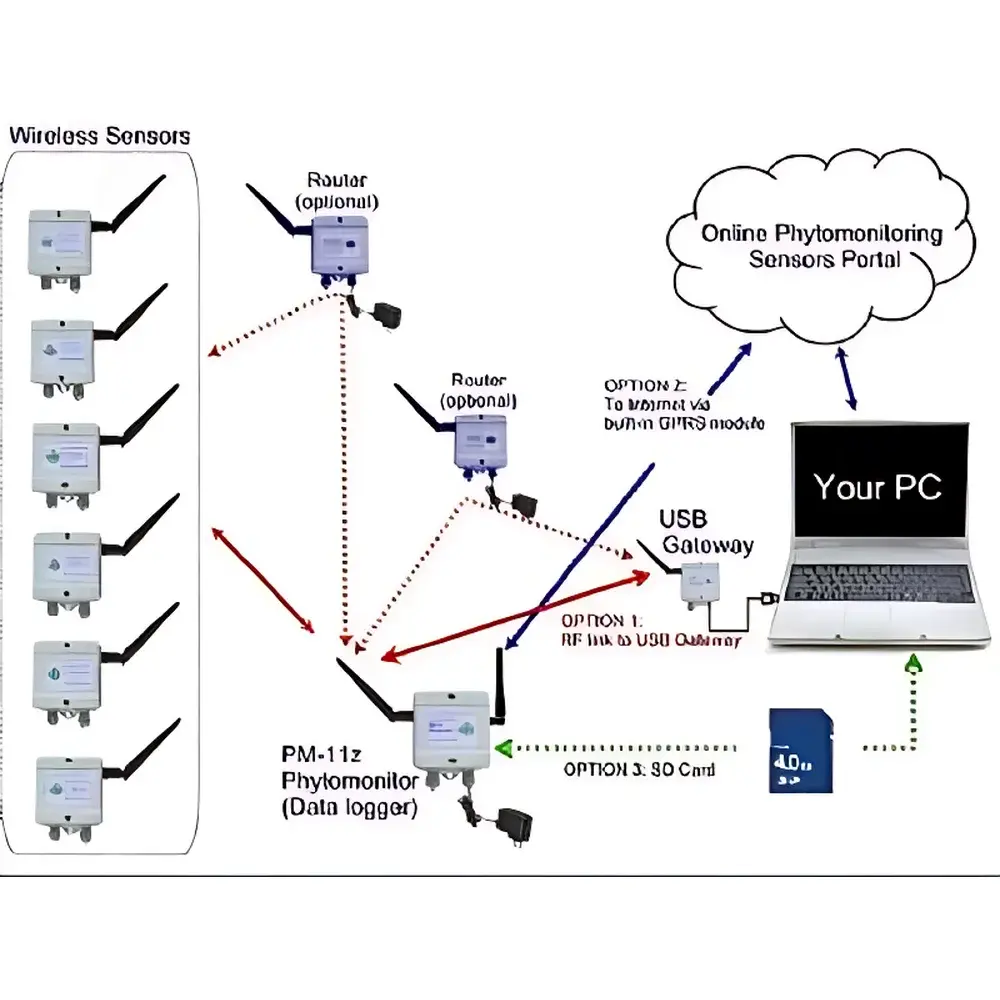
The PM-11z Plant Physiology & Ecology Monitoring System is a field-deployable, wireless environmental and plant physiological data acquisition platform engineered for long-term, unattended monitoring in natural and agricultural ecosystems. It operates on a distributed sensor architecture grounded in low-power RF (2.4 GHz) communication and GPRS-based remote data telemetry—enabling continuous measurement of plant functional traits (e.g., stem diameter variation, leaf temperature, fruit growth, stomatal conductance proxies) alongside critical microclimatic and edaphic variables (e.g., PAR, soil volumetric water content, air temperature/humidity, total solar radiation). Unlike laboratory-bound photosynthesis analyzers, the PM-11z does not measure gas exchange directly (e.g., CO₂ assimilation or transpiration rates via IRGA); rather, it provides high-temporal-resolution proxy metrics validated in peer-reviewed agronomic and ecophysiological studies—including those published in Photosynthetica, Russian Journal of Plant Physiology, and Journal of Environmental Monitoring. Its design prioritizes operational robustness in remote deployments: IP67-rated sensors, battery life up to 6 months per AA cell set, and support for solar-rechargeable power systems ensure compliance with GLP-aligned field data integrity requirements.
Key Features
- Modular wireless sensor network architecture supporting up to 15 autonomous nodes per USB transmitter or centralized relay unit
- 2.4 GHz RF communication with line-of-sight range up to 4 km; optional repeater units extend coverage across heterogeneous terrain
- Onboard SD card storage (host unit) plus individual sensor memory (up to 7,200 readings per node) for redundancy during GPRS outages
- GPRS module (SIM card required) enables scheduled or event-triggered data upload to secure cloud or local server infrastructure
- Field-configurable sampling intervals (1 min to 24 h), programmable via Windows-based control software with audit-trail logging
- Compliance-ready firmware: supports time-stamped, tamper-evident data records aligned with ISO/IEC 17025 documentation principles
- Solar power compatibility: integrated charge controller, deep-cycle battery interface, and mounting hardware for off-grid operation
Sample Compatibility & Compliance
The PM-11z accommodates a validated suite of non-destructive, in situ plant and environmental sensors—including LT-1z (leaf temperature), SD-5z/SD-6z (stem expansion), DE-1z (tree girth), FI-Lz/FI-Mz/FI-Sz (fruit diameter), PIR-1z (400–700 nm PAR), TIR-4z (broadband solar irradiance), ATH-2z/ATH-3z (ventilated air T/RH), SMS-5z (soil moisture), and SMTE-z (soil moisture/temperature/electrical conductivity). All sensors undergo factory calibration traceable to NIST-equivalent reference standards; accuracy specifications (e.g., ±0.2°C for LT-1z, ±5% for PIR-1z) are verified per ASTM E2897-21 (Standard Practice for Calibration of Environmental Sensors). The system supports deployment under USDA ARS, FAO, and EU Horizon-funded field trials where adherence to FAIR data principles (Findable, Accessible, Interoperable, Reusable) and ALCOA+ (Attributable, Legible, Contemporaneous, Original, Accurate, Complete, Consistent, Enduring, Available) is mandated.
Software & Data Management
The proprietary Windows application provides full configuration, real-time visualization, and post-processing functionality. Users define measurement schedules, configure sensor thresholds for alerting, and assign metadata (location, treatment group, phenological stage) prior to deployment. Data export is natively supported in CSV and Excel (.xlsx) formats—with column headers conforming to CF Metadata Conventions v1.8 for climate and ecological datasets. Audit logs record all parameter changes, firmware updates, and manual data retrieval events—meeting FDA 21 CFR Part 11 requirements for electronic records when deployed in regulated agricultural research environments. Optional API integration enables ingestion into institutional LIMS or time-series databases (e.g., InfluxDB, TimescaleDB) for cross-platform analytics.
Applications
- Long-term drought response phenotyping in cereals (e.g., wheat, maize) and perennial crops (e.g., pitaya, cactus pear)
- Microclimate-driven modeling of diurnal stem shrinkage/swelling cycles as indicators of plant water status
- Validation of remote sensing indices (e.g., NDVI, PRI) using ground-truthed leaf temperature and PAR time series
- Soil-plant-atmosphere continuum (SPAC) studies integrating soil moisture dynamics with canopy-level thermal behavior
- Climate change impact assessment on Mediterranean agroecosystems, as applied in ICCAP and RIHN Kyoto projects
- Smart irrigation scheduling based on real-time stem growth rate anomalies and evaporative demand metrics
FAQ
Does the PM-11z measure net photosynthesis or stomatal conductance directly?
No. It collects indirect physiological proxies (e.g., leaf temperature, stem diameter variation, PAR) used in empirical and mechanistic models to infer photosynthetic performance and water use efficiency.
Can sensor data be synchronized with external meteorological stations or eddy covariance towers?
Yes—via timestamp alignment and configurable UTC offset settings; raw data files include GPS-derived coordinates and precise epoch timestamps (ms resolution).
Is the system compatible with ISO 11120-compliant data archiving protocols?
Yes. Exported datasets include embedded provenance metadata (sensor ID, calibration date, firmware version) and support SHA-256 checksum generation for integrity verification.
What is the expected maintenance interval for field-deployed sensors?
Biannual visual inspection and cleaning recommended; no routine recalibration required within first 24 months under standard environmental exposure.
How is data security ensured during GPRS transmission?
All transmissions use TLS 1.2 encryption; SIM cards must be provisioned with APN credentials restricted to authorized IP endpoints only.
Related Products



