
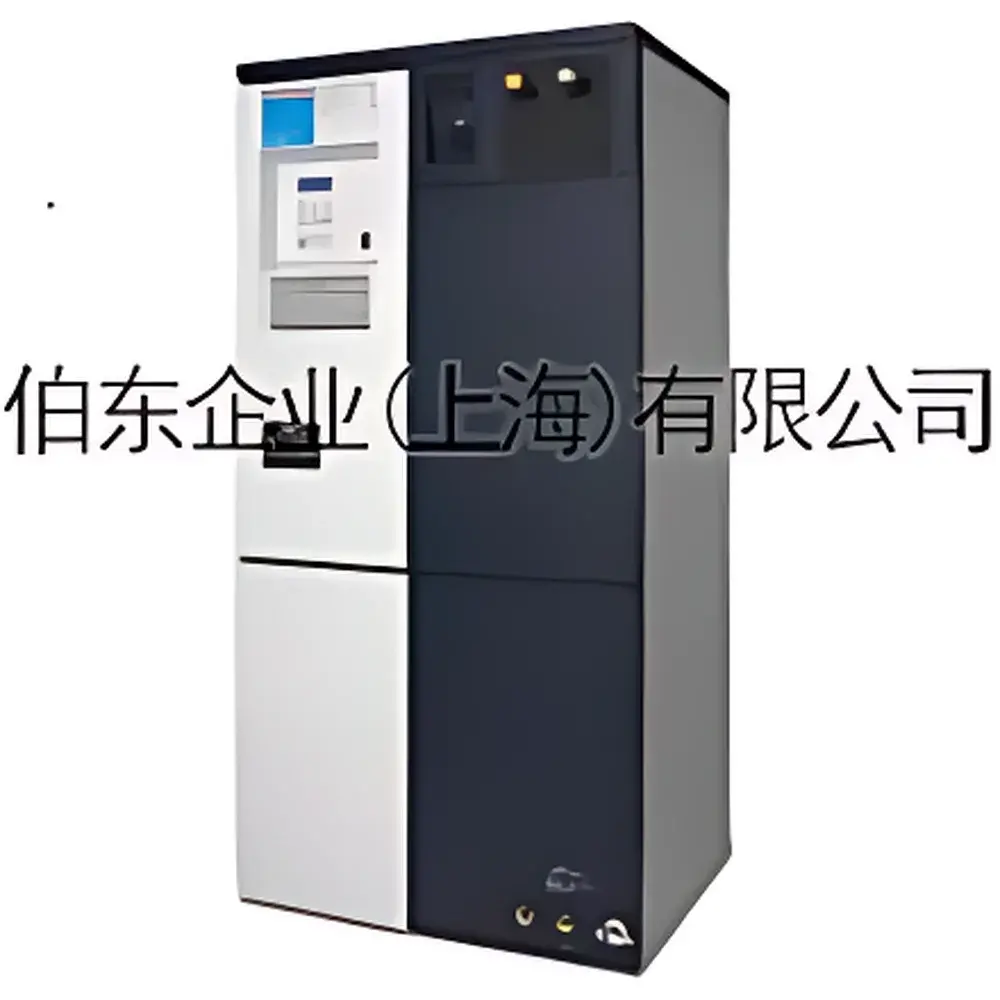
Polycold MaxCool 4000 H Cryogenic Water Vapor Pump
| Brand | Polycold |
|---|---|
| Origin | USA |
| Model | MaxCool 4000 H |
| Cooling Method | Water-Cooled |
| Circulating Pump Pressure | 7 × 10⁻⁸ mbar |
| Refrigeration Capacity | 4000 W |
| Condensing Surface Area | 2.2 m² |
| Cold Trap Tube Diameter | 16 mm |
| Single-Loop Tube Length | 43 m |
| Dual-Loop Tube Length | 2 × 21.9 m |
| Standard Cold Finger Length | 2.44 m |
| Cooling Water Flow Rate (at ΔT = 13°C/26°C/29°C) | 13.6 / 27.3 / 54.1 L/min |
| Noise Level | ≤78 dB(A) |
| Dimensions (Min. Footprint) | 34 m³ |
| Weight | 533 kg |
Overview
The Polycold MaxCool 4000 H is a high-capacity, closed-loop cryogenic water vapor pump engineered for ultra-high vacuum (UHV) and high-vacuum (HV) applications requiring rapid, selective removal of water vapor and condensable gases. Unlike conventional mechanical or turbomolecular pumps, the MaxCool 4000 H operates on the principle of cryosorption—utilizing a precisely temperature-controlled cryogenic surface (typically cooled to –120 °C to –140 °C via a two-stage helium refrigeration cycle) to condense and immobilize water molecules directly onto a high-surface-area cold trap. This mechanism achieves theoretical pumping speeds of up to 327,800 L/s for water vapor, with conservative, application-relevant speeds maintained at ≥220,000 L/s across its operational pressure range (1 atm startup to ultimate operating pressure of 7 × 10⁻⁸ mbar). Designed and manufactured in the USA by Brooks Instrument (formerly Polycold Systems), the MaxCool 4000 H integrates seamlessly into vacuum systems used in physical vapor deposition (PVD), optical coating, semiconductor wafer processing, and analytical instrumentation where residual water partial pressure critically impacts film stoichiometry, adhesion, stress, and layer uniformity.
Key Features
- 4000 W nominal refrigeration capacity—optimized for large-volume, high-throughput vacuum chambers (≥5 m³) commonly found in industrial sputtering and evaporation systems
- Dual configuration options: single-loop (43 m cold tube length) and dual-loop (2 × 21.9 m) configurations enable flexible integration with chamber geometry and thermal load distribution requirements
- High-efficiency helium-based closed-cycle refrigeration—eliminates dependency on liquid nitrogen, reducing operational cost, safety risk, and logistical overhead
- Ultra-low ultimate pressure capability (7 × 10⁻⁸ mbar) sustained during active pumping, supporting processes demanding sub-10⁻⁷ mbar water vapor partial pressure
- Rapid defrost cycle (≤5.5 minutes) with integrated heating and controlled venting—minimizes process downtime between runs
- Robust stainless-steel cold finger assembly with 2.2 m² effective condensing surface area; optimized fin geometry for maximum water vapor capture cross-section and minimal thermal bridging
- Water-cooled condenser design compatible with standard industrial cooling water supplies (flow rate: 13.6–54.1 L/min depending on inlet temperature differential)
Sample Compatibility & Compliance
The MaxCool 4000 H is fully compatible with UHV-compatible materials including 316L stainless steel, oxygen-free copper, and electropolished surfaces. Its cold trap surfaces meet ASTM F2251-22 specifications for vacuum system cleanliness and outgassing performance. The unit complies with CE marking requirements per EU Machinery Directive 2006/42/EC and Electromagnetic Compatibility Directive 2014/30/EU. Electrical safety conforms to UL 61010-1 and IEC 61010-1 standards. When integrated into GMP or GLP environments—such as semiconductor front-end fabrication or medical device coating lines—the MaxCool 4000 H supports audit-ready operation through optional analog/digital I/O interfaces for external monitoring of refrigerant temperature, condenser pressure, and defrost status. While not inherently 21 CFR Part 11 compliant, its process-critical parameters can be logged via third-party SCADA or MES platforms meeting electronic record and signature requirements.
Software & Data Management
The MaxCool 4000 H features an embedded microcontroller-based control system with local LED interface for setpoint adjustment, status monitoring, and fault diagnostics. It provides isolated 0–10 VDC and 4–20 mA analog outputs for remote integration with PLCs or vacuum system controllers. Optional RS-485 Modbus RTU communication enables bidirectional data exchange—including real-time cold head temperature, compressor discharge pressure, cooling water flow confirmation, and operational mode (cooling/defrost/idle). All critical events (e.g., high-pressure trip, low-flow alarm, defrost completion) are timestamped and stored in non-volatile memory for traceability. No proprietary software installation is required; configuration and trending may be performed using standard industrial HMI platforms or custom LabVIEW/Python scripts interfacing via Modbus.
Applications
- Optical thin-film deposition: Reduces water-induced absorption bands in anti-reflective, high-reflector, and filter coatings; improves repeatability of refractive index and thickness control
- Semiconductor manufacturing: Enables stable electrostatic chuck (ESC) temperature control during PVD/CVD; suppresses hydrogen-related defects in gate oxides and metal interconnect layers
- Research-scale UHV systems: Supports surface science experiments (XPS, AES, LEED) requiring <10¹¹ molecules/cm² residual water coverage on sample surfaces
- Electron microscopy: Mitigates ice contamination on TEM/SEM specimen stages and detectors during cryo-workflows
- Industrial vacuum metallizing: Increases throughput by up to 100% through reduction of pump-down time from atmosphere to base pressure (<10⁻⁶ mbar), while improving coating density and reducing pinhole defect rates
FAQ
What is the primary mechanism of water vapor removal in the MaxCool 4000 H?
It relies on cryocondensation—water vapor molecules impinging on the sub-130 °C cold surface lose kinetic energy and transition directly from gas to solid phase, forming an amorphous ice layer with negligible re-evaporation under operating vacuum conditions.
Can the MaxCool 4000 H be used alongside turbomolecular or dry scroll pumps?
Yes—it is designed as a complementary pump, typically installed downstream of a roughing pump and upstream of a turbomolecular pump to enhance total system speed for condensables while protecting the TMP from water-induced bearing corrosion and oil backstreaming.
Does the unit require periodic cryogen refills?
No—its hermetically sealed helium refrigeration circuit operates continuously without consumables; only routine maintenance includes cooling water filter replacement and annual compressor oil analysis.
How does it compare to liquid nitrogen-cooled cryopanels in terms of operational stability?
The MaxCool 4000 H maintains constant cold surface temperature within ±0.5 °C over full load cycles, whereas LN₂ systems exhibit thermal drift due to boil-off rate variability—critical for reproducible film growth kinetics.
Is remote monitoring and predictive maintenance supported?
Through optional Modbus-enabled integration, users can log refrigeration cycle parameters and correlate them with vacuum chamber performance metrics to establish failure mode baselines and schedule proactive service interventions.



