
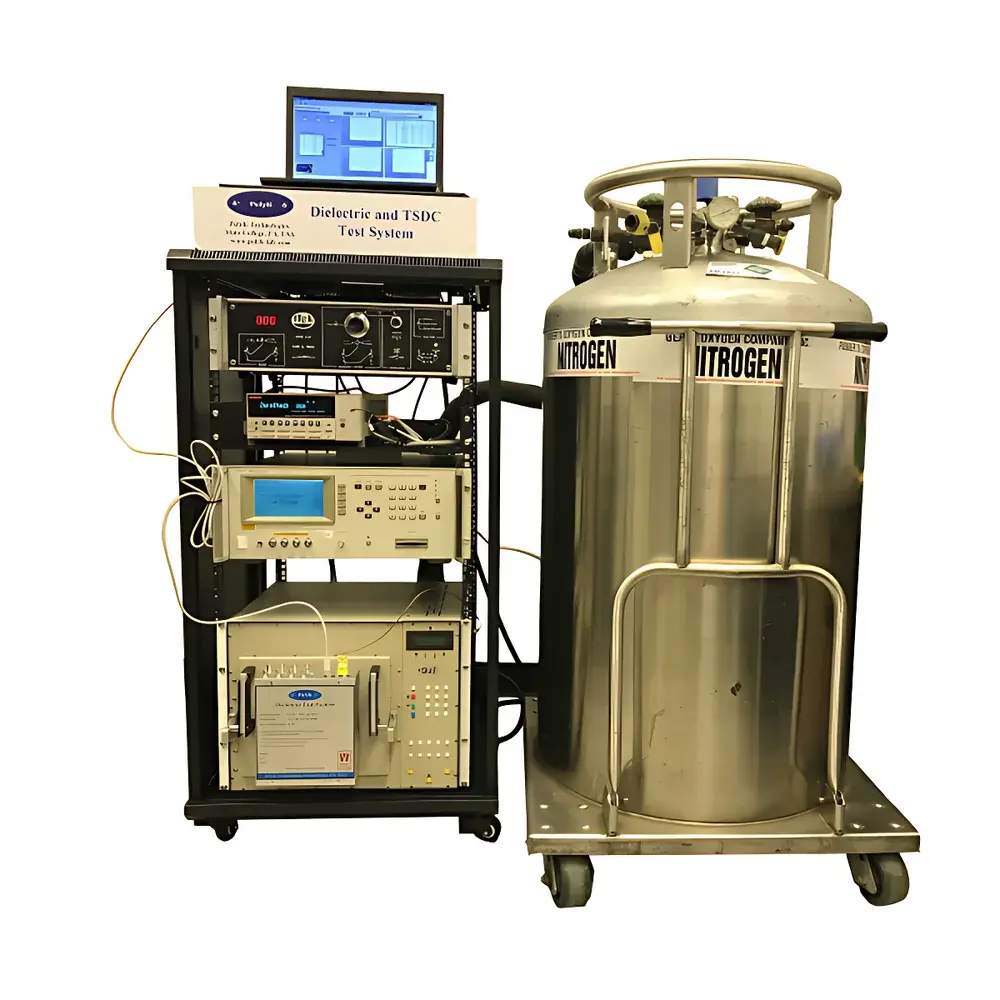
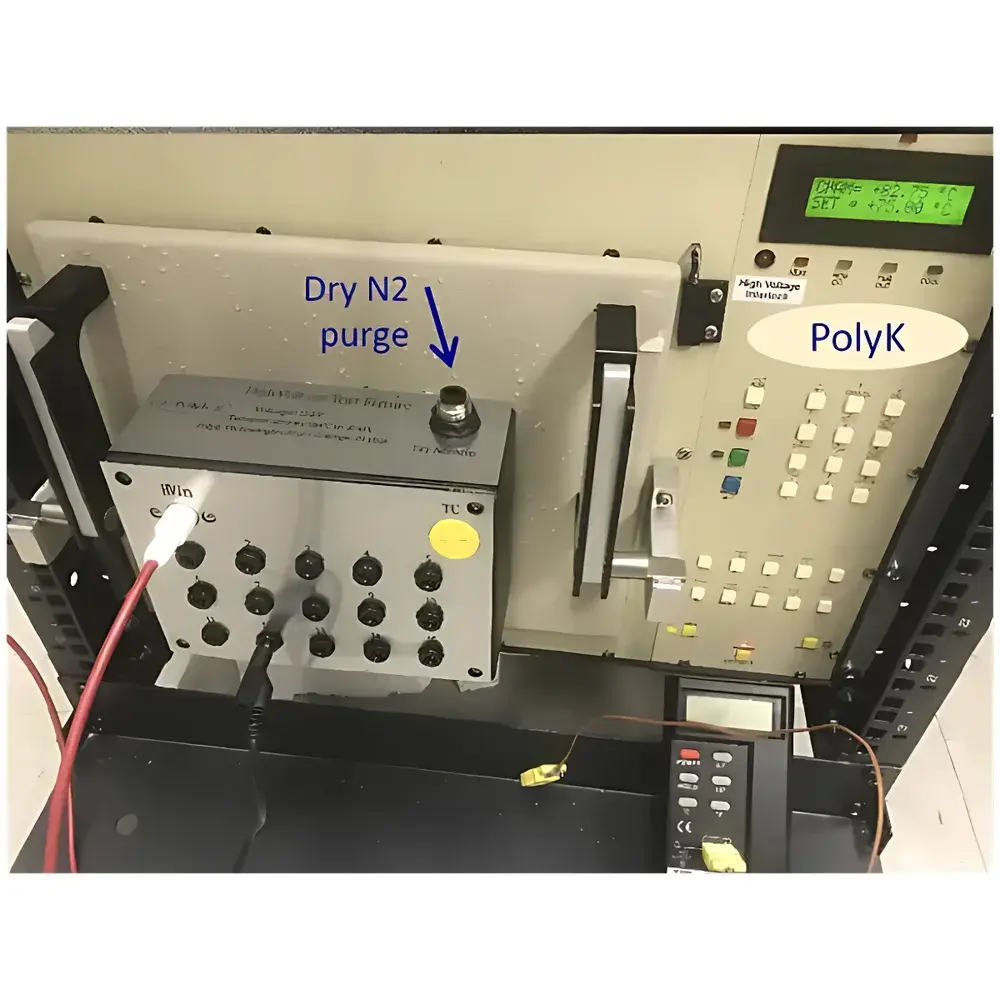
PolyK CPT1706 Low-Temperature Broadband Dielectric Measurement System
| Brand | PolyK Technologies |
|---|---|
| Origin | USA |
| Model | CPT1706 |
| Voltage Range | ±4000 V |
| Current Range | ±20 mA |
| Frequency Range | 100 Hz – 1 MHz |
| Capacitance Range | 100 pF – 100 nF |
| Temperature Range | −184 °C to 250 °C |
| Optional Cryo-Free Chamber | −75 °C to 200 °C |
| Optional High-Temp Chamber | RT to 1000 °C |
| Optional Extended Frequency | 0.01 Hz – 110 MHz (dependent on integrated impedance analyzer) |
Overview
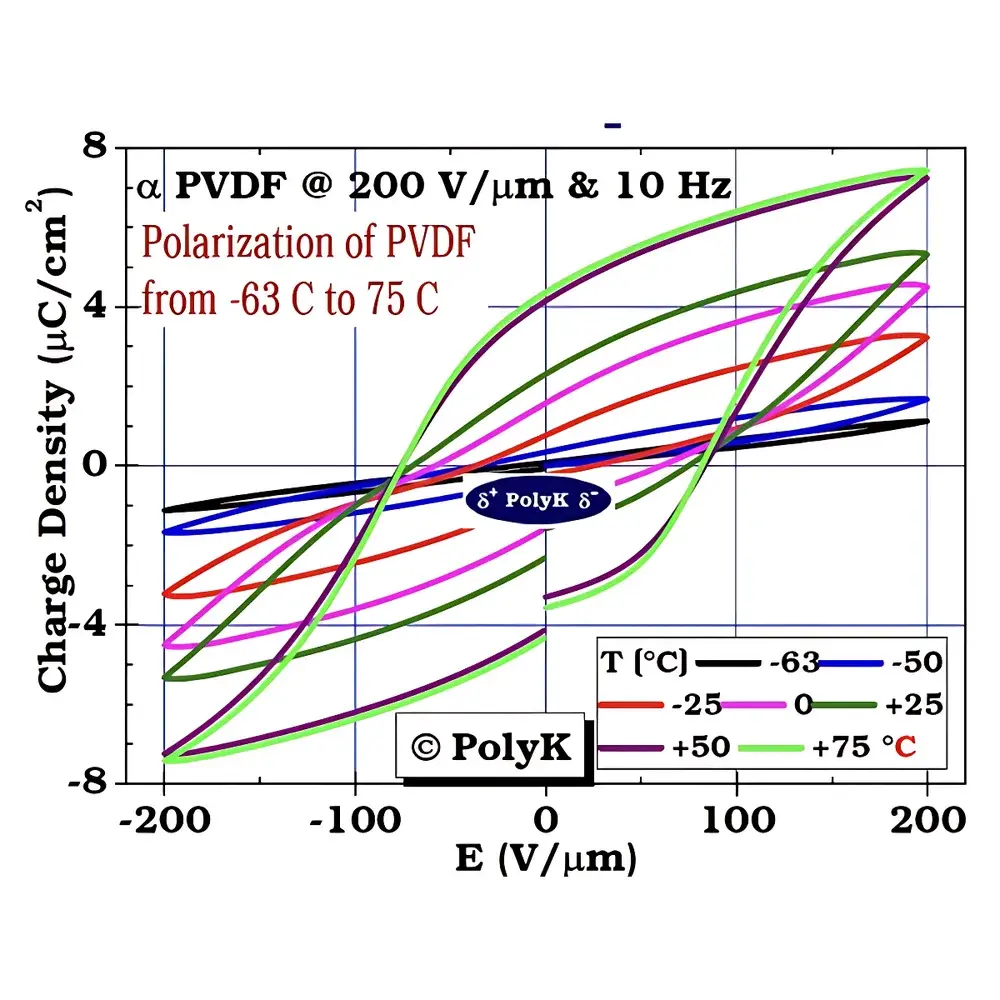
The PolyK CPT1706 Low-Temperature Broadband Dielectric Measurement System is an engineered solution for characterizing nonlinear dielectric behavior of functional materials under high electric field, controlled temperature, and broad frequency excitation. Unlike conventional LCR meters or impedance analyzers—typically limited to low-amplitude AC signals (e.g., 1 Vrms)—the CPT1706 integrates a high-voltage, high-current signal conditioning architecture with precision thermal control to enable true in-situ dielectric spectroscopy under application-relevant bias conditions. Its operational principle is based on guarded four-terminal impedance measurement combined with synchronized high-voltage AC/DC bias superposition, enabling stable acquisition of complex permittivity (ε* = ε′ − jε″) and loss tangent (tan δ) across wide dynamic ranges. This system is specifically designed for materials where dielectric response exhibits strong field dependence—such as piezoelectric ceramics (e.g., PZT), ferroelectric polymers (e.g., PVDF-TrFE), multilayer ceramic capacitors (MLCCs), and high-k thin films—where performance at >10 V/µm or even >100 V/µm fields governs real-world reliability and efficiency.
Key Features
- High-voltage AC/DC bias capability: ±4000 V DC or peak AC voltage with active current limiting up to ±20 mA, ensuring safe operation during dielectric breakdown events.
- Broadband frequency coverage: Standard 100 Hz – 1 MHz range; optionally extendable to 0.01 Hz – 110 MHz via integration with compatible impedance analyzers (e.g., Keysight E4990A, Solartron 1260A).
- Cryogenic-to-high-temperature environmental control: Base configuration supports −184 °C to 250 °C using closed-cycle helium refrigeration and resistive heating; optional cryo-free chamber (−75 °C to 200 °C) eliminates liquid nitrogen dependency.
- High-fidelity capacitance measurement: Optimized for 100 pF – 100 nF sample range with sub-0.1% amplitude accuracy and phase resolution <0.01°.
- Guarded electrode interface with triaxial cabling: Minimizes stray capacitance and leakage current errors, critical for high-resistivity or thin-film samples.
- Modular architecture: Supports optional large-signal AC excitation unit for harmonic distortion analysis and field-dependent permittivity mapping.
Sample Compatibility & Compliance
The CPT1706 accommodates standard parallel-plate, interdigitated electrode (IDE), and coaxial fixture configurations for bulk ceramics, polymer films, sputtered thin films, and wafer-level devices. Sample holders are vacuum-compatible and configurable for controlled-atmosphere testing (e.g., dry N2, O2, or forming gas). The system complies with ASTM D150 (Standard Test Methods for Dielectric and Resistivity Properties of Solid Electrical Insulating Materials) and ISO 257-3 (Plastics — Determination of the dielectric properties — Part 3: Determination of dielectric loss factor and permittivity). Data acquisition workflows support audit-ready metadata tagging per GLP/GMP requirements, and optional software modules provide 21 CFR Part 11–compliant electronic signatures and full audit trails.
Software & Data Management
PolyK’s proprietary DielectricStudio™ software provides real-time instrument control, multi-parameter sweep sequencing (field, frequency, temperature), and automated data reduction. It enables simultaneous acquisition of ε′(f,E,T), ε″(f,E,T), tan δ(f,E,T), and conductivity spectra σ*(f,E,T). Export formats include CSV, HDF5, and MATLAB .mat for post-processing in third-party platforms (e.g., Python SciPy, OriginPro). All raw and processed datasets are time-stamped, version-controlled, and linked to experimental metadata—including calibration history, sensor status, and environmental logs—to ensure traceability and reproducibility.
Applications
- Field-dependent permittivity mapping of relaxor ferroelectrics and antiferroelectrics for energy storage capacitor development.
- Low-temperature dielectric relaxation studies of polymer electrolytes in solid-state batteries (−100 °C to 80 °C).
- High-field aging and breakdown precursor analysis in gate oxides and high-k dielectrics.
- Phase transition characterization (e.g., Curie point, glass transition) via temperature-dependent dielectric spectroscopy under bias.
- Quality assurance of MLCC stacks and embedded passive components under operational field stress.
- Validation of computational models (e.g., Landau-Ginzburg-Devonshire, dipole-glass theory) against experimental ε*(E,f,T) datasets.
FAQ
Can the CPT1706 be used with third-party impedance analyzers?
Yes—the system features IEEE-488 (GPIB), USB-TMC, and Ethernet (VXI-11) interfaces for seamless integration with Keysight, Zurich Instruments, or Solartron analyzers.
Is liquid nitrogen required for cryogenic operation?
No—standard configuration uses a closed-cycle helium cryocooler; liquid nitrogen is only needed if the optional ultra-low-temperature extension (to −184 °C) is selected.
How does the system protect the impedance analyzer during dielectric breakdown?
An active current-limiting circuit and fast-response HV crowbar disconnect the analyzer within <1 µs upon detecting overcurrent, isolating it from fault energy.
Does the system support time-domain dielectric spectroscopy (TDDS)?
Yes—when paired with optional time-domain modules, it enables direct measurement of polarization current transients and extraction of relaxation time distributions.
Are calibration standards included?
Yes—NIST-traceable air-gap, SiO₂, and SrTiO₃ reference standards are supplied with each system, along with fixture-specific calibration kits.



