
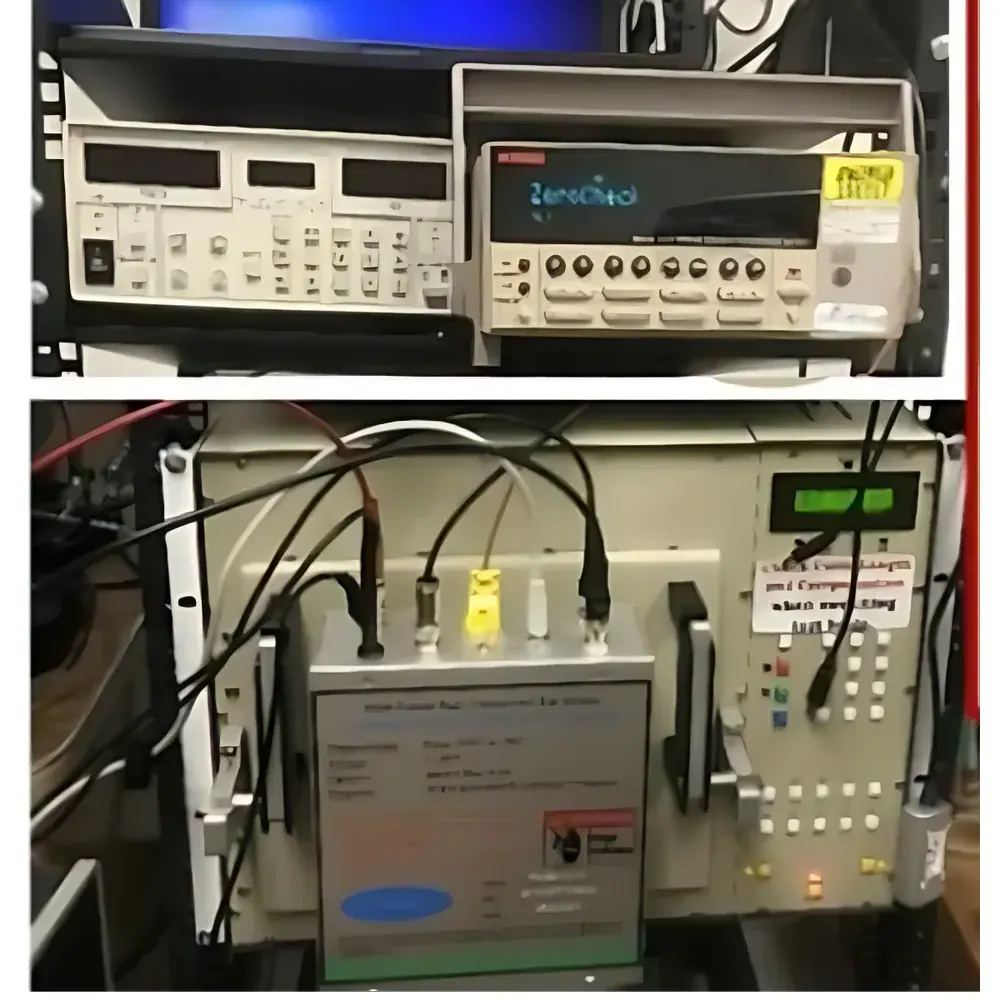
PolyK PK-Pyro Pyroelectric Property Tester
| Brand | PolyK Technologies |
|---|---|
| Origin | USA |
| Model | PK-Pyro |
| Temperature Range | −184 °C to >300 °C (with liquid nitrogen cooling) |
| Current Measurement Sensitivity | down to 1 pA |
| Maximum Electric Field | >100 V/µm (air-gap configuration) |
| Sample Diameter | up to 8 cm |
| Electrode Configuration | spring-loaded spherical electrodes |
| Shielding | fully enclosed, grounded Faraday cage enclosure |
| Compliance | ASTM D257, ASTM D877, IEC 60243-1, ISO 60243-1 |
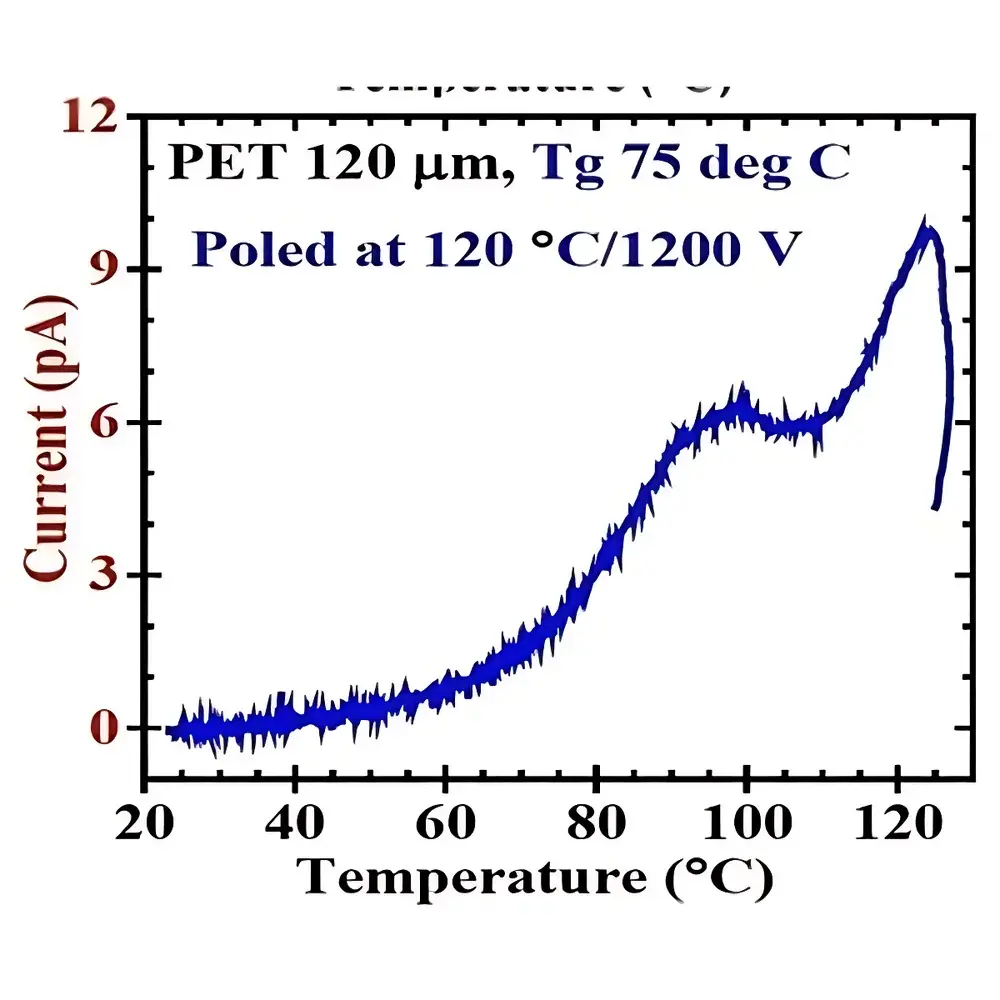
| Measurement Modes | pyroelectric current, leakage current, thermally stimulated depolarization current (TSDC) |
Overview
The PolyK PK-Pyro Pyroelectric Property Tester is a purpose-engineered, high-precision instrumentation platform designed for quantitative characterization of pyroelectric, leakage, and thermally stimulated depolarization currents in dielectric thin films—particularly polymer-based capacitive materials operating under extreme electrothermal stress. Unlike conventional dielectric constant meters or basic resistivity testers, the PK-Pyro implements a physics-consistent measurement architecture grounded in fundamental polarization dynamics: it directly resolves transient pyroelectric current (dP/dt) induced by controlled thermal perturbations, while simultaneously enabling stable, low-noise DC leakage current acquisition at electric fields exceeding 100 V/µm—conditions representative of real-world high-energy-density capacitor operation. Its design explicitly addresses critical limitations in standard ASTM D257-compliant resistivity testing, where short-duration (<60 s), low-field (<1 V/µm) measurements fail to capture field-activated conduction mechanisms (e.g., Poole–Frenkel emission, trap-assisted tunneling) that dominate under service conditions. By integrating cryogenic temperature control, ultra-low-current metrology, and air-gap high-voltage biasing, the PK-Pyro delivers reproducible, traceable data under application-relevant stress states.
Key Features
- Sub-picoampere current resolution (≤1 pA) achieved via Keithley 6517B (or 6514) electrometer with triaxial guarding and optimized low-noise cabling
- High-voltage sourcing up to ±10 kV using SRS PS350 or Trek 610E amplifiers, calibrated and certified for stability over extended duration (>20 h)
- Cryogenic-to-high-temperature operation from −184 °C (liquid nitrogen) to >300 °C, with programmable ramp rates and isothermal hold capability
- Hermetically sealed, double-walled Faraday cage enclosure with RF-tight gasketed access door and internal insulated sample stage
- Spring-loaded spherical electrode assembly ensuring uniform contact pressure on fragile polymer films (<10 µm thickness) without mechanical deformation or puncture
- Modular chamber architecture compatible with optional dielectric spectroscopy (impedance analyzer integration) and AC/DC breakdown testing configurations
- Full electromagnetic interference (EMI) mitigation: shielded power supplies, optical signal isolation, and grounded copper mesh lining throughout the test cavity
Sample Compatibility & Compliance
The PK-Pyro accommodates circular dielectric specimens up to 8 cm in diameter and thicknesses ranging from 100 nm to 200 µm—including biaxially oriented polypropylene (BOPP), polyethylene naphthalate (PEN), polyimide (PI), and ceramic-polymer composites. Its air-gap electrode configuration eliminates dielectric fluid contamination risks and enables direct assessment of intrinsic film breakdown strength. All electrical safety and measurement protocols conform to ASTM D257 (DC resistance of insulating materials), ASTM D877 (dielectric breakdown voltage of insulating oils—adapted for solid-film air-gap validation), IEC 60243-1 (electric strength of insulating materials), and ISO 60243-1. The system supports GLP-compliant audit trails when integrated with validated LabVIEW-based control software, including timestamped parameter logging, operator ID tagging, and electronic signature support per FDA 21 CFR Part 11 requirements.
Software & Data Management
Control and analysis are executed through a modular LabVIEW-based application suite with deterministic real-time loop timing (≤10 ms loop period). The software provides synchronized acquisition of temperature, voltage, current, and time-stamped thermal ramp profiles. Raw pA-level current waveforms are stored in HDF5 format with embedded metadata (calibration coefficients, sensor IDs, environmental timestamps). Post-processing modules include baseline drift correction, numerical differentiation for pyroelectric coefficient (p = dP/dT) extraction, Arrhenius and Poole–Frenkel fitting routines, and TSDC deconvolution using Gaussian or exponential trap distribution models. Export options include CSV, MATLAB .mat, and PDF report generation with customizable templates aligned to internal QA documentation standards.
Applications
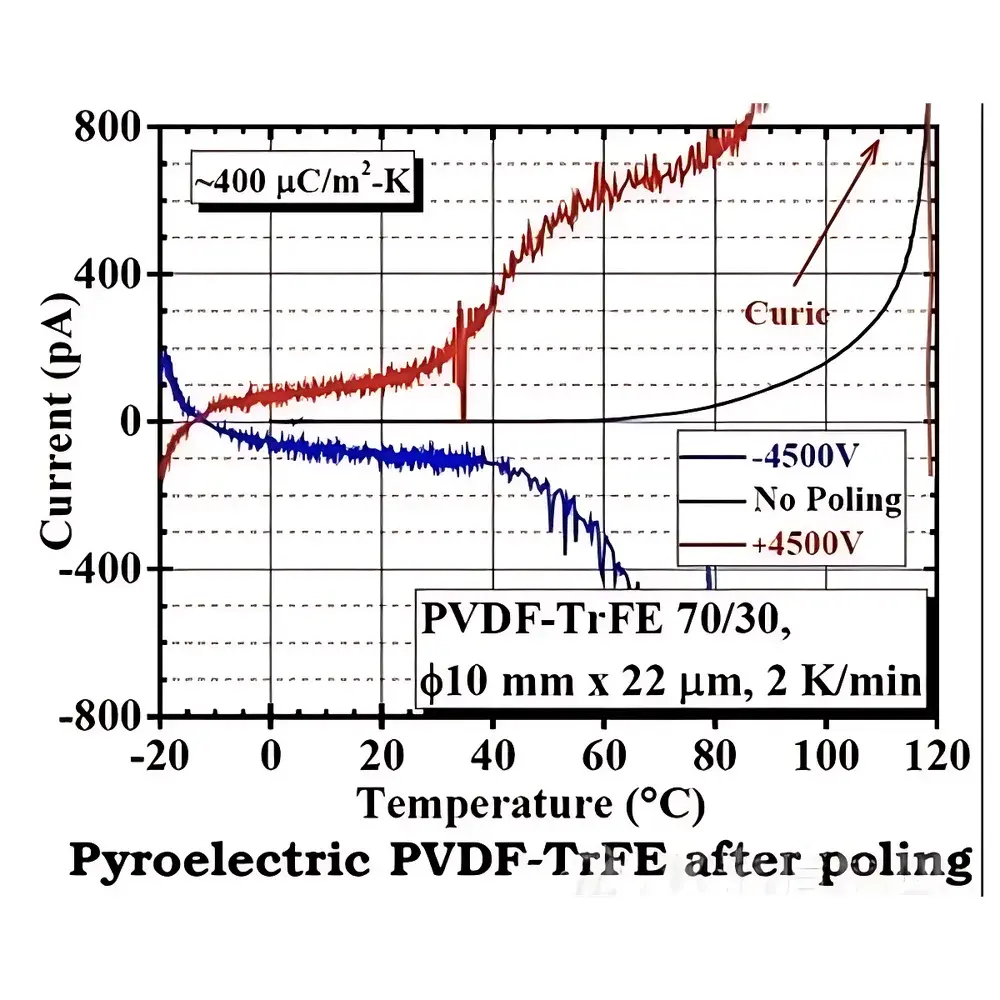
- Quantification of pyroelectric coefficients in ferroelectric polymers (e.g., PVDF-TrFE) for infrared sensor development
- Leakage current mapping across electric field (1–200 V/µm) and temperature (−150 °C to 250 °C) domains to model conduction mechanisms in pulse-power capacitor dielectrics
- TSDC analysis to resolve trap energy depth (0.3–2.0 eV) and density in space-charge-limited transport regimes
- Accelerated aging studies under combined high-field/high-temperature stress to predict lifetime in DC-link and snubber capacitor applications
- Material screening for next-generation high-temperature (>150 °C) automotive and aerospace power electronics
- Validation of surface passivation efficacy on metalized polymer film electrodes
FAQ
What is the minimum measurable pyroelectric current with the PK-Pyro system?
The system achieves a noise floor of ≤0.5 pA RMS over 10 s integration time, enabling reliable detection of pyroelectric signals from sub-100 nm-thick PVDF films under 0.5 °C/s thermal ramps.
Can the PK-Pyro perform simultaneous pyroelectric and leakage current measurements?
Yes—the dual-channel acquisition architecture allows concurrent recording of thermal-step-induced pyroelectric transients and steady-state DC leakage under identical bias and thermal conditions.
Is liquid nitrogen handling automated or manual?
LN₂ delivery is manually refilled; however, the cryostat includes level sensors, auto-shutoff valves, and PID-regulated cold-head coupling to maintain stable sub-ambient temperatures without operator intervention during long-term runs.
Does the system support custom electrode geometries beyond the standard sphere-plane configuration?
Yes—modular electrode holders accept interchangeable probes, including guarded parallel plates and interdigitated electrodes, subject to chamber clearance and shielding validation.
How is calibration traceability maintained for current and voltage measurements?
Keithley 6517B units are factory-calibrated annually per NIST-traceable procedures; high-voltage sources are verified using Fluke 8508A multimeter with HV probe (1000:1 ratio, ±0.1% accuracy). Calibration certificates are archived with each test sequence.



