
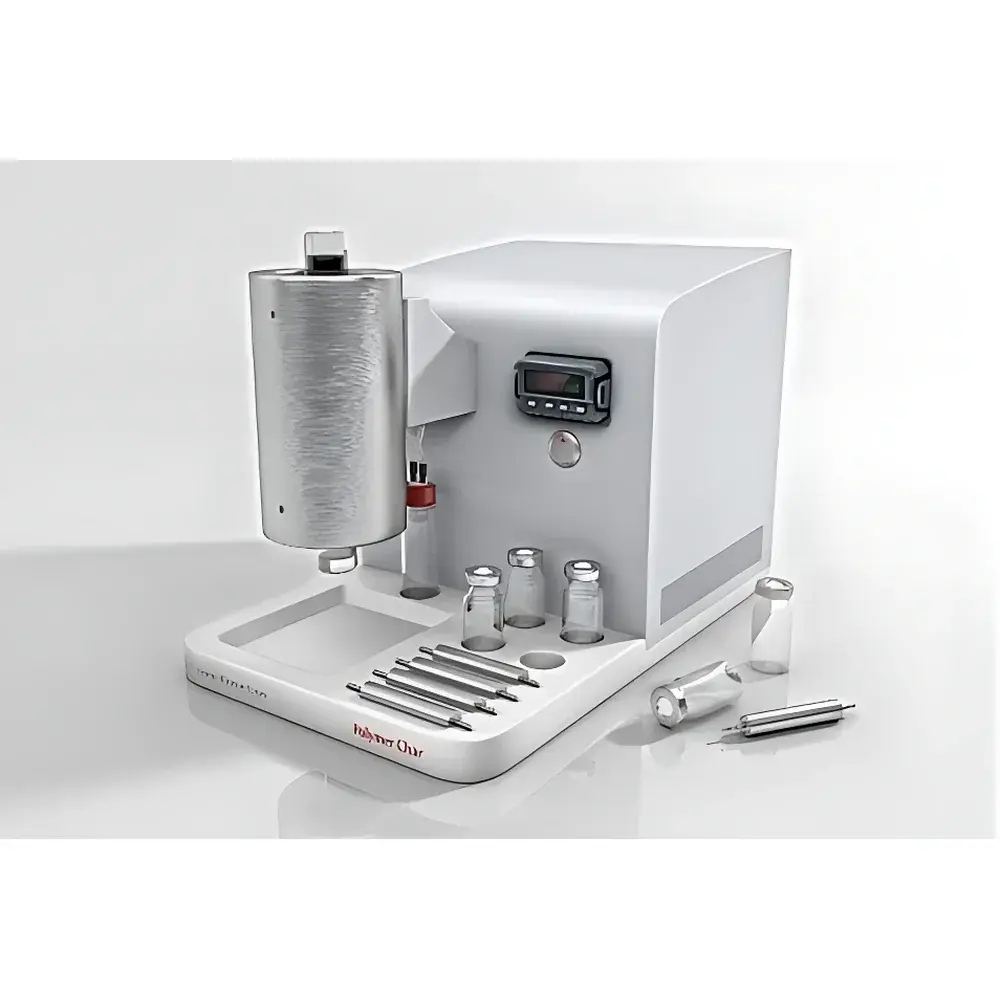
Polymer Char EFS Automated External Filtration System for Polymer Solutions
| Brand | Polymer Char |
|---|---|
| Origin | Spain |
| Manufacturer Type | Authorized Distributor |
| Origin Category | Imported |
| Model | EFS |
| Pricing | Available Upon Request |
Overview
The Polymer Char EFS Automated External Filtration System is an engineered solution designed to remove insoluble particulates—such as carbon black, masterbatch pigments, talc, calcium carbonate, and other micron-scale additives—from polymer solutions prior to gel permeation chromatography (GPC), also known as size exclusion chromatography (SEC), or light scattering analysis. Unlike manual syringe filtration or centrifugation, the EFS employs a programmable, pressure-driven, inline filtration protocol that integrates seamlessly with existing GPC/SEC autosamplers and solvent delivery systems. Its operation is based on controlled flow-through membrane filtration under inert atmosphere conditions, minimizing oxidative degradation and ensuring sample integrity. By eliminating particulate contaminants before column injection, the EFS directly addresses four critical analytical failure modes: irreversible GPC column fouling, capillary and detector cell clogging, premature inline filter exhaustion, and elevated baseline noise in multi-angle light scattering (MALS) or refractive index (RI) detectors. This pre-analytical step is essential for achieving high-resolution molecular weight distributions, accurate branching quantification, and long-term system stability in regulated and research-grade polymer laboratories.
Key Features
- Fully automated, walk-away operation: Pre-programmed filtration cycles—including priming, sample loading, pressure-controlled filtration, and post-run flush—are executed without user intervention.
- Integrated pressure regulation: Maintains consistent transmembrane pressure (typically 1–3 bar) across varying solvent viscosities and particle loadings, ensuring reproducible retention of sub-5 µm particulates.
- Chemically resistant fluid path: Constructed from PEEK, stainless steel (316L), and fluoropolymer-sealed components compatible with chlorinated solvents (e.g., trichlorobenzene), THF, and o-dichlorobenzene at elevated temperatures (up to 160 °C).
- Zero solvent evaporation design: Closed-loop architecture with sealed vial handling and inert gas purging complies with occupational health and safety (HSE) requirements and prevents concentration drift during filtration.
- Minimal sample loss and contamination risk: Eliminates manual transfer steps; filtration occurs directly from original dissolution vials into GPC autosampler vials, preserving quantitative recovery (>98% typical for 1–5 mL samples).
- Modular integration: Designed for direct coupling with Polymer Char IR4, IR5, or third-party GPC systems via standard 1/16″ PTFE tubing and female Luer-lock interfaces.
Sample Compatibility & Compliance
The EFS accommodates common polymer dissolution matrices including polyolefins (PP, PE), styrenics (PS, ABS), engineering thermoplastics (PC, PBT), and elastomers dissolved in high-boiling-point solvents. It supports filtration of samples containing up to 5 wt% insoluble content without flow interruption. The system conforms to ISO 16014-4:2019 (GPC of polymers), ASTM D5296 (standard test method for molecular weight averages of polystyrene by SEC), and aligns with GLP-compliant laboratory practices through audit-trail-capable method logging (via optional Ethernet-connected controller). All wetted materials meet USP Class VI biocompatibility criteria, and the system can be validated per IQ/OQ protocols for regulated environments operating under FDA 21 CFR Part 11 and EU Annex 11 requirements.
Software & Data Management
Controlled via Polymer Char’s proprietary EFS Manager software (Windows-based), the system records timestamped event logs—including filtration duration, applied pressure, volume processed, and error flags—for each run. Method files are digitally signed and version-controlled, supporting traceability in quality-controlled workflows. Exportable CSV reports include raw pressure vs. time profiles and cumulative filtrate volume metrics. Optional integration with Laboratory Information Management Systems (LIMS) is available through OPC UA or REST API endpoints, enabling automatic metadata synchronization with chromatographic data systems (e.g., Empower, Chromeleon).
Applications
- Routine QC of industrial polyolefin resins containing carbon black stabilizers or pigment masterbatches.
- Research-grade characterization of branched polyethylenes using triple-detection SEC-MALS-RI.
- Pre-filtration for high-sensitivity viscometry or dielectric spectroscopy where particulate-induced signal artifacts must be excluded.
- Method development labs validating ASTM D6477 (carbon black content in rubber compounds) where solution clarity directly impacts UV-Vis quantitation accuracy.
- GMP-compliant polymer release testing requiring documented particulate removal prior to final molecular weight certification.
FAQ
What membrane pore sizes are supported by the EFS?
Standard configurations use 0.45 µm or 0.22 µm hydrophobic PTFE membranes; custom pore sizes (0.1 µm, 1.0 µm) are available upon request.
Can the EFS be used with thermally unstable polymers?
Yes—the system operates at ambient temperature by default; heated modules (up to 80 °C) are optional for viscosity-sensitive samples.
Is method validation documentation provided?
Polymer Char supplies IQ/OQ templates, material compatibility charts, and pressure calibration certificates compliant with ISO/IEC 17025 requirements.
How often does the filtration module require maintenance?
Under typical lab use (20–30 samples/day), the disposable filtration cartridge is replaced every 200–300 runs; pump seals and pressure sensors are rated for >10,000 cycles.
Does the EFS support unattended overnight operation?
Yes—integrated leak detection, overpressure shutoff, and low-solvent alerts enable fully autonomous batch processing with no operator supervision required.





