
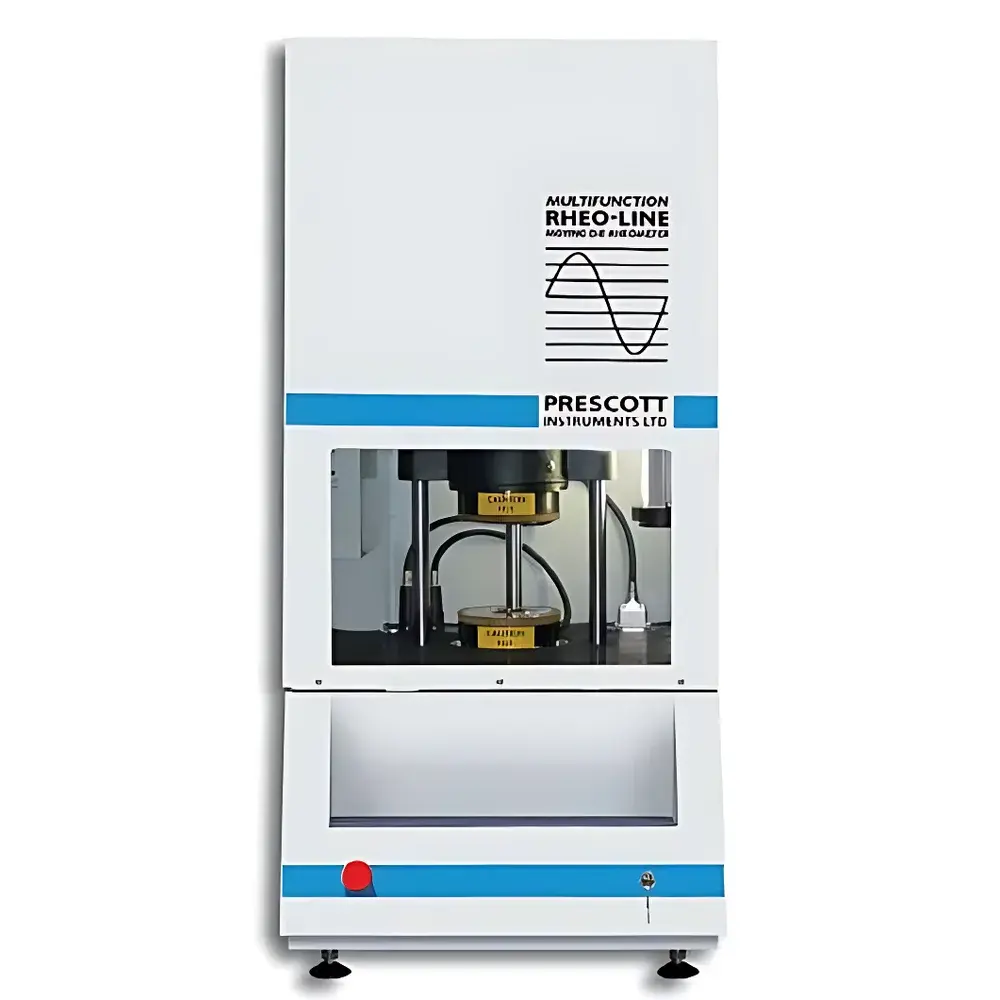
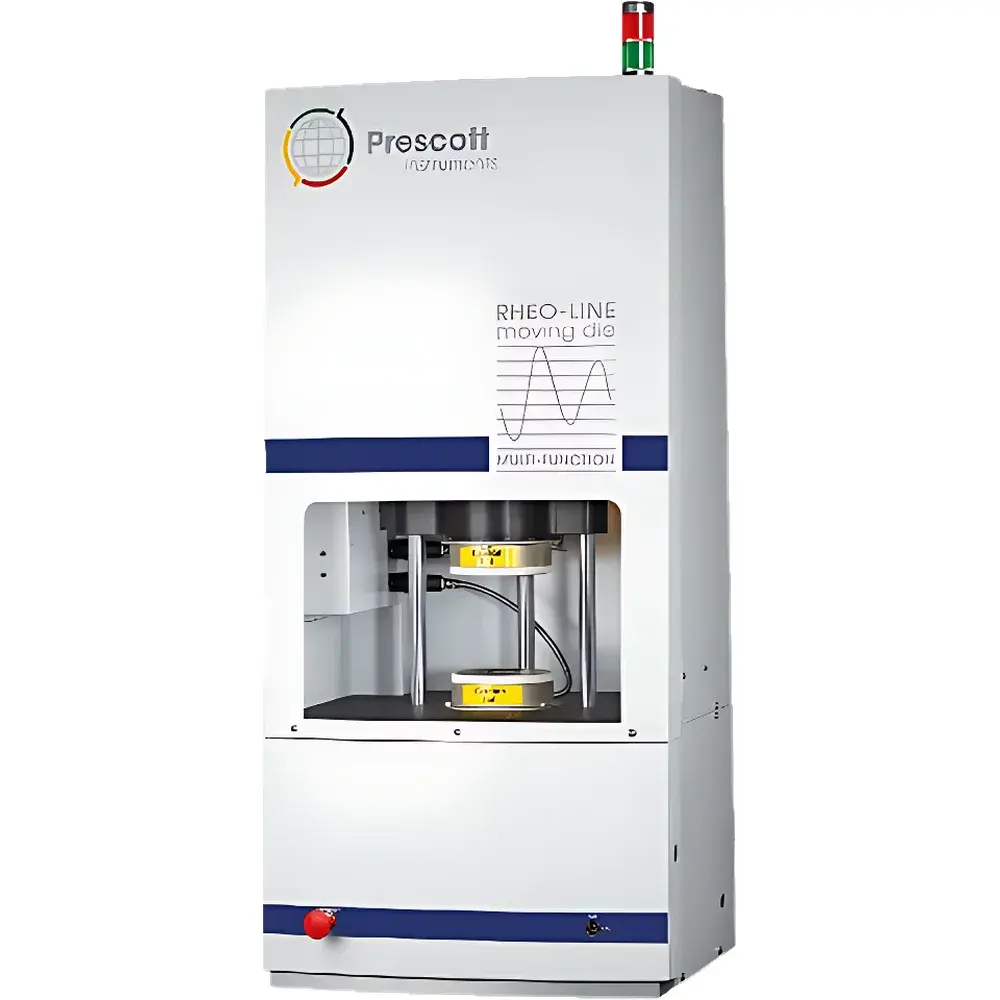
Prescott Rheo-Line MFR Multifunctional Rubber Processing Analyzer
| Brand | Prescott |
|---|---|
| Origin | United Kingdom |
| Model | Rheo-Line MFR |
| Compliance | ASTM D5289, ASTM D6204, ASTM D6601 |
| Cavity Type | Dual-cone, fully sealed |
| Cavity Gap | 0.45 mm (nominal) |
| Torque Measurement | Top platen-mounted torque transducer |
| Closure System | Flexible closure mechanism to prevent film rupture and sample distortion |
| Temperature Control | 3-zone PID, ±0.03 °C accuracy |
| Drive System | High-performance servo motor with aerospace-grade digital servo controller |
| Frequency Range | 0.01–40 Hz |
| Strain Amplitude Range | 1%–200% |
| Torque Calibration | Precision torque spring |
| Power Supply | 220 V AC, 50 Hz, single-phase |
| Pneumatic Requirement | 4.2 kg/cm² (60 psi) |
| Torque Units | in·lb or N·m (user-selectable) |
| Temperature Units | °C / °F |
| Pressure Units | psi / kg/cm² (configurable) |
| Time Format | min/sec, min/decimal, sec |
| Data Export | Universal ASCII/CSV format compatible with SQL, LabVIEW, MATLAB, and LIMS platforms |
| Host PC Requirements | Pentium-class processor, Ethernet interface |
| Optional Accessories | Automated sample loader, volumetric sample cutter |
Overview
The Prescott Rheo-Line MFR Multifunctional Rubber Processing Analyzer is a precision-engineered rotational rheometer specifically designed for comprehensive characterization of uncured, curing, and cured rubber compounds. Operating on the principle of controlled-strain oscillatory shear within a sealed dual-cone cavity, the instrument delivers high-fidelity viscoelastic data under isothermal, frequency-sweep, strain-sweep, or temperature-ramp conditions. Unlike conventional moving-die rheometers (MDR), the Rheo-Line MFR integrates advanced digital servo control and real-time torque transduction to enable simultaneous acquisition of dynamic mechanical parameters—including storage torque (S′), loss torque (S″), complex torque (S*), pressure (P), loss angle (δ), storage shear modulus (G′), loss shear modulus (G″), complex shear modulus (G*), tan δ, complex dynamic viscosity (η*), and real dynamic viscosity (η′). Its architecture supports full traceability and compliance with international testing standards governing rubber processing and vulcanization behavior.
Key Features
- Triple-mode operational capability: functions as a low-temperature processing analyzer, standard MDR per ASTM D5289, and post-cure dynamic mechanical analyzer per ASTM D6601.
- Dual-cone, fully sealed cavity with nominal 0.45 mm gap—optimized for minimal wall slip and representative bulk deformation of high-viscosity elastomers.
- Top-platen-mounted torque transducer with spring-based calibration traceable to NPL (UK) reference standards.
- Flexible pneumatic closure system (4.2 kg/cm² / 60 psi) ensures uniform sample confinement without edge tearing or axial misalignment.
- Three-zone PID temperature control delivering ±0.03 °C stability across the full operating range (typically 30–200 °C), critical for reproducible scorch and cure kinetics.
- Wide dynamic range: 0.01–40 Hz frequency sweep and 1–200% strain amplitude—enabling linear viscoelastic region (LVR) identification and nonlinear response mapping.
- Aerospace-grade digital servo controller with real-time feedback loop ensures precise angular displacement and velocity tracking during oscillatory and step tests.
Sample Compatibility & Compliance
The Rheo-Line MFR accommodates raw compound batches (NR, SBR, BR, EPDM, fluoroelastomers), masterbatches, and post-vulcanized specimens up to 12 g. Its sealed cavity design prevents volatile loss and oxidation during extended cure profiling. The system meets the mechanical and procedural requirements of ASTM D5289 (standard MDR test), ASTM D6204 (non-vulcanizing compound processability), and ASTM D6601 (dynamic mechanical analysis of vulcanized rubber). All torque, temperature, pressure, and time data are timestamped and logged with audit-trail metadata, supporting GLP-compliant reporting and FDA 21 CFR Part 11–ready electronic records when integrated with validated laboratory information management systems (LIMS).
Software & Data Management
The instrument operates via Windows-based RheoControl software, offering preconfigured test templates (MDR, frequency sweep, strain sweep, temperature ramp) and full user-defined protocol scripting. All raw and derived parameters—including G′, G″, tan δ, and η*—are computed in real time and stored in ASCII/CSV format. Exported datasets include column headers, units, and measurement timestamps, ensuring seamless ingestion into statistical process control (SPC) platforms, MATLAB, Python (pandas), or enterprise databases (SQL Server, Oracle). Software supports configurable report generation with embedded pass/fail criteria aligned with internal QC specifications or ISO 9001 documentation requirements.
Applications
- Scorch safety evaluation and optimal cure time (t90) determination for compound development.
- Processing window assessment via low-strain oscillatory tests at elevated temperatures (e.g., 100–140 °C).
- Dynamic mechanical spectroscopy of vulcanizates to correlate crosslink density, filler dispersion, and polymer network heterogeneity with service performance.
- Quality assurance of incoming raw materials and batch-to-batch consistency monitoring in tire, conveyor belt, and sealing component manufacturing.
- Research into thermally induced degradation, reversion behavior, and fatigue resistance through time–temperature superposition (TTS) analysis.
FAQ
What standards does the Rheo-Line MFR comply with?
ASTM D5289 (MDR), ASTM D6204 (uncured compound processing), and ASTM D6601 (cured rubber DMA) — all implemented with documented test method validation protocols.
Can the instrument perform both cure and dynamic mechanical testing on the same sample?
Yes — sequential isothermal cure followed by post-cure oscillatory testing is supported using the same specimen, minimizing inter-sample variability.
Is torque calibration traceable to national standards?
Yes — factory calibration uses NPL-traceable torque springs; field recalibration kits and procedures are provided.
What data export formats are supported?
ASCII/CSV with header metadata; no proprietary binary formats — fully interoperable with third-party analytics tools and LIMS.
Does the system support automated sample handling?
Optional accessories include an automated sample loader and volumetric cutter, enabling unattended operation for high-throughput QC labs.




