
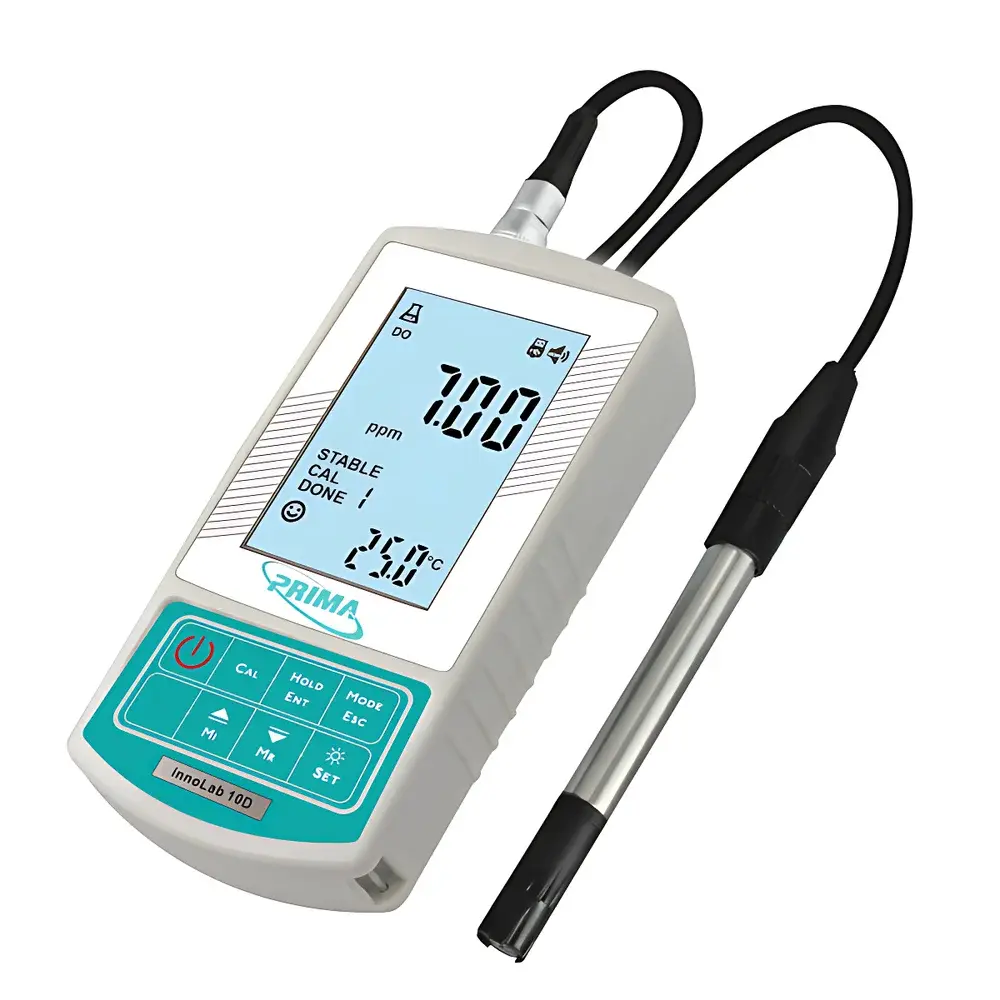
PRIMA innoLab 10D Portable Dissolved Oxygen Meter
| Brand | PRIMA (UK) |
|---|---|
| Origin | Taiwan |
| Model | innoLab 10D |
| Instrument Type | Portable/HANDHELD Water Quality Analyzer |
| Measured Parameters | Dissolved Oxygen (DO), mg/L and % Saturation |
| Measurement Range | 0.00–40.00 mg/L, 0.0–400.0% sat |
| Temperature | −5.0–120.0°C / 23.0–248.0°F |
| Resolution | 0.01 mg/L, 0.1% sat, 0.1°C/0.1°F |
| Accuracy | ±1.5% F.S. (DO), ±0.3°C / ±0.5°F (Temp) |
| Calibration | Manual 1-point or 2-point (air-saturated water or zero-oxygen solution) |
| Salinity Compensation | 0.0–45.0 ppt (manual input) |
| Atmospheric Pressure Compensation | 450–800 mmHg / 0.600–1.100 bar (manual input) |
| Depth Compensation | 0.0–10.0 m (liquid level) |
| Memory Capacity | 100 data sets |
| Auto Power-Off | After 10 min inactivity |
| Power Supply | 2 × AA batteries |
| Enclosure Rating | IP67 |
| Dimensions | 73 × 152 × 42 mm |
| Weight | 250 g |
Overview
The PRIMA innoLab 10D is a rugged, field-deployable dissolved oxygen (DO) meter engineered for reliable, on-site measurement of aqueous oxygen concentration across environmental, aquacultural, wastewater, and educational applications. It operates on the electrochemical principle—supporting interchangeable galvanic (fuel-cell) and Clark-type polarographic DO sensors—to deliver stable, low-drift readings under variable thermal and hydrostatic conditions. Unlike benchtop analyzers requiring fixed installations, the innoLab 10D integrates real-time environmental compensation logic directly into its firmware: automatic temperature compensation (ATC), user-configurable salinity correction, atmospheric pressure adjustment, and depth-based hydrostatic pressure offset—all essential for achieving metrologically traceable DO values in natural waters where ionic strength, elevation, and column height significantly influence oxygen solubility. Its compact form factor and IP67-rated housing ensure operational integrity during extended outdoor deployments, including stream surveys, pond monitoring, and effluent discharge verification.
Key Features
- Electrochemical sensing architecture compatible with both galvanic and Clark-type DO electrodes—enabling flexible sensor selection based on response time, maintenance requirements, and application longevity.
- High-contrast, wide-view LCD display (120° viewing angle) with adjustable high-brightness backlight for legibility under direct sunlight or low-light field conditions.
- Dual-unit reporting: simultaneous or toggle-enabled display of DO as concentration (mg/L or ppm) and percent saturation (% sat), supporting both regulatory reporting and biological interpretation.
- Comprehensive environmental compensation suite: manual entry of salinity (0.0–45.0 ppt), barometric pressure (450–800 mmHg), and liquid depth (0.0–10.0 m), with automatic application to raw sensor output per ISO 5814 and ASTM D888 calculation protocols.
- Real-time electrode health diagnostics: on-screen visualization of offset (zero-current deviation) and slope (sensitivity calibration coefficient), enabling proactive sensor validation prior to critical measurements.
- Configurable acoustic feedback (keypad beep), HOLD function for stabilized reading capture, and user-selectable auto-off delay (10 minutes default) to conserve battery life without compromising workflow continuity.
- Robust mechanical design: sealed IP67 enclosure, impact-resistant polycarbonate housing, and 250 g mass optimized for single-hand operation during boat-based or bank-side sampling.
Sample Compatibility & Compliance
The innoLab 10D is validated for use with freshwater, seawater, brackish systems, activated sludge, aquaculture tanks, and surface runoff samples. Its sensor interface supports standardized BNC or mini-DIN connectors per IEC 60068-2 environmental test specifications. While not certified for GMP or FDA 21 CFR Part 11 compliance out-of-the-box, its calibration traceability, audit-ready parameter logging (100-point memory with timestamp-equivalent sequence indexing), and documented compensation algorithms align with GLP-aligned field data collection practices. The instrument adheres to ISO 5814:2012 (water quality — determination of dissolved oxygen — electrochemical probe method) and supports method adaptation per US EPA Method 360.1 and APHA Standard Method 4500-O G.
Software & Data Management
Data acquisition is fully self-contained: no PC connectivity or proprietary software required. All 100 stored measurements retain associated environmental context—temperature, entered salinity, pressure, and depth—though timestamps are sequential rather than RTC-synchronized. Export is manual via visual transcription; no USB, Bluetooth, or SD card interface is integrated. This design prioritizes field reliability over digital integration—eliminating firmware update dependencies, wireless interference risks, and battery drain from communication modules. For laboratories requiring electronic records, users may pair the device with external digital logbooks compliant with 21 CFR Part 11 Annex 11 when manually entering validated results.
Applications
- Environmental monitoring: Stream, river, lake, and estuary DO profiling—especially where diurnal variation, thermal stratification, or hypolimnetic anoxia must be quantified.
- Aquaculture management: Real-time DO surveillance in hatcheries, raceways, and recirculating aquaculture systems (RAS) to prevent stress-induced mortality.
- Wastewater treatment: Verification of aerobic zone performance in activated sludge basins, trickling filters, and oxidation ditches.
- Educational fieldwork: Undergraduate hydrology and limnology labs requiring portable, intuitive instrumentation with transparent calibration diagnostics.
- Regulatory compliance support: Field screening for NPDES permit reporting, where rapid, compensated DO data informs follow-up laboratory analysis per EPA-approved protocols.
FAQ
Does the innoLab 10D support automatic barometric pressure detection?
No—it requires manual entry of local atmospheric pressure (in mmHg or bar) prior to measurement; no onboard barometer is included.
Can the device store date/time stamps with each measurement?
No—memory entries are indexed sequentially (1–100); no real-time clock (RTC) is implemented.
Is the instrument suitable for seawater measurements?
Yes, provided salinity is manually entered (up to 45.0 ppt) and a marine-grade DO electrode (e.g., Clark-type with protective membrane) is installed.
What calibration standards are recommended?
Air-saturated water (100% saturation) at known temperature and salinity is standard for one-point calibration; sodium sulfite solution (0% DO) may be used for two-point verification.
How often should the DO electrode be calibrated?
Calibration frequency depends on usage intensity and environmental exposure; daily calibration is recommended for regulatory field work, while weekly verification suffices for routine educational use.
Related Products







