
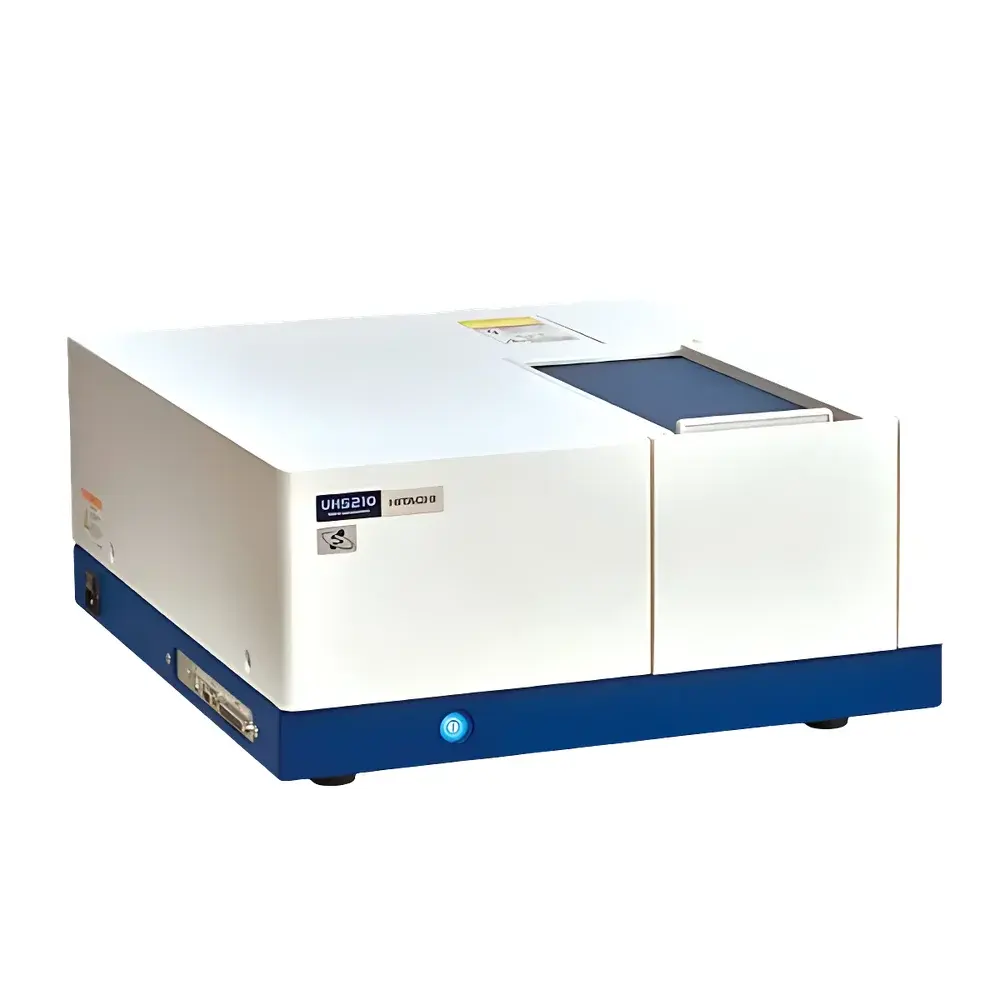
Hitachi UH5210 Dual-Beam Ultraviolet-Visible Spectrophotometer
| Brand | Hitachi |
|---|---|
| Origin | Japan |
| Manufacturer Type | Original Equipment Manufacturer (OEM) |
| Instrument Architecture | Dual-Beam |
| Detector Type | Photodiode Array (PDA) |
| Wavelength Range | 190–1100 nm |
| Wavelength Accuracy | ±0.3 nm |
| Wavelength Repeatability | ±0.1 nm |
| Spectral Bandwidth | 1.5 nm |
| Wavelength Scanning Mode | Motorized Auto-Scanning |
| Compliance | ISO/IEC 17025-compatible optical validation protocols, ASTM E275 and E387 spectral performance standards |
Overview
The Hitachi UH5210 Dual-Beam Ultraviolet-Visible Spectrophotometer is a high-precision analytical instrument engineered for routine and research-grade quantitative and qualitative analysis across pharmaceutical, environmental, academic, and industrial laboratories. Based on the fundamental principle of absorption spectroscopy—where sample absorbance is measured as a function of wavelength—the UH5210 employs a true dual-beam optical architecture to continuously compare sample and reference beam intensities in real time. This configuration compensates for fluctuations in source intensity, detector drift, and environmental thermal effects, delivering superior photometric stability and long-term measurement reproducibility. The system utilizes a Seya-Namioka monochromator equipped with a proprietary, in-house fabricated holographic diffraction grating—optimized for high luminous efficiency and minimal optical aberration across the full 190–1100 nm spectral range. Its motorized wavelength drive enables automated scanning, peak search, kinetic profiling, and multi-wavelength quantitation with sub-nanometer positional fidelity.
Key Features
- Dual-beam optical design with beam-splitting semi-reflective mirror for real-time reference compensation and enhanced baseline stability
- Photodiode array (PDA) detector enabling rapid full-spectrum acquisition without mechanical scanning delays
- 1.5 nm nominal spectral bandwidth optimized for resolution/sensitivity trade-off in compliance with pharmacopoeial methods (e.g., USP & EP)
- Wavelength accuracy of ±0.3 nm and repeatability of ±0.1 nm—validated per ASTM E275 and ISO 6425 calibration protocols
- Integrated high-resolution color LCD touchscreen with ergonomic keypad; supports USB peripheral connectivity (keyboard, card reader, flash storage)
- Robust mechanical construction with temperature-stabilized optical bench to minimize thermal drift during extended measurements
Sample Compatibility & Compliance
The UH5210 accommodates standard 10 mm pathlength cuvettes (quartz, glass, or plastic), microvolume adapters (down to 50 µL), and optional solid-sample reflectance accessories. Its sample compartment is mechanically and dimensionally compatible with legacy Hitachi U-2900/U-2910 systems—enabling seamless transition and reuse of existing holders, temperature controllers, and flow cells. All optical and electronic subsystems are designed and tested to meet international quality assurance requirements, including ISO/IEC 17025 method validation support, GLP-compliant audit trails (via UV Solutions Plus software), and alignment with FDA 21 CFR Part 11 data integrity principles when configured with user authentication and electronic signature modules.
Software & Data Management
UV Solutions Plus—the dedicated PC-based control and analysis software—provides an intuitive, task-oriented interface compliant with modern laboratory informatics workflows. It supports method creation with embedded wavelength calibration checks, automatic baseline correction algorithms, and customizable report templates exportable in PDF, CSV, and XML formats. The software implements secure data handling: all measurement events—including instrument parameter changes, calibration logs, and user login sessions—are timestamped and stored with immutable audit trails. Raw spectral data files are saved in vendor-neutral .jdx format for third-party spectral library integration. USB mass storage mode allows direct saving of spectra and reports to external drives without requiring network infrastructure—ideal for regulated environments with air-gapped instrumentation networks.
Applications
The UH5210 is routinely deployed in applications requiring trace-level quantification and spectral characterization, including but not limited to: active pharmaceutical ingredient (API) assay and dissolution testing per USP ; nucleic acid and protein concentration determination (A260/A280); enzyme kinetics monitoring (e.g., NADH oxidation at 340 nm); water quality analysis (nitrate, phosphate, COD); thin-film thickness evaluation via interference fringe analysis; and colorimetric assay development (e.g., ELISA, BCA, Bradford). Its broad spectral coverage and stable photometry also support method transfer from older UV-Vis platforms, minimizing revalidation burden in GMP manufacturing settings.
FAQ
Is the UH5210 compliant with 21 CFR Part 11 for electronic records and signatures?
Yes—when used with UV Solutions Plus v3.2 or later and configured with role-based user accounts, password policies, and enabled audit trail logging, the system meets core technical requirements for electronic record integrity.
Can I use my existing U-2900 sample holders and accessories with the UH5210?
Yes—the sample compartment dimensions, optical height, and mechanical mounting interfaces are fully backward-compatible with U-2900/U-2910 accessories, including Peltier temperature controllers and fiber-optic probes.
What is the recommended calibration frequency for routine QC use?
Hitachi recommends wavelength calibration using NIST-traceable holmium oxide and didymium filters every 6 months, and photometric calibration with neutral density filters prior to each analytical batch in regulated environments.
Does the photodiode array require periodic recalibration?
No—the PDA is factory-aligned and thermally stabilized; however, daily baseline verification using air or solvent blank is required to maintain photometric linearity per ISO 10012.
Is remote operation supported over LAN or Ethernet?
The UH5210 does not include built-in Ethernet; remote PC control is achieved via USB 2.0 connection—compatible with Windows 10/11 x64 systems and virtual desktop infrastructure (VDI) environments using certified USB-over-IP solutions.
Related Products




