
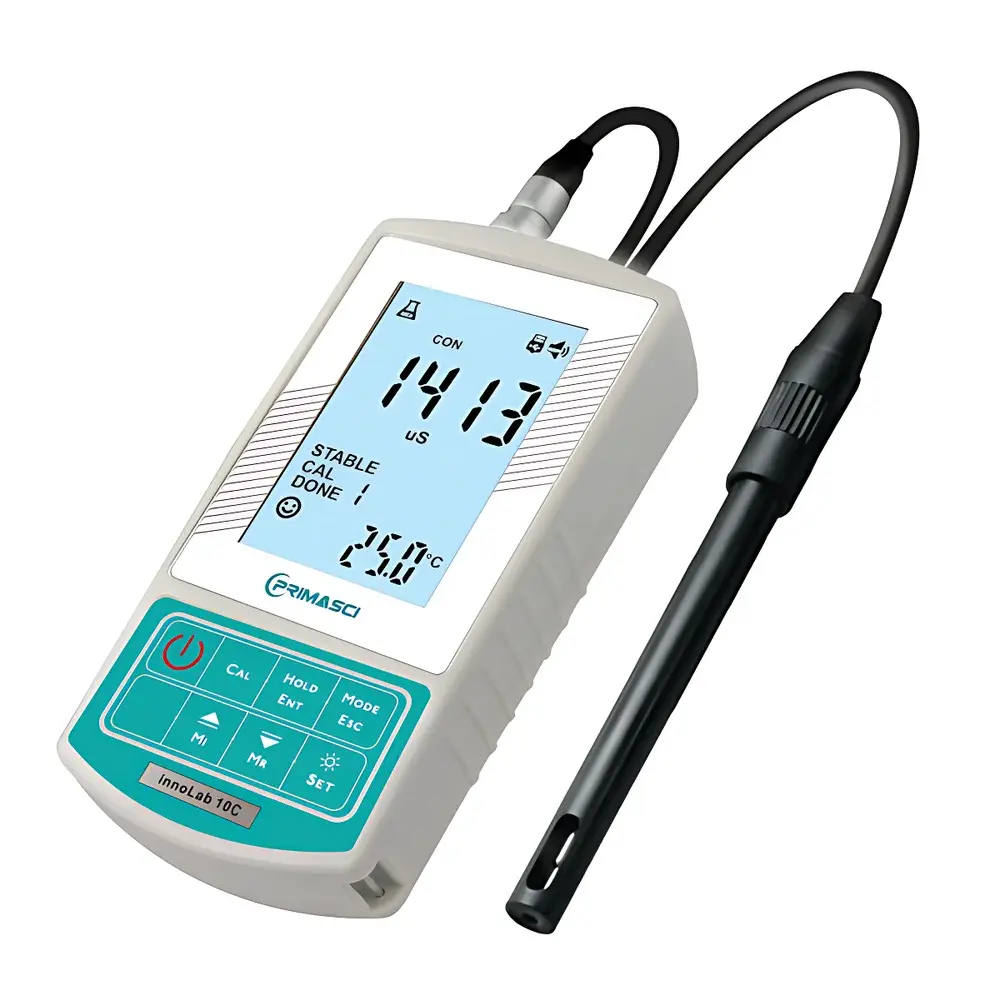
PRIMASCI innoLab 10 C Portable Conductivity / Resistivity / TDS / Salinity Meter
| Brand | PRIMASCI |
|---|---|
| Origin | Shanghai, China |
| Model | innoLab 10 C |
| Portability | Handheld |
| Conductivity Range | 0–500 mS/cm |
| TDS Range | 0–500,000 ppm (as NaCl) |
| Resistivity Range | 0–100.0 MΩ·cm |
| Salinity Range | 0–325 ppt (Practical Salinity Scale) |
| Temperature Range | −5 to +120 °C |
| Accuracy | ±1% F.S. (Conductivity), ±0.3 °C (Temperature) |
| Resolution | 0.001 µS/cm (low range), 0.01 mS/cm (high range), 0.1 °C |
| Calibration | Auto-ranging 1-point or manual multi-point (up to 3 points) |
| Temperature Compensation | Automatic/manual, −5 to +120 °C, selectable reference temp (15–30 °C, default 25 °C) |
| Electrode Constants | 0.01, 0.1, 1.0, 10.0 cm⁻¹ |
| TDS Factor | 0.40–1.00 (adjustable) |
| Salinity Factor | 0.65 (PSS-78 compliant) |
| Memory Capacity | 100 data sets with timestamp |
| Display | 40 × 70 mm LCD, 120° viewing angle |
| IP Rating | IP67 |
| Power | 2 × AA alkaline batteries (>500 h operation) |
| Dimensions | 73 × 152 × 42 mm (W × L × H) |
| Weight | 250 g |
Overview
The PRIMASCI innoLab 10 C is a field-deployable, multi-parameter electrochemical meter engineered for high-reproducibility measurement of conductivity, resistivity, total dissolved solids (TDS), salinity, and temperature in aqueous solutions. Based on four-electrode (or two-electrode, depending on cell configuration) AC conductivity measurement principles, the instrument applies a low-frequency sinusoidal excitation voltage to minimize polarization effects and electrode fouling—critical for long-term stability in industrial process streams and environmental monitoring. Its dual-range architecture (µS/cm to mS/cm) and programmable cell constant support applications spanning ultrapure water validation (e.g., ASTM D5127, USP ) to high-salinity seawater analysis (per ISO 9073-7 and IOC Manuals). The built-in non-linear compensation algorithm for ultrapure water accounts for temperature-dependent dissociation of H⁺ and OH⁻ ions, ensuring trace-level accuracy below 0.1 µS/cm without requiring external calibration standards.
Key Features
- IP67-rated enclosure for full dust ingress protection and immersion resistance up to 1 m for 30 minutes—validated per IEC 60529.
- Large-format 40 × 70 mm backlit LCD with 120° wide-angle viewing, optimized for outdoor daylight readability and gloved operation.
- Auto-ranging conductivity measurement across four decades (0.001 µS/cm to 500 mS/cm), with automatic range switching and real-time STABLE indicator for endpoint confirmation.
- Configurable electrode constants (0.01, 0.1, 1.0, 10.0 cm⁻¹) enabling compatibility with micro-cell probes for ultrapure water and large-area sensors for wastewater effluent.
- Programmable TDS conversion factor (0.40–1.00) and fixed salinity coefficient (0.65) aligned with PSS-78 (Practical Salinity Scale 1978), supporting compliance with ISO/IEC 17025 accredited testing workflows.
- HOLD function with manual trigger and auto-hold on stability detection; 100-measurement internal memory with timestamp (YYYY-MM-DD HH:MM) exportable via optional IR interface.
- Adjustable temperature coefficient (0.00–9.99 %/°C, default 2.00 %/°C for KCl), user-selectable reference temperature (15–30 °C), and dual-unit display (°C/°F).
- Low-power design: >500 hours continuous operation on two AA alkaline cells; configurable 10-minute auto-off to preserve battery life during intermittent use.
Sample Compatibility & Compliance
The innoLab 10 C is validated for direct measurement in deionized water, boiler feedwater (per ASME PTC 19.11), municipal wastewater (EPA Method 120.1), electroplating baths (ASTM B137), and marine samples. Its resistivity mode (0–100.0 MΩ·cm) meets the lower detection threshold for pharmaceutical water systems (USP , EP 2.2.38). All measurements adhere to the fundamental relationship σ = G × Kcell, where conductance (G) is measured and Kcell is applied per NIST-traceable cell certification. The instrument supports GLP-compliant data integrity through stable calibration logging, operator ID entry (via optional software), and audit-ready memory records—facilitating alignment with FDA 21 CFR Part 11 requirements when paired with validated PC software.
Software & Data Management
While standalone operation requires no software, optional PC connectivity (via infrared adapter) enables raw data download in CSV format, including conductivity, TDS, salinity, temperature, timestamp, and calibration history. Firmware updates are delivered via encrypted HEX files compatible with Windows-based configuration utilities. All stored measurements retain metadata: date/time stamp, selected unit, active electrode constant, and temperature-compensation status—essential for laboratory quality audits and ISO/IEC 17025 documentation. No cloud dependency or proprietary subscription model is required; data ownership remains fully with the end user.
Applications
- Power generation: Monitoring condensate purity and demineralizer effluent conductivity in thermal and nuclear plants (IEEE Std 450).
- Pharmaceutical manufacturing: On-site verification of purified water (PW) and water for injection (WFI) per pharmacopoeial monographs.
- Environmental fieldwork: Rapid assessment of river, estuary, and groundwater salinity gradients for hydrological modeling.
- Surface finishing: Real-time control of rinse tank conductivity to prevent drag-in contamination in electroplating lines.
- Food & beverage: Batch verification of brine concentration and cleaning-in-place (CIP) solution conductivity.
- Academic teaching labs: Demonstrating Kohlrausch’s law, ion mobility, and temperature dependence of electrolyte conduction.
FAQ
What electrode constants are supported, and how are they selected?
The innoLab 10 C accepts four standard cell constants (0.01, 0.1, 1.0, and 10.0 cm⁻¹) via menu selection. Users must input the certified Kcell value matching their physical probe—no automatic recognition.
Does the instrument comply with ASTM D1125 or ISO 7888 for conductivity reporting?
Yes—when used with NIST-traceable calibration standards and proper temperature compensation, it satisfies the procedural requirements of both standards for routine field measurement.
Can the device store calibration data separately from sample readings?
Calibration parameters (date, standard value, cell constant, temperature) are embedded within each measurement record and retained independently in non-volatile memory.
Is the temperature sensor integrated or external?
A co-located Pt1000 RTD is built into the conductivity probe interface; no separate temperature probe is required for standard operation.
How is ultrapure water non-linearity compensated?
The firmware applies an empirically derived correction curve based on the thermodynamic dissociation constants of water (Kw) across the −5 to 120 °C range, eliminating systematic bias below 1 µS/cm.





