
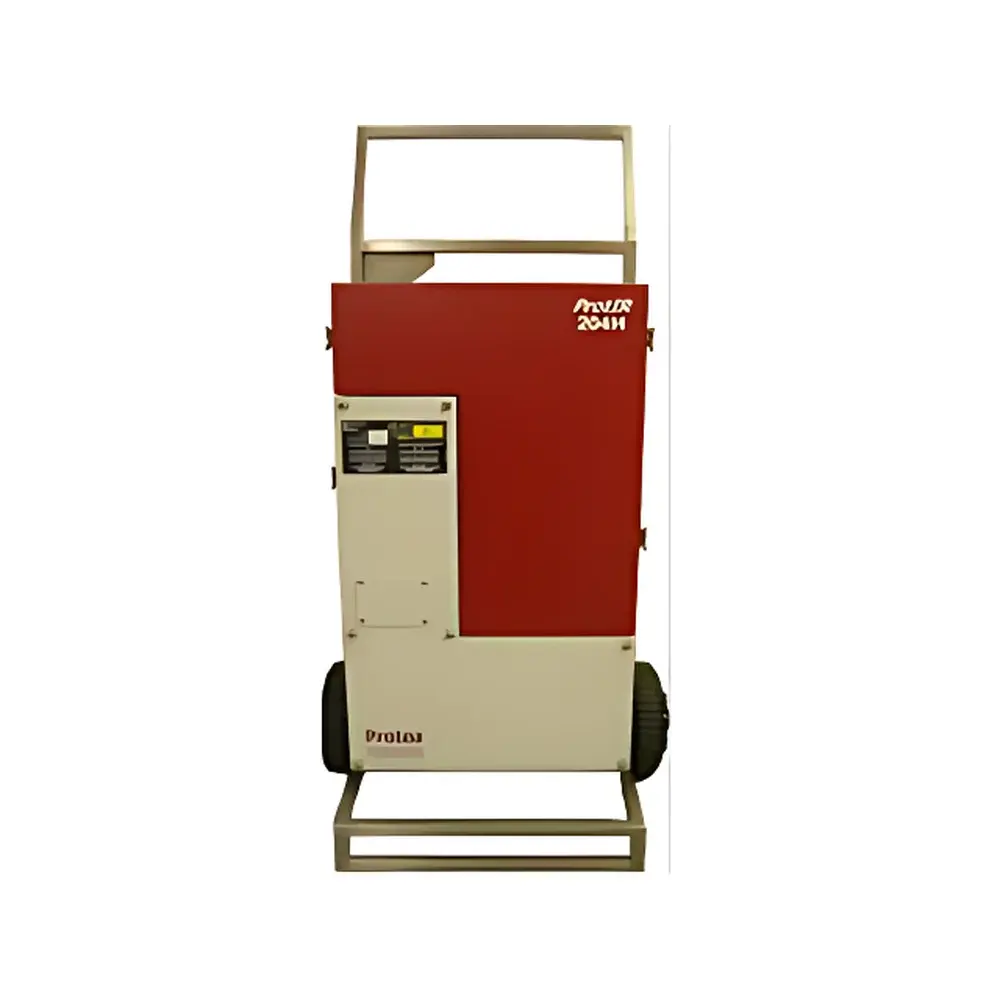
Protea ProtIR 204M Fourier Transform Infrared (FTIR) Flue Gas Analyzer
| Brand | Protea |
|---|---|
| Origin | United Kingdom |
| Model | ProtIR 204M |
| Instrument Type | Continuous Emission Monitoring System (CEMS) |
| Measurement Principle | Fourier Transform Infrared Spectroscopy (FTIR) |
| Accuracy (Relative Error) | <5% |
| Repeatability | <2% |
| Response Time | <30 s |
| Long-term Stability | <5% over 7 days |
| Measured Gases | SO₂, NO, NO₂, CO, CO₂, HCl, HF, NH₃, CH₄, N₂O, H₂O vapor, and >28 pre-calibrated VOCs & inorganic species |
| Spectral Resolution | 1–128 cm⁻¹ (selectable) |
| Wavenumber Range | 485–8500 cm⁻¹ |
| Optical Path Length | 6.4 m |
| Detector | DTGS |
| IR Source | Globar mid-IR source |
| Beamsplitter | ZnSe |
| Sample Cell Material | Nickel-plated aluminum with gold-coated mirrors & BaF₂ windows |
| Operating Temperature | 5–40 °C |
| Weight | 71 kg |
| Dimensions | 117 × 66.5 × 43 cm |
| Data Interface | Ethernet (OPC DA v3.0 compliant), 16 × 4–20 mA outputs (optional), 5 × digital I/O (optional) |
| Software Suite | PAS, PAS-Pro, Protea Spectrum Viewer |
| Calibration Support | Automated N₂ purge, real-time pressure & temperature compensation, built-in zirconia O₂ sensor (optional), dynamic dilution module (optional) |
| Compliance | UK MCerts certified, compatible with BS EN 14181, EN 15267, ISO 12039, and EPA Method 320 |
Overview
The Protea ProtIR 204M is a field-deployable, high-performance Fourier Transform Infrared (FTIR) flue gas analyzer engineered for quantitative, multi-component analysis of hot, humid, and corrosive industrial exhaust streams. Unlike filter-based or electrochemical gas sensors, the ProtIR 204M employs broadband mid-infrared absorption spectroscopy—capturing full spectral signatures across 485–8500 cm⁻¹—to resolve overlapping absorption bands of target analytes including SO₂, NO, NO₂, CO, CO₂, HCl, HF, NH₃, N₂O, CH₄, and volatile organic compounds (VOCs). Its 6.4-meter folded optical path within a thermally stabilized, nickel-plated aluminum sample cell ensures high signal-to-noise ratio and detection limits down to 0.5 ppm (v/v) for many species. The system operates on the principle of interferometric modulation: infrared radiation from a Globar source passes through a ZnSe beamsplitter, generating interference patterns detected by a deuterated triglycine sulfate (DTGS) detector. Subsequent Fourier transformation yields calibrated absorbance spectra, enabling simultaneous quantification via chemometric modeling. Designed for compliance-grade monitoring, the ProtIR 204M meets UK MCerts requirements for continuous emission monitoring systems (CEMS) and supports regulatory alignment with BS EN 14181 (QA/QC procedures), EN 15267 (performance certification), and ISO 12039 (stack gas analysis).
Key Features
- True multi-gas FTIR platform with pre-loaded calibration models for 28+ gases—including regulated pollutants (SO₂, NOₓ, HCl) and VOCs—validated per MCerts protocols.
- Selectably tunable spectral resolution (1, 2, 4, 8, 16, 64, or 128 cm⁻¹) to balance detection sensitivity, scan speed, and spectral fidelity for application-specific optimization.
- Integrated real-time environmental compensation: simultaneous pressure, temperature, and water vapor correction applied to all spectral quantifications to minimize matrix effects.
- Robust sample handling architecture: heated, corrosion-resistant 6.4-m optical cell with gold-coated mirrors and BaF₂ windows; dual-stage particulate filtration upstream of the measurement zone.
- Modular I/O expansion: standard Ethernet interface with OPC DA v3.0 server/client support; optional 16-channel 4–20 mA analog outputs and 5-channel digital I/O for integration into DCS/SCADA environments.
- Automated zeroing capability via integrated N₂ purge valve and external zirconia O₂ sensor for dry-basis correction and stoichiometric combustion analysis.
Sample Compatibility & Compliance
The ProtIR 204M is validated for direct analysis of raw, uncooled flue gases up to 200 °C (with optional heated probe extension), accommodating high-moisture, high-dust, and acidic matrices typical of waste incineration, cement kilns, power generation, and chemical process stacks. Its MCerts certification confirms conformance to UK Environment Agency standards for CEMS performance, including accuracy (<5% error), repeatability (<2%), and stability (<5% drift over 7 days). The instrument satisfies functional requirements of BS EN 14181 for automated quality assurance (AQMS Level 1–3), supports GLP-compliant data logging with audit-trail functionality in PAS-Pro mode, and aligns with FDA 21 CFR Part 11 when configured with electronic signature and user access controls. Pre-installed analytical methods adhere to EN 15267-3 for FTIR-based emission monitoring and are extensible to non-standard analytes using user-defined PLS or CLS chemometric models.
Software & Data Management
Protea provides three interoperable software modules: PAS (Protea Analyser Software), PAS-Pro, and Protea Spectrum Viewer. PAS serves as the primary laboratory and mobile deployment interface—enabling spectral acquisition, baseline correction, peak integration, and custom multivariate model development (Univariate, Classical Least Squares [CLS], Partial Least Squares [PLS]). PAS-Pro extends this capability to fixed-site, 24/7 operation: it executes scheduled measurements, enforces QA/QC checks per BS EN 14181, applies automatic range-switching between low-ppm and %-level calibrations, and displays real-time Pass/Fail status indicators aligned with regulatory thresholds. All software versions enforce time-stamped, immutable data records with operator ID tagging, supporting traceability under ISO/IEC 17025 and GMP environments. Raw interferograms and processed spectra are stored in vendor-neutral formats (.csv, .spc) for third-party validation. Optional dynamic dilution control and flow stabilization algorithms ensure consistent residence time and prevent saturation during high-concentration event sampling.
Applications
The ProtIR 204M is routinely deployed in regulatory compliance testing at municipal solid waste incinerators (MSWIs), hazardous waste treatment facilities, and energy-from-waste plants where simultaneous monitoring of acid gases, nitrogen oxides, and dioxin precursors (e.g., chlorobenzenes, PAHs) is required. It supports R&D investigations into combustion efficiency optimization, catalyst performance evaluation, and fugitive emission characterization in refinery flare stacks or pharmaceutical manufacturing suites. Field researchers utilize its portability and rapid spectral acquisition (<30 s response) for ambient air profiling near industrial perimeters, landfill gas screening, and emergency response scenarios involving unknown chemical releases. Its capacity to quantify both permanent gases and semi-volatile organics without reconfiguration makes it suitable for method development under US EPA Method 320 and EU Reference Method 17 alternatives.
FAQ
Does the ProtIR 204M require external calibration gases for routine operation?
No—its factory-certified chemometric models eliminate daily span gas requirements; however, periodic verification using certified reference standards (e.g., NIST-traceable SO₂/N₂ mixtures) is recommended per BS EN 14181 QA Level 2 protocols.
Can the system measure oxygen concentration?
Yes—when equipped with an optional externally mounted zirconia O₂ sensor, the system performs real-time dry-basis correction and calculates excess air ratios for combustion diagnostics.
Is remote monitoring supported?
Yes—via embedded Ethernet and OPC DA v3.0, the analyzer integrates natively with plant-wide SCADA systems and allows secure web-based access to live spectra, trend logs, and alarm states using standard industrial firewalls.
What maintenance intervals are recommended?
Optical alignment verification every 6 months; DTGS detector and Globar source replacement every 24–36 months depending on duty cycle; BaF₂ window cleaning after 500 hours of high-particulate exposure.
How does the system handle water vapor interference?
Through real-time, physics-based compensation: the full 485–8500 cm⁻¹ spectrum captures H₂O absorption features, allowing iterative subtraction during PLS modeling—eliminating need for aggressive gas drying that may alter speciation.
Related Products







