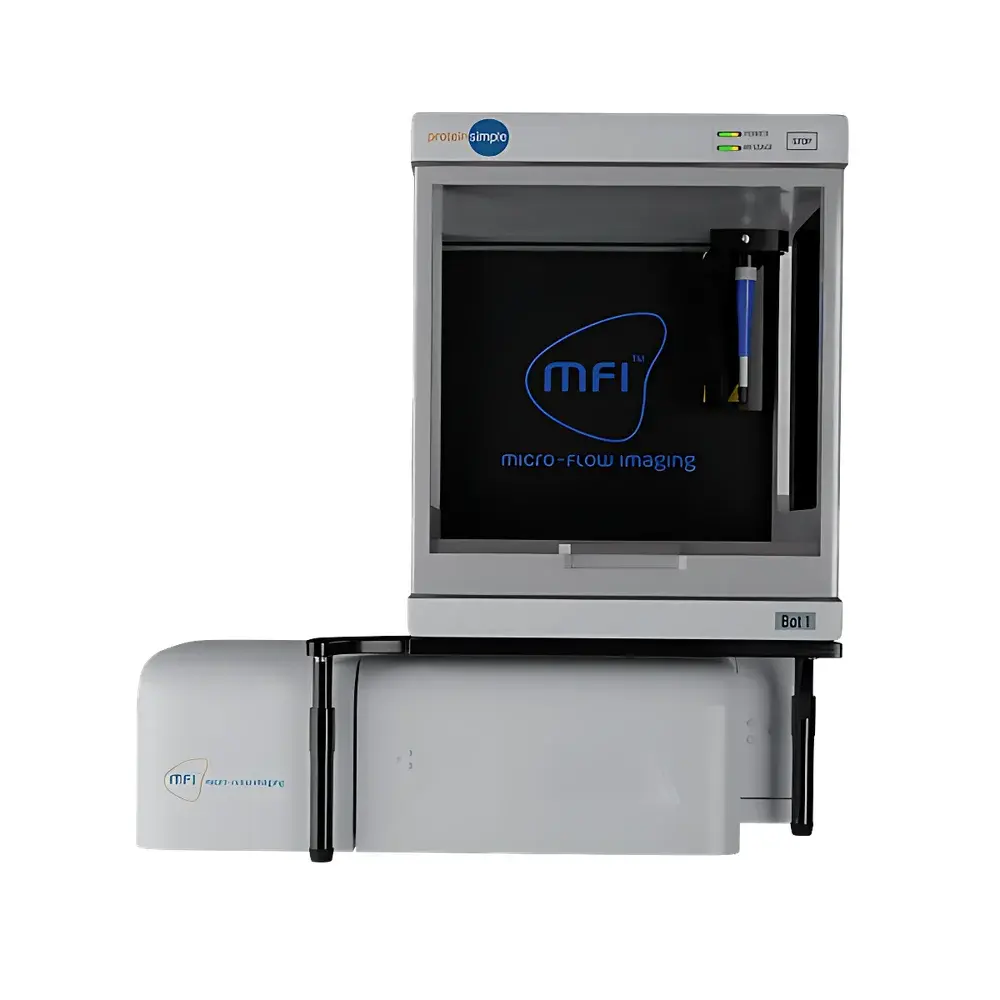
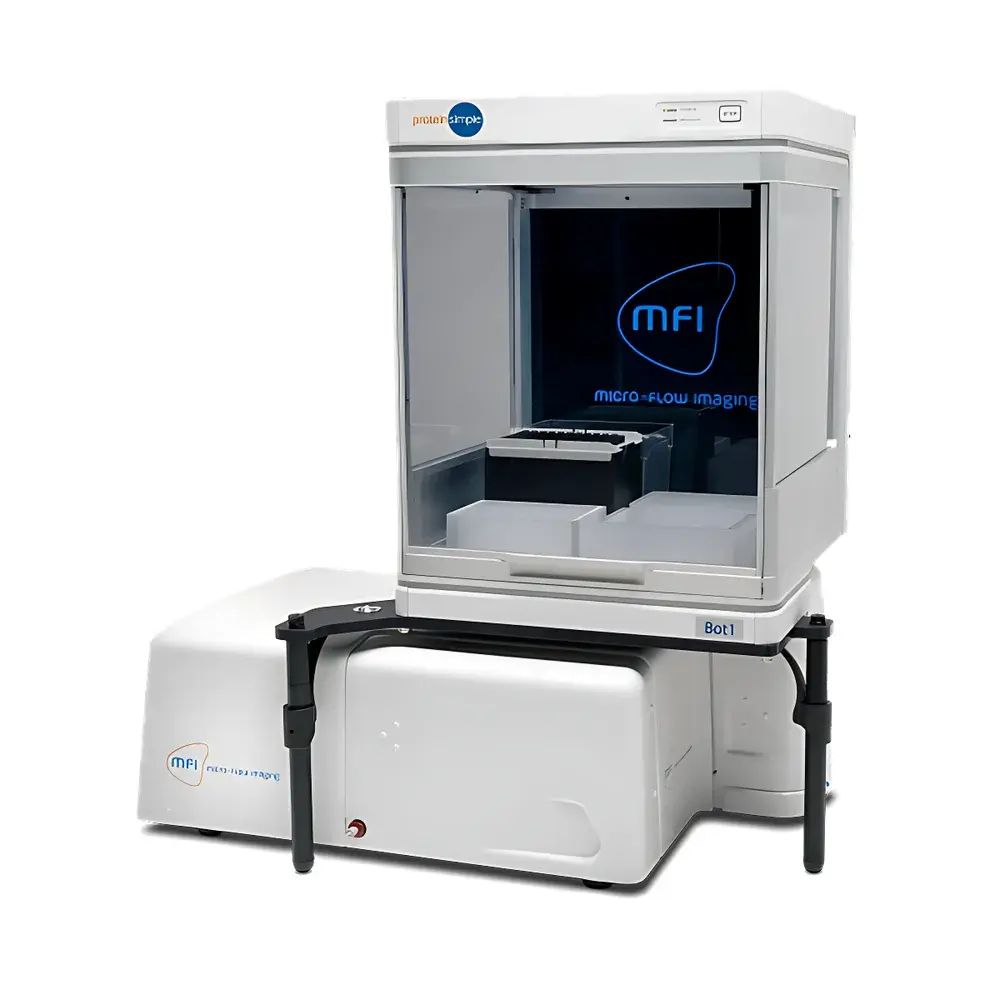
ProteinSimple MFI Micro-Flow Imaging Particle Analysis System
| Brand | ProteinSimple |
|---|---|
| Origin | Canada |
| Manufacturer Type | Authorized Distributor |
| Origin Category | Imported |
| Model | MFI |
| Pricing | Available Upon Request |
Overview
The ProteinSimple MFI Micro-Flow Imaging Particle Analysis System is an automated, high-resolution imaging-based instrument engineered for quantitative and qualitative characterization of subvisible and visible particles in biopharmaceutical formulations. It operates on the principle of microfluidic flow imaging—where a sample is hydrodynamically focused through a precision-machined flow cell and illuminated with collimated LED light; high-speed digital microscopy captures orthogonal, in-focus images of individual particles as they pass through the field of view. Unlike light obscuration or laser diffraction methods, MFI provides direct visual evidence of particle morphology, transparency, and spatial distribution—critical attributes for root cause analysis of protein aggregation, silicone oil droplets, cellulose fibers, or glass delamination fragments. The system complies with ICH Q5A(R2), USP , , and FDA guidance on subvisible particle assessment in monoclonal antibodies (mAbs), bispecifics, fusion proteins, antibody-drug conjugates (ADCs), and other advanced biologics.
Key Features
- High-fidelity microflow imaging with 2.2 µm optical resolution and adjustable magnification (10×–40×) for robust detection of particles from 1 µm to 1000 µm.
- Automated image acquisition at up to 100 frames per second, enabling statistically significant particle counts (>10,000 particles per run) without manual intervention.
- Integrated particle classification engine using morphological descriptors—including circularity, aspect ratio, convexity, opacity (grayscale intensity), and texture—to differentiate proteinaceous aggregates from intrinsic or extrinsic contaminants.
- Dynamic imaging capability supports time-lapse monitoring of particle behavior under shear, temperature ramping, or agitation—enabling stability-indicating studies.
- Rugged fluidic architecture with disposable, low-binding microfluidic cartridges minimizes carryover and cross-contamination between runs.
- Compliant with 21 CFR Part 11 requirements via optional audit trail, electronic signatures, and user access controls when deployed in regulated GMP environments.
Sample Compatibility & Compliance
The MFI system accommodates a broad range of liquid biopharmaceutical samples—including pre-filled syringes, vials, IV bags, and bulk drug substances—with minimal dilution or filtration. It accepts viscous formulations (up to 20 cP) and low-concentration suspensions (≥100 particles/mL). All analyses adhere to internationally recognized standards: ISO 21501-4 for particle sizing instrumentation, ASTM F3250–20 for subvisible particle characterization in biologics, and USP general chapters (Particulate Matter in Injections) and (Particulate Matter in Ophthalmic Solutions). Data outputs meet GLP/GMP documentation requirements, including raw image archives, metadata logs, and PDF summary reports with embedded traceability.
Software & Data Management
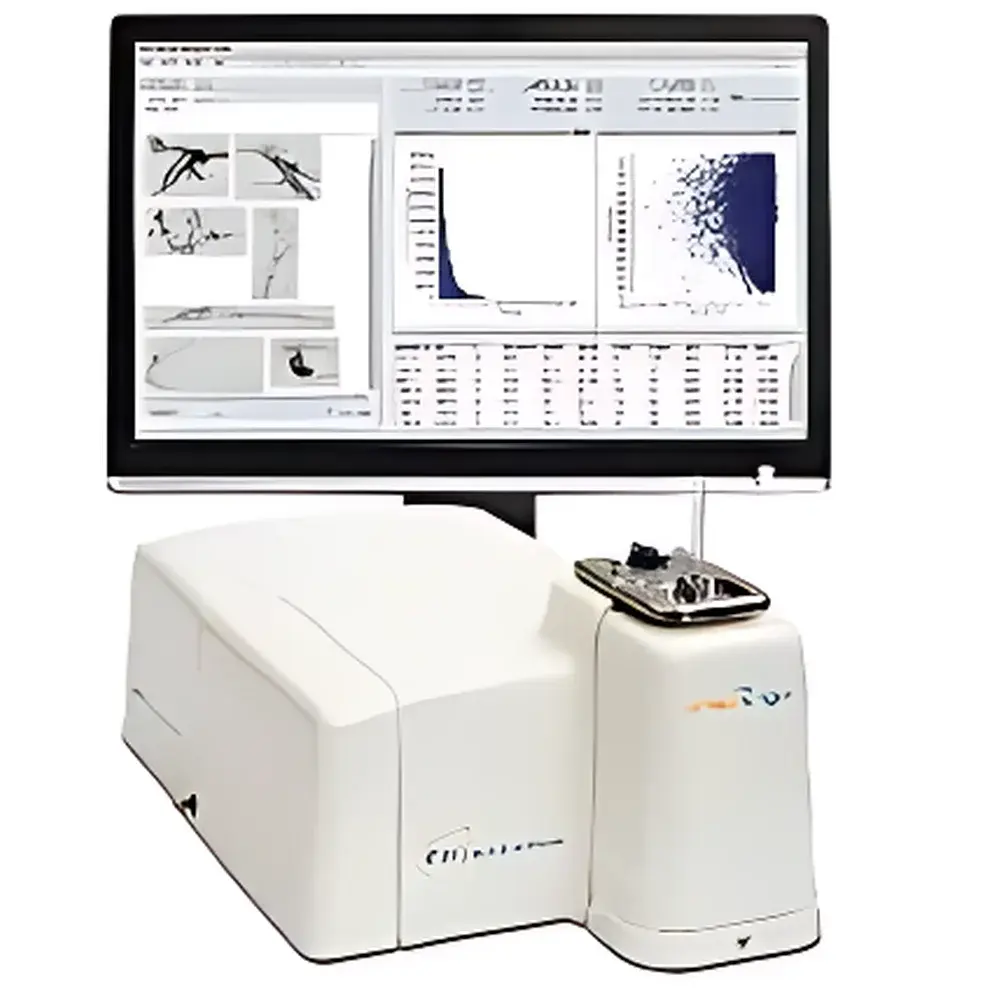
The MFI software suite (v6.x or later) provides full workflow control—from method setup and run execution to statistical analysis and report generation. Image processing algorithms apply adaptive thresholding and edge detection to ensure consistent segmentation across heterogeneous populations. Batch analysis mode enables comparative assessment across multiple lots, timepoints, or formulation variants. Export options include CSV (for statistical packages), TIFF (for regulatory submission archives), and interactive HTML reports with zoomable image galleries. When configured with networked deployment and role-based permissions, the software supports ALCOA+ data integrity principles and facilitates FDA inspection readiness.
Applications
- Characterization of protein aggregates in mAb therapeutics during formulation development and forced degradation studies.
- Identification and source attribution of extrinsic particles (e.g., rubber stopper fragments, stainless steel wear debris) in container-closure system evaluations.
- Monitoring of particulate evolution during freeze-thaw cycling, shipping simulation, and long-term stability programs.
- Supporting comparability protocols for biosimilar development and manufacturing process changes.
- Root cause investigation of opalescence, haze, or visible particulates observed during visual inspection or light obscuration testing.
FAQ
What particle size range can the MFI system reliably detect?
The system detects and images particles from 1 µm to 1000 µm in equivalent spherical diameter, with optimal resolution and classification accuracy between 2 µm and 500 µm.
Does MFI require sample filtration prior to analysis?
Filtration is not required—and is discouraged—unless particulate load exceeds 10⁵ particles/mL; the system’s dynamic range and auto-dilution capability accommodate most undiluted drug product concentrations.
Can MFI distinguish between silicone oil droplets and protein aggregates?
Yes—through combined analysis of refractive index contrast (opacity), edge sharpness, and deformation under flow, the system achieves >92% classification accuracy for silicone vs. proteinaceous particles in validated test sets.
Is the MFI platform compliant with FDA 21 CFR Part 11?
Yes—when deployed with validated software configuration, electronic signature modules, and documented system validation protocols, it meets Part 11 requirements for electronic records and signatures in regulated submissions.
How does MFI support regulatory filing submissions?
It generates auditable image datasets, annotated particle catalogs, and IQ/OQ/PQ documentation templates aligned with ICH M4Q(R2) and FDA CMC guidance for analytical method validation and control strategy justification.