
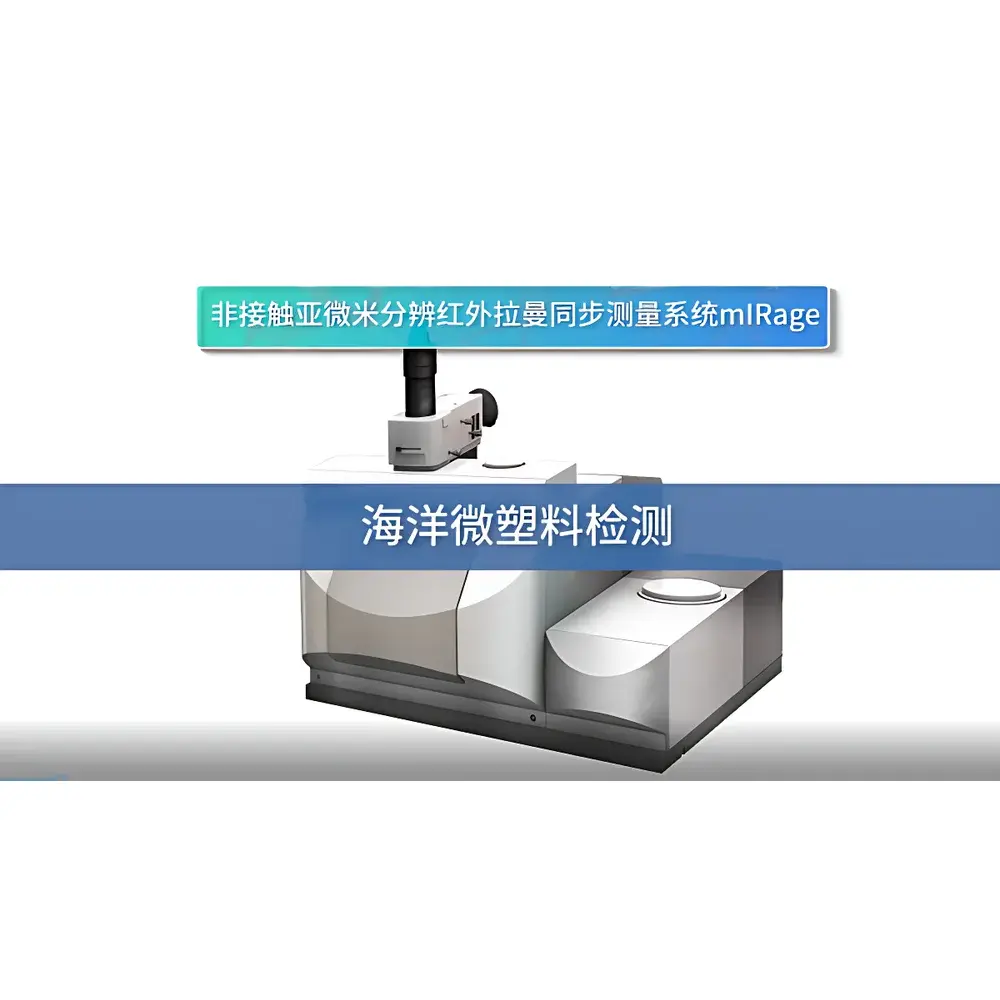
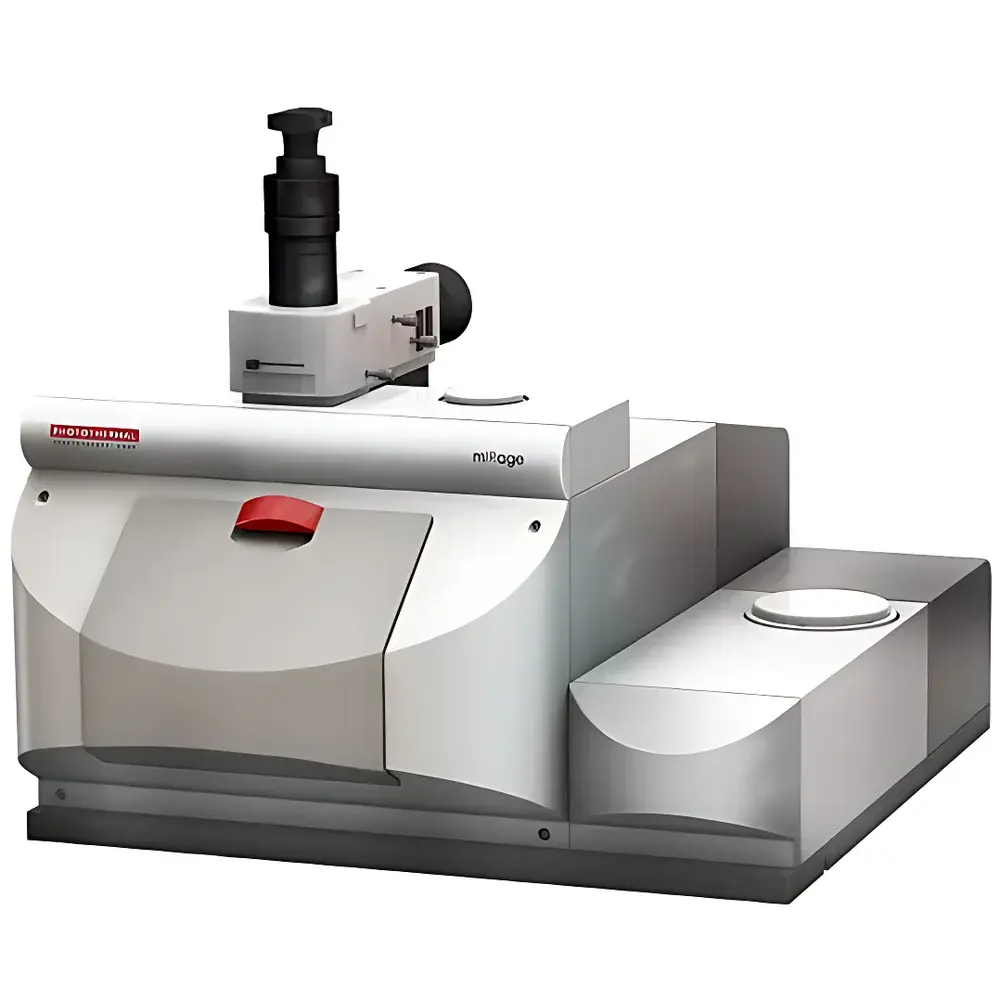
PSC mIRage Optical Photothermal Infrared (O-PTIR) Microspectrometer with Simultaneous Raman Capability
| Brand | PSC |
|---|---|
| Origin | USA |
| Model | mIRage |
| Instrument Type | Laboratory Benchtop System |
| Spectral Range | IR (3600–800 cm⁻¹), Raman (3900–200 cm⁻¹) |
| Spatial Resolution | ~500 nm |
| Measurement Mode | Non-contact, Reflection-Based Optical Photothermal Infrared (O-PTIR) |
| Compliance | Fully Compatible with ASTM E1252, ISO 18387, USP <1119>, FDA 21 CFR Part 11 (via optional audit-trail software module) |
| Software Platform | mIRage Pro v4.2 with GLP/GMP-ready data integrity controls |
Overview
The PSC mIRage is a laboratory-grade optical photothermal infrared (O-PTIR) microspectrometer engineered for sub-diffraction-limit chemical imaging and spectroscopy. Unlike conventional Fourier-transform infrared (FTIR) or attenuated total reflection (ATR) systems, the mIRage employs a dual-beam, non-contact photothermal detection principle: a tunable quantum cascade laser (QCL) delivers pulsed mid-infrared excitation (3600–800 cm⁻¹), while a co-aligned visible probe beam (532 nm) detects nanoscale thermal expansion induced by localized IR absorption. This O-PTIR mechanism decouples spatial resolution from IR wavelength—enabling consistent ~500 nm lateral resolution across the entire spectral range. Integrated Raman capability (3900–200 cm⁻¹) operates simultaneously on the identical sample location using the same optical path, delivering truly correlative vibrational data without registration error or fluorescence interference. The system is designed for quantitative, label-free molecular characterization of heterogeneous solid, semi-solid, and liquid-phase samples in life science, pharmaceutical, materials, forensic, and cultural heritage research.
Key Features
- Sub-diffraction spatial resolution (~500 nm) independent of IR wavelength—achieved via visible-light detection of photothermal response
- True simultaneous IR + Raman acquisition at identical coordinates and pixel resolution—eliminating misregistration and enabling direct spectral cross-validation
- Non-contact, far-field reflection geometry—no ATR crystal contact, no sample compression, no cross-contamination risk
- Minimal to no sample preparation required—compatible with thick sections, hydrated films, embedded tissues, and native-state biological specimens
- High-fidelity IR spectra fully compatible with commercial FTIR spectral libraries (e.g., Sadtler, Hummel, NIST) for automated peak assignment and chemometric analysis
- Robust architecture optimized for GLP/GMP environments: optional 21 CFR Part 11-compliant software with electronic signatures, audit trails, and user-access controls
- Modular polarization optics support orientation-sensitive measurements (e.g., collagen fiber alignment, polymer chain anisotropy)
Sample Compatibility & Compliance
The mIRage accommodates diverse sample formats—including glass slides, CaF₂ windows, silicon wafers, metal substrates, and liquid cells—without requiring thin-sectioning or metallization. Its non-destructive, non-contact operation preserves forensic evidence integrity, enables repeated measurement of live or delicate specimens (e.g., neurons, primary cell monolayers), and supports time-resolved studies of dynamic processes such as polymer curing or drug dissolution. The system meets analytical requirements defined in ASTM E1252 (standard practice for general techniques of infrared quantitative analysis), ISO 18387 (microspectroscopic imaging of polymers), and USP (infrared spectroscopy for pharmaceutical identification). When configured with mIRage Pro software’s optional compliance package, it supports full 21 CFR Part 11 functionality—including role-based access, electronic signatures, immutable audit logs, and secure data archiving—making it suitable for regulated QC/QA workflows in pharmaceutical development and manufacturing.
Software & Data Management
mIRage Pro v4.2 provides a unified interface for instrument control, hyperspectral acquisition, real-time visualization, and multivariate analysis. It supports rapid single-wavelength imaging (video-rate capability for select modes), full spectral mapping (up to 1024 × 1024 pixels), and advanced processing including 2D correlation spectroscopy (2D-COS), cluster analysis (k-means, hierarchical), and machine learning–enabled classification (PCA-LDA, SVM). All raw interferograms and photothermal transients are stored in vendor-neutral HDF5 format, ensuring long-term data portability. Export options include CSV, ASCII, and JCAMP-DX for third-party chemometric tools (e.g., MATLAB, Python scikit-learn, Unscrambler). For regulated environments, the optional Compliance Module enforces ALCOA+ principles: attributable, legible, contemporaneous, original, and accurate data handling, with full traceability from spectrum acquisition through final report generation.
Applications
The mIRage has been validated across multidisciplinary domains requiring submicron chemical specificity. In pharmaceuticals, it maps active pharmaceutical ingredient (API) distribution in dry powder aerosols and quantifies phase separation in amorphous solid dispersions (e.g., PLGA/dexamethasone blends). In life sciences, it resolves amyloid-β aggregation heterogeneity within neuronal dendrites and characterizes collagen molecular orientation in tendon fibrils at <500 nm scale—without staining or fixation. Forensic laboratories use it to identify trace explosive residues (e.g., RDX, PETN) in latent fingerprints on non-IR-transparent substrates. Environmental researchers apply it to microplastic identification (PS/PMMA/PLA/PHA mixtures) and polymer degradation profiling in silicone baby teats after steam sterilization. Additional use cases span semiconductor failure analysis (metallic contamination on die surfaces), art conservation (zinc soap heterogeneity in 19th-century oil paintings), bone mineral-to-matrix ratio quantification, and high-throughput antimicrobial susceptibility testing via deuterium-labeled protein synthesis imaging.
FAQ
How does O-PTIR achieve submicron resolution when conventional IR is diffraction-limited?
O-PTIR bypasses the Abbe diffraction limit by detecting IR absorption indirectly: the QCL excites molecular vibrations, inducing nanoscale thermal expansion; this mechanical response is probed with a visible laser whose wavelength (~532 nm) governs spatial resolution—not the IR wavelength.
Can the mIRage analyze hydrated or aqueous samples?
Yes—transmission-mode measurements through water-compatible windows (e.g., CaF₂) enable direct analysis of cells in buffer, hydrogels, and liquid-phase reactions without evaporation artifacts.
Is spectral quality comparable to benchtop FTIR?
Yes—O-PTIR spectra exhibit signal-to-noise ratios and peak shapes equivalent to transmission-mode FTIR, with full compatibility for library searching and quantitative modeling.
Does Raman integration introduce fluorescence interference?
No—the O-PTIR detection scheme is inherently immune to fluorescence, and the synchronized Raman channel uses notch-filtered excitation and time-gated detection to suppress background.
What regulatory documentation is provided for GxP validation?
PSC supplies IQ/OQ protocols, 21 CFR Part 11 readiness assessment reports, and vendor-supported PQ execution support for installation in FDA- or EMA-regulated facilities.






