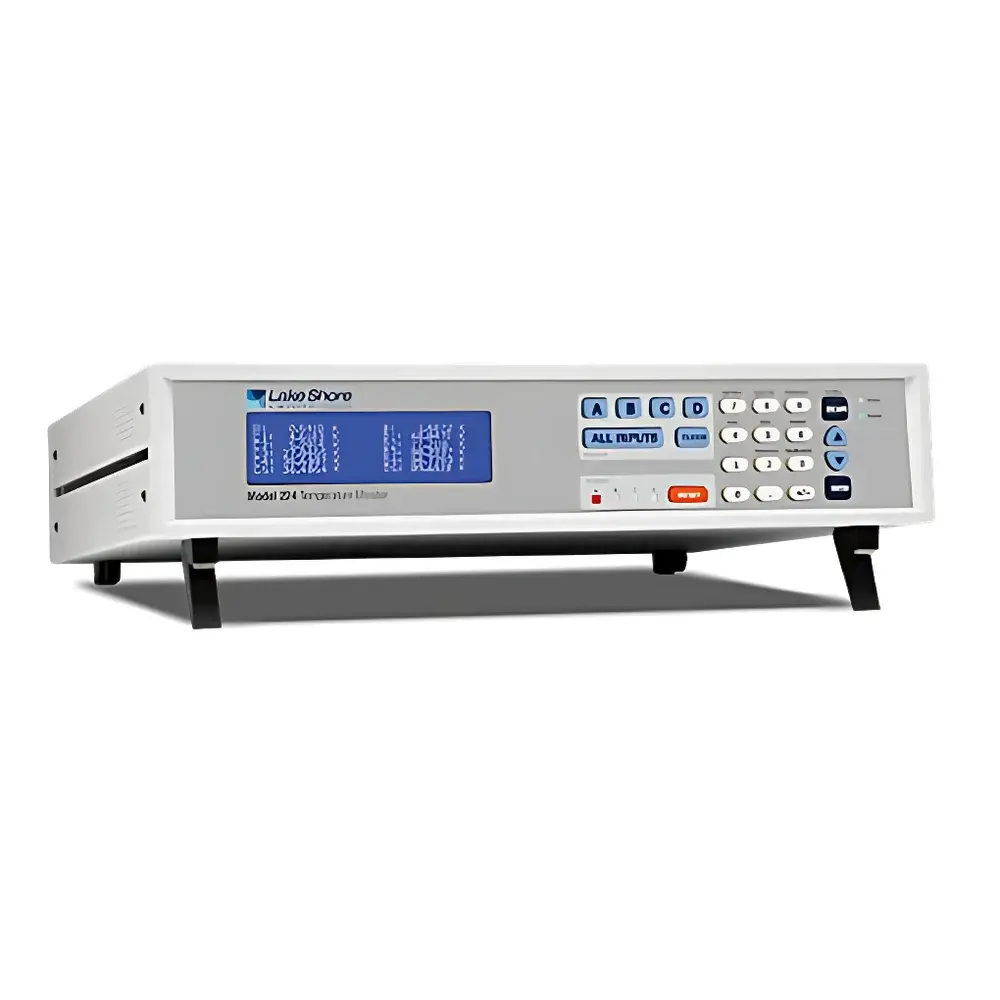
Lake Shore Model 224 Temperature Monitor
| Brand | Lake Shore |
|---|---|
| Origin | USA |
| Model | 224 |
| Sensor Channels | 12 (2 dedicated, 10 multiplexed) |
| Operating Range | 300 mK to 375 K |
| Input Types | Cernox®, silicon diodes (e.g., DT-670), Pt RTDs (100 Ω / 1000 Ω), Rox™, germanium, carbon-glass |
| A/D Resolution | 24-bit |
| Update Rate | up to 10 readings/s (dedicated channels), 1–2 readings/s (scanned channels) |
| Isolation | optical isolation between sensor inputs and system ground |
| Calibration Storage | 39 user-defined 200-point curves |
| Display | 240 × 64 pixel LCD (8 × 40 characters), LED backlit |
| Interface | front-panel 6-pin DIN connectors |
| Compliance | designed for GLP/GMP-aligned lab environments |
Overview
The Lake Shore Model 224 Temperature Monitor is a high-precision, multi-channel cryogenic and ambient temperature measurement instrument engineered for demanding low-temperature physics, materials science, and superconducting systems. Based on four independent 24-bit analog-to-digital converters and optically isolated input circuitry, the Model 224 delivers stable, low-noise resistance and voltage measurements essential for accurate thermometry across extreme thermal ranges—from 300 mK in dilution refrigerator mixing chambers to 375 K in high-temperature vacuum environments. Its architecture implements true 4-wire differential excitation with current reversal to eliminate thermoelectric EMF errors—critical for sub-kelvin reproducibility. Designed for integration into complex cryogenic infrastructure—including closed-cycle refrigerators (CCR), liquid helium (He-4 and He-3) cryostats, and superconducting magnet systems—the Model 224 enables simultaneous, independent monitoring of thermal gradients, redundancy validation, and leak detection without cross-channel interference.
Key Features
- Twelve fully configurable sensor inputs: two dedicated non-scanning channels (A and B) with 10 rdg/s update rate, and ten scanning inputs (C and D banks, five per bank) supporting variable scan rates from 1 to 10 rdg/s depending on active channel count.
- Optically isolated sensor inputs reduce ground-loop noise and improve measurement integrity in electrically noisy cryogenic setups—particularly important near high-field magnets or RF sources.
- Comprehensive sensor compatibility: native support for Lake Shore Cernox® thin-film sensors (optimized for <4 K and high magnetic fields), silicon diodes (DT-670, DT-470), platinum RTDs (100 Ω and 1000 Ω), Rox™ (ruthenium oxide), germanium, and carbon-glass thermometers.
- Automatic range selection for NTC/PTC RTDs ensures excitation voltage remains below 10 mV—minimizing self-heating while preserving resolution down to 300 mK.
- Onboard SoftCal™ algorithm enables user-generated calibration curves for DT-470 diodes (30–375 K) and Pt RTDs (70–325 K) with ±0.25 K accuracy improvement over standard curves; stored as editable 200-point user curves.
- Non-volatile memory retains up to 39 custom calibration curves—supporting traceable sensor characterization and multi-lab standardization.
Sample Compatibility & Compliance
The Model 224 is routinely deployed in applications requiring metrological traceability and long-term stability under thermal cycling. It supports sensor configurations aligned with ASTM E1142 (Standard Guide for Use of Resistance Thermometers), IEC 60751 (Industrial Platinum Resistance Thermometers), and ISO/IEC 17025-compliant calibration workflows. While the instrument itself does not carry FDA 21 CFR Part 11 certification, its data output—when paired with validated third-party acquisition software—can be structured to meet GLP/GMP audit requirements, including time-stamped readings, user authentication logs, and immutable curve storage. The device’s optical isolation, low-power excitation, and thermal EMF mitigation align with best practices defined in NIST SP 250-98 (Cryogenic Thermometry) and IEEE Std 1127-1999 (Superconducting Systems Instrumentation).
Software & Data Management
Data acquisition and configuration are managed via the front-panel interface or remotely through RS-232, GPIB, or Ethernet (optional). Lake Shore provides Curve Processing Software for Windows, enabling users to import, fit, smooth, and export calibration data—ensuring consistency across instrument fleets. All calibration curves—including factory-provided standards (e.g., DT-670, PT-1000, RX-202A)—are stored in non-volatile memory with checksum verification. Real-time readings can be streamed at user-defined intervals; timestamped ASCII output supports direct ingestion into LabVIEW, Python (PyVISA), MATLAB, or LIMS platforms. Optional firmware updates maintain alignment with evolving sensor standards and security protocols.
Applications
- Multi-point thermal profiling in dilution refrigerators and adiabatic demagnetization refrigerators (ADR), where spatial resolution of thermal gradients informs heat load analysis.
- Redundant temperature monitoring of superconducting magnets in MRI, NMR, and particle accelerator facilities—ensuring quench prevention through real-time delta-T tracking.
- Qualification testing of quantum computing hardware (e.g., qubit chips, control wiring), where millikelvin stability and channel-to-channel crosstalk immunity are mandatory.
- Process validation in semiconductor cryo-processing tools, including ion implantation and cryo-etching systems operating between 4 K and 300 K.
- Long-duration environmental stress screening of aerospace components in thermal vacuum chambers, leveraging the unit’s drift-free 24-bit digitization and auto-ranging capability.
FAQ
Does the Model 224 support Cernox® sensors at 300 mK?
Yes—the Model 224 is specifically optimized for Cernox® sensors and achieves reliable, repeatable measurements down to 300 mK using selectable low-current excitation modes and current reversal to suppress thermal EMF effects.
Can I use custom calibration curves from my own cryogenic characterization lab?
Yes—up to 39 user-defined 200-point curves may be uploaded and stored in non-volatile memory using Lake Shore’s Curve Processing Software or direct ASCII file transfer.
What is the difference between dedicated and scanned input channels?
Dedicated channels A and B operate continuously at up to 10 readings per second with no multiplexing delay; scanned channels (C and D banks) share ADC resources and exhibit reduced update rates as more channels are enabled—typically 2 rdg/s when all 10 are active.
Is optical isolation applied between individual sensor inputs?
No—optical isolation exists only between each sensor input and the instrument’s internal ground/reference plane; inputs are not isolated from one another, which is consistent with industry-standard cryogenic thermometry practice.
How does SoftCal™ improve measurement accuracy?
SoftCal™ applies a piecewise polynomial fit to raw diode or RTD resistance data, generating a higher-fidelity inverse function than standard interpolation tables—yielding ±0.25 K improvement within specified temperature ranges when saved as a user curve.