
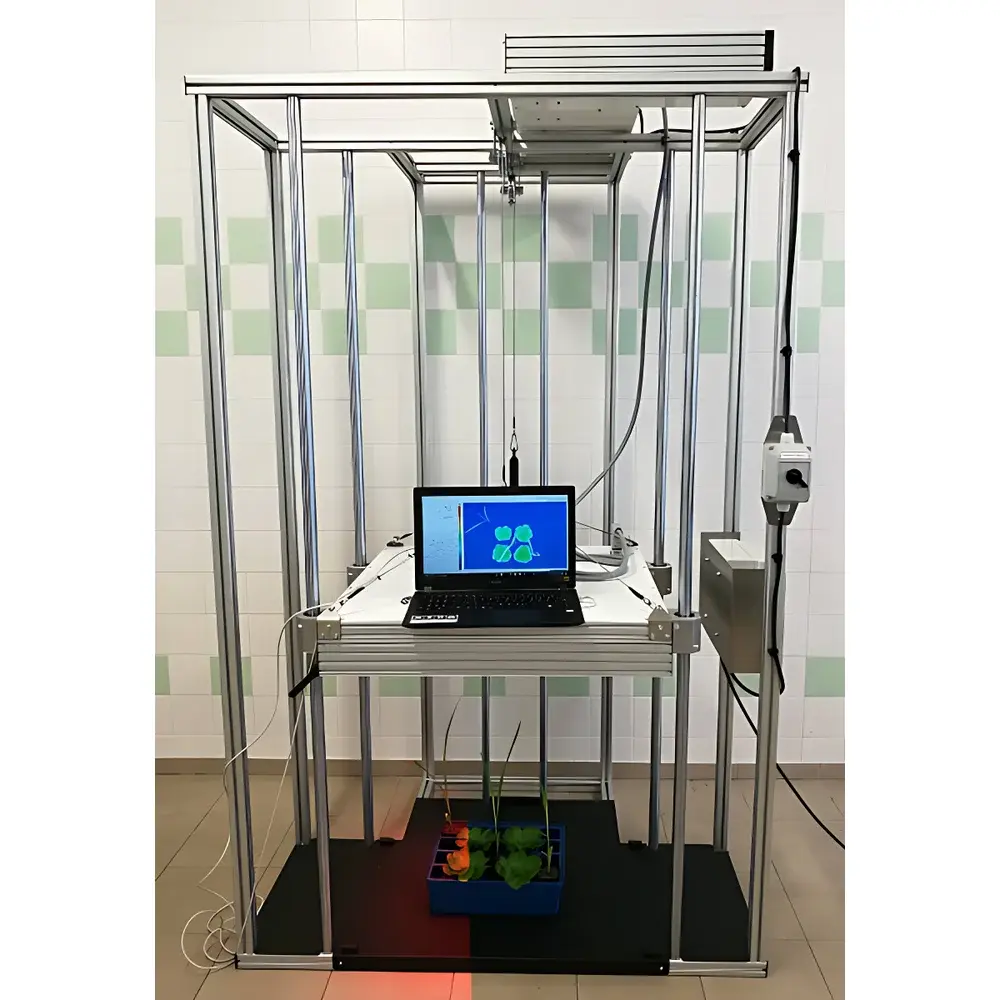
PSI FluorCam Large-Scale Plant Multispectral Fluorescence Imaging Platform
| Brand | PSI (Czech Republic) |
|---|---|
| Origin | Czech Republic |
| Model | FluorCam Large-Scale Version |
| Imaging Area | 35 × 35 cm |
| CCD Resolution | 1360 × 1024 pixels |
| Frame Rate | up to 20 fps at full resolution |
| A/D Depth | 16-bit (65,536 gray levels) |
| Pixel Size | 6.45 µm × 6.45 µm |
| Adjustable Platform Height | 350–1350 mm |
| Excitation Sources | 620 nm red, dual-color (620 nm + cool white), optional blue/UV/IR LEDs |
| Filter Wheel | 7-position motorized |
| Standard Fluorescence Parameters | >50 chlorophyll fluorescence parameters (e.g., Fv/Fm, ΦPSII, NPQ, qP, Rfd) |
| Optional Modules | UV-induced multispectral fluorescence (F440, F520, F690, F740), GFP/YFP imaging, PAR absorption & NDVI imaging, IR thermography (640 × 512, -25 to +150 °C, 30 mK sensitivity) |
Overview
The PSI FluorCam Large-Scale Plant Multispectral Fluorescence Imaging Platform is a high-precision, non-invasive optical phenotyping system engineered for quantitative analysis of plant physiological status across spatial and temporal scales. Built upon the foundational principles of pulse-amplitude modulated (PAM) fluorometry and multispectral excitation-emission spectroscopy, the platform enables simultaneous acquisition of chlorophyll fluorescence kinetics, UV-induced autofluorescence spectra, and optional GFP/YFP reporter signals — all within a single, unified imaging field of view measuring 35 × 35 cm. This represents the largest monolithic imaging area available in commercial plant fluorescence instrumentation, permitting whole-plant or multi-plant canopy-level analysis without spatial stitching or mechanical scanning artifacts. The system operates on a vertically adjustable gantry architecture, accommodating specimens ranging from seedlings to mature rosettes or small shrubs (height: 350–1350 mm), and integrates synchronized LED excitation sources, a scientific-grade 16-bit CCD camera, and a motorized 7-position filter wheel to ensure spectral fidelity and measurement reproducibility under controlled laboratory or greenhouse environments.
Key Features
- Large-format imaging capability (35 × 35 cm) supports high-throughput phenotyping of intact plants, plant communities, or multi-well plates — eliminating the need for destructive sampling or image tiling.
- Modular multispectral excitation architecture: standard 620 nm red and cool-white actinic light sources; optional UV (365 nm), blue (450 nm), green (520 nm), and far-red (735 nm) LEDs enable targeted activation of distinct fluorophores including chlorophyll a, NAD(P)H, phenolic compounds, GFP, YFP, and anthocyanins.
- UV-induced multispectral fluorescence profiling with four resolved emission bands: F440 (blue), F520 (green), F690 (red), and F740 (far-red), each linked to specific anatomical and biochemical compartments — epidermal cell walls (F440/F520), photosystem II reaction centers (F690/F740).
- Scientific-grade CCD sensor with 1360 × 1024 resolution, 20 fps video capture at full resolution, and 16-bit dynamic range ensures high signal-to-noise ratio for kinetic parameter extraction (e.g., Kautsky induction, OJIP transients, NPQ relaxation).
- Automated protocol-driven operation: users define experimental sequences (Protocols) with programmable timing, light intensities, excitation wavelengths, and measurement intervals; measurements are timestamped and stored with metadata compliance for GLP/GMP traceability.
- Comprehensive software suite supporting live preview, ROI-based quantification, threshold segmentation (“分级操作”), multi-sample batch processing, and dual-mode signal averaging (signal-then-average vs. average-then-signal) optimized for variable SNR conditions.
Sample Compatibility & Compliance
The FluorCam Large-Scale Platform accommodates diverse biological samples without physical contact or labeling requirements: detached leaves, intact seedlings, flowering shoots, fruits, mosses, algae suspensions, and soil-grown plant cohorts. Its non-destructive design aligns with OECD Guideline 208 (terrestrial plant toxicity testing) and supports ISO 11269-2 compliant photosynthetic efficiency assessments. When configured with optional IR thermography (7.5–13.5 µm spectral band, calibrated to ±0.03 °C), the system meets ASTM E1933-19 standards for infrared emissivity measurement and enables correlative analysis of stomatal conductance proxies (thermal heterogeneity) alongside fluorescence-derived water-use efficiency indices. All data files include embedded timestamps, instrument configuration logs, and user-defined annotations — fulfilling audit-trail requirements under FDA 21 CFR Part 11 for regulated research environments.
Software & Data Management
FluorCam Control & Analysis Software (v8.x) provides an integrated workflow from acquisition to publication-ready output. Core modules include Live Mode (real-time video monitoring, manual exposure adjustment, and immediate parameter preview), Protocol Editor (graphical wizard for constructing custom light regimes, including multi-phase actinic sequences and saturating pulses), Pre-processing (automated or manual ROI definition using geometric templates — e.g., multi-well plate masks — or freehand polygon selection), and Result Viewer (parametric false-color maps, kinetic curve overlays, histogram distributions, and per-ROI statistical tables). Data export supports CSV, Excel (.xlsx), TIFF, and JPEG formats; raw kinetic traces retain full 16-bit depth. Batch analysis scripts allow cross-experiment normalization and meta-analysis of fluorescence parameters against environmental variables (e.g., VPD, PAR, temperature). The software architecture is compatible with LIMS integration via standardized API endpoints and supports metadata tagging per MIAPPE v1.1 guidelines for plant phenomics data interoperability.
Applications
This platform serves as a core analytical tool in academic and industrial plant science laboratories focusing on abiotic and biotic stress physiology, functional genomics, and precision breeding. It is routinely deployed for: drought and salinity response phenotyping via NPQ dynamics and UV-F440/F520 ratio shifts; early detection of pathogen infection through localized quenching anomalies and thermal-physiological decoupling; nitrogen use efficiency screening using Fv/Fm and Rfd kinetics; ecotoxicological assessment of heavy metal bioavailability via root-shoot fluorescence partitioning; high-resolution mapping of stomatal aperture dynamics using concurrent IR thermography and blue-light-induced fluorescence transients; and forward/reverse genetic screens leveraging GFP/YFP-tagged reporters under native promoters. Its scalability makes it suitable for both hypothesis-driven mechanistic studies and large-scale QTL mapping pipelines requiring spatially resolved physiological metrics.
FAQ
What is the maximum sample height supported by the adjustable imaging platform?
The vertical gantry permits height adjustment from 350 mm to 1350 mm above the base plane, accommodating specimens from petri-dish-grown seedlings to potted Arabidopsis or tomato plants.
Can the system quantify absolute fluorescence intensity, or are measurements limited to relative ratios?
While primary outputs are normalized kinetic parameters (e.g., Fv/Fm, ΦPSII), absolute intensity calibration is achievable using NIST-traceable fluorescence reference standards; optional integration with spectroradiometric validation tools enables quantitative radiance conversion.
Is remote monitoring and unattended operation supported?
Yes — scheduled protocols execute autonomously with local storage (SSD or network drive); email/SMS alerts trigger upon completion or error detection; remote desktop access via secure SSH or VNC is fully supported.
How does the system handle heterogeneous illumination across the 35 × 35 cm field?
Each LED panel (750 × 750 mm) undergoes factory photometric calibration; flat-field correction algorithms compensate for edge falloff and spectral non-uniformity during image preprocessing.
Are software updates and technical support included post-purchase?
PSI provides 24-month complimentary software maintenance and priority remote diagnostics; extended service contracts include on-site calibration verification and application-specific protocol development assistance.
Related Products



