
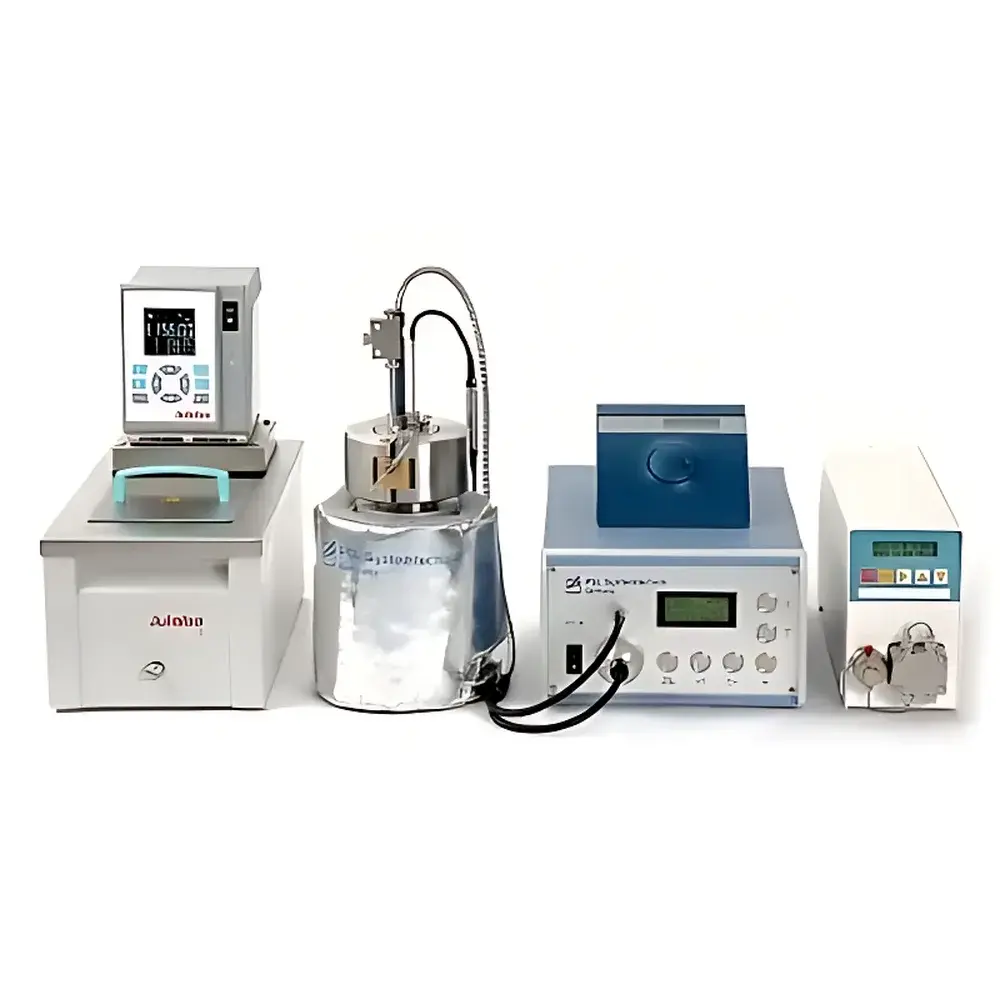
PSL FT High-Pressure Asphaltene Flocculation Titration Analyzer
| Origin | Germany |
|---|---|
| Manufacturer Type | Authorized Distributor |
| Origin Category | Imported |
| Model | FT |
| Quotation | Upon Request |
| Temperature Range | –25 °C to 80 °C (standard) |
| Pressure Range | 10 bar (145 psi), 200 bar (2,900 psi), or 700 bar (10,000 psi) |
| Stirring Speed | 0–1,000 rpm |
| Titration Flow Rate | 0.3–30 mL/min |
| Optical Detection Sensitivity | 0.005 lux |
| Probe Interface | Threaded in-line mounting (NPT/BSP options available) |
Overview
The PSL FT High-Pressure Asphaltene Flocculation Titration Analyzer is a purpose-built optical titration system engineered for quantitative, real-time detection of asphaltene flocculation onset under dynamically controlled pressure and temperature conditions. It operates on the principle of turbidimetric endpoint detection: as asphaltene aggregates nucleate and grow during titrant addition (e.g., n-heptane or other precipitants), light transmission through the sample decreases measurably. A high-sensitivity photodetector—calibrated to 0.005 lux—monitors this attenuation continuously, enabling precise identification of the flocculation point (FP) defined per ASTM D6703 (Heithaus method). Unlike conventional benchtop analyzers, the FT integrates directly into process lines or high-pressure autoclaves via threaded optical probes, supporting true in-situ measurement at up to 700 bar and 200 °C. Its modular architecture allows seamless integration with external temperature controllers, automated syringe pumps, and pressure transducers—making it suitable for both field-deployable pipeline monitoring and laboratory-based compatibility screening of crude blends, condensates, and inhibitor formulations.
Key Features
- Three-tier pressure-rated optical probe options: 10 bar (for ambient/low-pressure screening), 200 bar (for deepwater reservoir simulation), and 700 bar (for ultra-high-pressure gas-condensate systems)
- Optical detection system featuring a rear-mounted mirror and auto-gain-adjusting photodiode to maintain signal fidelity across highly opaque, semi-transparent, or near-black crude samples
- Programmable titration delivery (0.3–30 mL/min) synchronized with real-time turbidity logging and temperature/pressure acquisition
- Integrated stirring module (0–1,000 rpm) with magnetic or mechanical coupling options to ensure homogeneous mixing under elevated pressure without seal compromise
- Modular thermal control: standard –25 °C to 80 °C bath-compatible operation; optional high-temperature jacketed cell rated to 200 °C with PID-controlled heating
- Threaded probe interface compliant with ANSI/ISO pipe thread standards (NPT, BSP), enabling direct installation into flow loops, sampling manifolds, or HPHT reactor vessels
Sample Compatibility & Compliance
The FT analyzer accommodates undiluted crudes, stabilized condensates, live oils, and inhibitor-dosed blends without pre-filtration or dilution. Its optical path design eliminates interference from suspended water droplets or gas bubbles when operated above bubble point. The system supports compliance-driven workflows: data acquisition meets ALCOA+ principles for traceability; audit trails, electronic signatures, and user-access controls align with FDA 21 CFR Part 11 requirements when configured with validated software modules. Test protocols conform to ASTM D6703 (Heithaus flocculation titration), ISO 10438 (petroleum industry fouling assessment), and internal API RP 14E corrosion/fouling screening guidelines. All wetted materials—including sapphire optical windows and Hastelloy C-276 probe bodies—are certified for sour service (NACE MR0175/ISO 15156).
Software & Data Management
The proprietary PSL AnalyzeSuite™ software provides synchronized acquisition of turbidity (%T), temperature (±0.1 °C), pressure (±0.25% FS), stir speed, and titrant volume. Raw signals are processed using second-derivative algorithms to objectively define FP as the inflection point of d²T/dV² = 0. Users may overlay multiple titration curves, apply baseline correction, and export time-stamped datasets in CSV, XML, or ASTM E1382-compliant format. The software includes built-in reporting templates aligned with API RP 14J and internal QA/QC checklists. For enterprise deployment, optional OPC UA server integration enables bidirectional communication with LIMS and DCS platforms. All data logs include immutable metadata: operator ID, instrument serial number, calibration timestamp, and environmental chamber status.
Applications
- Determination of asphaltene instability index (AII) and flocculation onset pressure (FOP) in reservoir fluid studies
- Evaluation of asphaltene precipitation inhibitors (APIs) and dispersant performance under representative downhole conditions
- Compatibility assessment of crude oil blends prior to commingling in shared pipelines or storage terminals
- In-situ monitoring of asphaltene deposition kinetics during cold flow assurance testing
- High-pressure phase behavior studies of waxy–asphaltenic systems, including discrimination between wax crystallization and asphaltene flocculation events via thermal ramping protocols
- Support for material balance modeling and PVT simulator validation using experimentally derived flocculation envelopes
FAQ
Can the FT system distinguish between wax crystallization and asphaltene flocculation?**
Yes—by combining controlled cooling ramps with simultaneous turbidity and differential scanning calorimetry (DSC)-correlated thermal profiling, users can differentiate exothermic wax events from endothermic or isothermal asphaltene aggregation. Optional integration with a calibrated DSC module enables direct enthalpy-based classification.
Is calibration traceable to NIST standards?**
Optical path calibration uses NIST-traceable neutral density filters; temperature sensors are certified to ASTM E74; pressure transducers are calibrated per ISO 9001-accredited procedures with certificate of conformity included.
What maintenance is required for the high-pressure optical probe?**
Probes require annual verification of window integrity via helium leak testing and optical throughput validation using reference turbidity standards (Formazin units). No consumables are needed beyond standard O-rings specified per AS568.
Does the system support automated inhibitor screening protocols?**
Yes—the software includes programmable multi-step titration sequences: e.g., initial flocculation titration → inhibitor dosing → re-titration → stability delta calculation—all executed unattended with pass/fail logic based on user-defined FP shift thresholds.
Can data be exported for third-party reservoir simulation tools?**
Yes—CSV exports include column headers compatible with CMG, PVTi, and Eclipse input formats; optional Python SDK enables direct API-driven data ingestion into custom workflow engines.




