
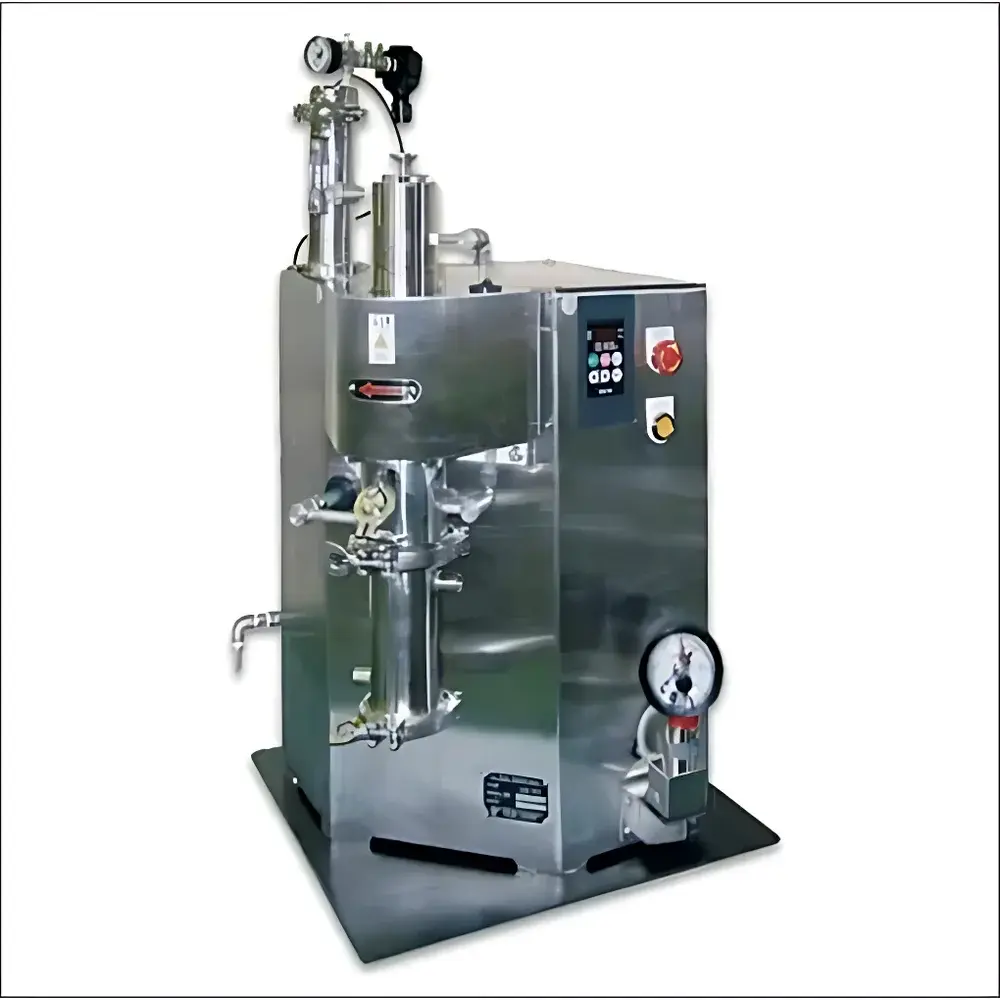
HM&M Apex Mill WAM Full-Length Bead Separator Mill
| Brand | HM&M (Japan) |
|---|---|
| Origin | Japan |
| Equipment Type | Wet Bead Mill |
| Model | Apex Mill WAM |
| Sample Applicability | Hard, brittle, and agglomerated materials |
| Feed Particle Size | >10 µm |
| Discharge Particle Size | <10 µm (down to 20 nm after processing) |
| Batch Processing Volume | 60 mL |
| Bead Size Range | Φ15 µm – Φ0.3 mm |
| Bead Separation Surface Area | 3–5× that of conventional separators |
| Maximum Slurry Viscosity | 2,000 mPa·s |
| Stirrer Tip Speed | 6–12 m/s |
| Motor Power Range | 2.2–55 kW |
| Chamber Volume Range | 0.15–30 L |
Overview
The HM&M Apex Mill WAM is a vertically oriented, full-length wet bead mill engineered for high-efficiency nano-dispersion and ultra-fine grinding of hard, brittle, or highly agglomerated solid materials in liquid suspension. It operates on the principle of high-shear mechanical attrition between precisely sized ceramic or zirconia beads and suspended particles under controlled hydrodynamic flow. Unlike conventional bead mills relying on static sieves or narrow-gap dynamic separators, the WAM integrates an extended axial multi-blade stirrer that simultaneously drives slurry circulation and performs active bead separation across an enlarged cross-sectional area—up to five times greater than standard designs. This architecture enables stable operation with sub-15 µm beads while maintaining throughput rates three times higher than comparable systems. The uniform vertical geometry of the stirrer ensures consistent shear distribution throughout the grinding chamber, minimizing localized hot spots and promoting reproducible particle size reduction down to 20 nm with narrow PDI (Polydispersity Index). Designed for R&D laboratories and pilot-scale production environments, the WAM supports stringent process validation requirements under GLP and GMP frameworks.
Key Features
- Full-length dynamic bead separator with 3–5× larger effective separation area versus conventional mills, enabling stable use of Φ15 µm beads without clogging.
- High-shear vertical stirrer optimized for uniform energy input—ensures homogeneous dispersion and minimizes secondary agglomeration.
- Capable of processing slurries up to 2,000 mPa·s viscosity while retaining sub-micron bead integrity and separation efficiency.
- Modular vertical design allows rapid disassembly for complete slurry recovery, cleaning, and bead inspection—critical for cross-material campaigns and regulatory traceability.
- Scalable platform with seven standard configurations (WAM-015 to WAM-30), supporting chamber volumes from 0.15 L to 30 L and motor power from 2.2 kW to 55 kW.
- Stirrer tip speed adjustable between 6–12 m/s, enabling precise control over impact energy and residence time distribution.
Sample Compatibility & Compliance
The Apex Mill WAM is validated for dispersion and size reduction of inorganic oxides (e.g., BaTiO₃, TiO₂, ITO), conductive nanomaterials (Ag, Cu), hollow silica, battery cathode/anode precursors (NMC, SiOₓ), pharmaceutical actives, and agrochemical suspensions. Its all-wet-contact path—constructed from corrosion-resistant stainless steel (SUS316L) and chemically inert wear components—complies with ISO 8502-3 for surface cleanliness and ASTM D7110 for colloidal stability assessment. For regulated applications, the system supports audit-ready operation when integrated with compliant data acquisition systems meeting FDA 21 CFR Part 11 requirements for electronic records and signatures.
Software & Data Management
While the base WAM operates via analog control panels with calibrated flow meters and pressure transducers, optional digital retrofit packages include PLC-based controllers with RS485/Modbus TCP interfaces. These enable integration into centralized lab automation platforms (e.g., LabVantage, Thermo Fisher SampleManager) for batch logging, parameter trending, and electronic batch record (EBR) generation. All operational parameters—including slurry feed rate, stirrer speed, inlet/outlet pressure differential, and temperature monitoring points—are timestamped and exportable in CSV or XML format. Audit trails are retained for ≥36 months per internal SOPs aligned with ALCOA+ data integrity principles.
Applications
The WAM delivers consistent performance in advanced material synthesis workflows requiring tight particle size control and minimal crystal lattice damage. Key use cases include: preparation of high-refractive-index pigment dispersions for LCD color filters; deagglomeration of lithium iron phosphate (LFP) cathode slurries prior to electrode coating; stabilization of photocatalytic TiO₂ nanoparticles for water purification membranes; formulation of nano-silver conductive inks with <5% CV in D50; and top-down nanonization of poorly soluble APIs to enhance bioavailability. Its ability to maintain narrow PSD under high-viscosity conditions makes it particularly suited for solvent-free or high-solid-content formulations common in battery electrolyte and thermal interface material development.
FAQ
What bead materials are compatible with the WAM series?
Zirconia (Y-TZP), silicon carbide, and alumina beads within Φ15 µm–Φ0.3 mm are fully supported. Bead density and hardness must be selected to match material hardness (e.g., Mohs ≥7 for ceramic precursors) and desired attrition profile.
Can the WAM process heat-sensitive materials?
Yes—jacketed grinding chambers (optional) support external cooling with thermostatic control (±0.5°C), and low-energy-per-pass configurations minimize adiabatic heating. Temperature probes at inlet/outlet and chamber wall are standard on WAM-1 and larger models.
Is validation documentation available for GMP environments?
HM&M provides Factory Acceptance Test (FAT) reports, IQ/OQ templates, and material compliance certificates (RoHS, REACH, USP Class VI for elastomers). Site-specific PQ protocols can be co-developed with qualified third-party validation partners.
How does the WAM compare to dual-axis or recirculation-type bead mills?
Unlike dual-stirrer systems, the WAM achieves equivalent homogeneity through axial flow optimization and extended separation length—not mechanical redundancy. Its single-axis design reduces maintenance complexity and eliminates inter-shaft synchronization risks, improving long-term operational reliability.



