
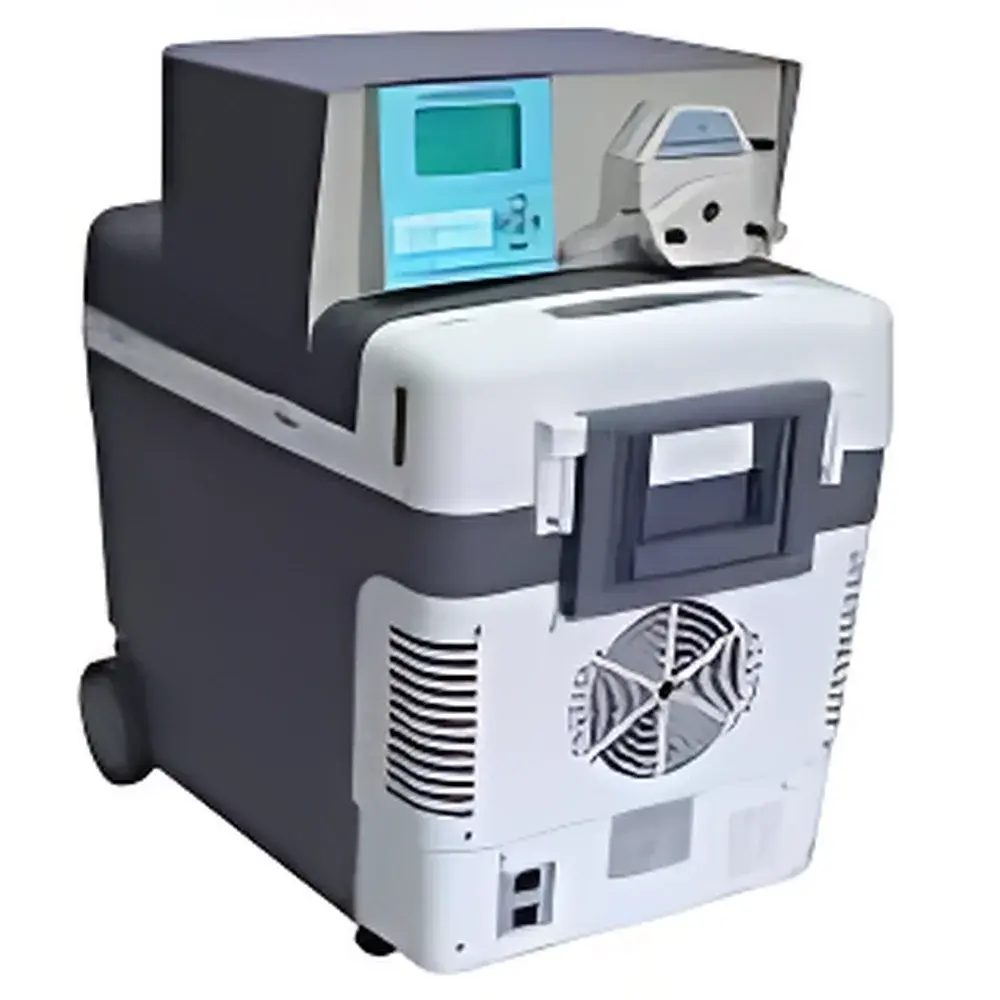
PTB-2012 Portable Multi-Function Water Sampler with Flow-Controlled Sampling
| Origin | Beijing |
|---|---|
| Manufacturer Type | Distributor |
| Origin Category | Domestic (China) |
| Model | PTB-2012 |
| Price Range | USD 1,400 – 2,800 |
| Instrument Type | Automatic Water Sampler |
| Sampling Mode | Time-Programmed and Volume-Quantified Sampling |
| Form Factor | Portable Water Sampler |
Overview
The PTB-2012 Portable Multi-Function Water Sampler is an integrated, field-deployable environmental monitoring instrument engineered for autonomous, flow-synchronized water sampling in dynamic surface water and wastewater discharge environments. It operates on the principle of programmable volumetric displacement combined with real-time hydraulic parameter acquisition—primarily using ultrasonic or submersible pressure transducers to measure liquid level, from which flow rate is derived based on pre-calibrated weir or flume geometry (e.g., triangular, rectangular, Parshall, or Palmer-Bowlus). Designed in strict compliance with China’s HJ/T 372–2007 “Technical Requirements and Testing Methods for Automatic Water Samplers”, the system supports regulatory-grade data collection for effluent monitoring, ambient water quality assessment, and source tracking applications. Its compact monocoque chassis (500 × 350 × 580 mm), lightweight construction (~12 kg), and dual-power architecture (AC 220 V / DC 12 V with internal rechargeable battery supporting ≥2,500 sampling cycles) enable extended unattended operation in remote watersheds, riverbanks, and municipal outfalls.
Key Features
- Modular firmware architecture with dual-CPU control and multi-stage opto-isolation for electromagnetic noise immunity in industrial and high-humidity field environments
- Configurable sampling logic: time-based, volume-based, flow-proportional (isokinetic), level-proportional, and fixed-interval modes
- Integrated flow computation engine compatible with standard hydraulic structures—including triangular weirs, rectangular weirs, broad-crested weirs, and Parshall flumes—enabling accurate discharge estimation across diverse channel geometries
- High-stability peristaltic pump driven by microstepping hybrid stepper motor, delivering consistent aspiration performance with ≤±5% volumetric accuracy (5–1000 mL per aliquot)
- Optically indexed mechanical sample distributor with auto-positioning precision, supporting single-bottle or composite (multi-port) fractionation into up to 12 vials
- Backlit LCD interface with Chinese-language menu navigation, password-protected configuration access, and auto-dimming function for power conservation
- Onboard non-volatile memory storing timestamps, flow records, level readings, pump actuation logs, and error diagnostics for post-deployment audit
- Remote sampling activation via RS-232/RS-485 serial interface or optional telemetry module, facilitating integration into SCADA networks and centralized EMS platforms
- Thermally insulated sample chamber maintaining internal temperature stability within ±2 °C, preserving sample integrity during transport
- Full-polymer enclosure rated IP65 for dust and water ingress resistance; certified for continuous operation >3,000 hours per maintenance cycle
Sample Compatibility & Compliance
The PTB-2012 accommodates standard polyethylene, glass, or fluoropolymer sampling containers (12-bottle carousel configuration supported). It meets structural and functional requirements outlined in HJ/T 372–2007 and aligns with internationally recognized practices for representative sampling under ISO 5667-10 (Water quality — Sampling — Part 10: Guidance on sampling of wastewater) and ASTM D3370 (Standard Practices for Sampling Water). While not FDA 21 CFR Part 11-certified out-of-the-box, its audit-trail-capable logging system supports GLP-compliant data handling when deployed in research or regulatory verification workflows. Electrical safety complies with GB 4793.1–2007 (equivalent to IEC 61010-1), with insulation resistance >50 MΩ and leak-tight tubing assembly rated to −0.05 MPa vacuum.
Software & Data Management
Data export is performed via USB or serial port in CSV format, containing timestamped entries for each sampling event, associated level/flow values, pump status flags, and battery voltage. Firmware supports user-defined calibration coefficients for specific weir/flume configurations and allows manual override of sampling parameters via keypad. No proprietary desktop software is required; raw logs are directly importable into LIMS, Excel, or Python/Pandas for statistical analysis. Optional Modbus RTU protocol implementation enables interoperability with third-party PLCs and telemetry gateways.
Applications
- Continuous effluent monitoring at industrial discharge points and WWTP outfalls
- Time-series sampling for nutrient (N/P), heavy metal, or organic contaminant trend analysis in rivers and reservoirs
- Flow-weighted composite sampling for compliance reporting under national discharge permits
- Source apportionment studies requiring synchronized hydrological and chemical data pairs
- Emergency response deployment for spill characterization and plume tracking
- Calibration validation of online analyzers (e.g., COD, NH₃-N, turbidity sensors) through grab-sample correlation
FAQ
What types of flow measurement devices can be interfaced with the PTB-2012?
It accepts analog 4–20 mA signals from ultrasonic level sensors or submersible pressure transmitters, and supports direct integration with Parshall, Palmer-Bowlus, and trapezoidal flumes via user-entered hydraulic equations.
Is the sampler suitable for seawater or highly corrosive wastewater?
Yes—the wetted path uses chemically resistant silicone or EPDM tubing, and the housing is corrosion-inhibited polymer; however, prolonged exposure to undiluted brine or strong oxidants requires periodic inspection of pump tubing and seals.
How is sample integrity maintained during extended field deployment?
The insulated cold compartment maintains ambient-equivalent temperatures (±2 °C deviation), and all sample contact materials comply with USP Class VI biocompatibility standards for aqueous matrices.
Can sampling intervals be dynamically adjusted in the field without returning to base?
Yes—field personnel may reprogram interval timing, volume targets, and trigger conditions using the onboard keypad and menu system, with changes saved immediately to non-volatile memory.
Does the unit support external GPS synchronization for georeferenced sampling events?
Not natively; however, UTC timestamps from the internal real-time clock (drift ≤0.1% per month) can be post-processed alongside GPS-track logs collected separately on mobile devices or dataloggers.
Related Products







