
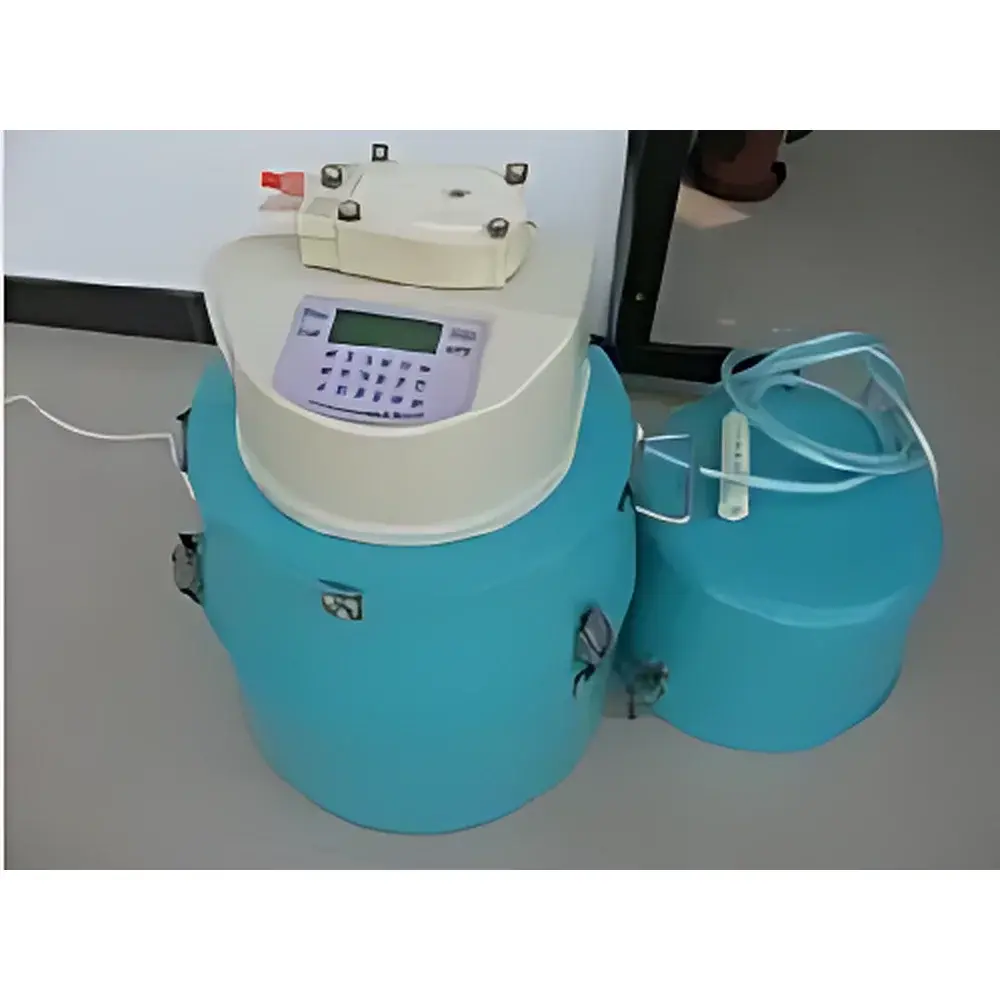
PTB2013 Portable Proportional Automatic Water Sampler
| Origin | Beijing |
|---|---|
| Manufacturer Type | Distributor |
| Origin Category | Domestic (China) |
| Model | PTB2013 |
| Price | Upon Request |
| Display | Large LCD with Full Chinese Menu |
| Printer Interface | RS232 |
| Sampling Modes | Time-Proportional & Flow-Proportional |
| Sampling Interval | 3 min – 6 days |
| Sample Volume per Event | 50–1000 mL (1 mL increment) |
| Maximum Composite Samples | 200 |
| Storage Capacity | 256 sets of flow data (date/time, instantaneous & cumulative flow) |
| Pump Type | Peristaltic |
| Tubing ID | 10 mm |
| Suction Lift | 7.2 m |
| Flow Rate | 2.4 L/min @ 3 m suction head |
| Sampling Depth | 2–18 m |
| Sampling Accuracy | ±8 mL (inter-sample repeatability) |
| Sample Container | Single 5 L or 10 L PE drum or glass bottle |
| Enclosure Rating | IP65 |
| Housing Material | Acid- and alkali-resistant polymer |
| Operating Temperature | −5 °C to +50 °C |
| Power Supply | AC 220 V or optional battery |
| Power Consumption | 45 W |
| Auto-Rinse Cycles | 0–2 per sampling event |
| Programmable Protocols | 10 user-storable methods |
| Flow Input Compatibility | Pulse (5–15 V positive), 4–20 mA analog, ultrasonic/pressure level sensors |
| Weir/Flume Support | Parshall, Palmer-Bowlus, Palmer-type, triangular, rectangular, trapezoidal weirs |
Overview
The PTB2013 Portable Proportional Automatic Water Sampler is an engineered field-deployable instrument designed for regulatory-compliant wastewater and surface water monitoring in accordance with national environmental monitoring protocols. It operates on two primary sampling principles: time-proportional (fixed-interval) and flow-proportional (dynamic-volume) sampling—both aligned with ISO 5667-10:2022 (Water quality — Sampling — Part 10: Guidance on sampling of wastewater) and China’s HJ/T 372–2007 technical specification for automatic water samplers. The device integrates a high-reliability peristaltic pump system with programmable logic control, enabling precise volumetric delivery under variable suction conditions (up to 7.2 m lift) and across depths ranging from 2 to 18 meters. Its single-container composite sampling architecture—using chemically inert 5 L or 10 L polyethylene drums—ensures representative integration of heterogeneous effluent streams while minimizing cross-contamination risk. The unit is explicitly intended for use by environmental monitoring stations, pollution supervision agencies, and municipal wastewater treatment facilities requiring auditable, traceable, and repeatable composite sample generation.
Key Features
- IP65-rated enclosure constructed from corrosion-resistant polymer housing, validated for long-term deployment in acidic, alkaline, and high-humidity industrial effluent environments.
- Peristaltic pumping mechanism with 10 mm internal-diameter tubing, delivering 2.4 L/min at 3 m suction head and maintaining ≥1.5 L/min at full 6 m lift—ensuring consistent performance across real-world hydraulic gradients.
- Dual-mode sampling logic: programmable time-based intervals (3 minutes to 6 days) and flow-proportional triggering via pulse (1–9999 pulses) or 4–20 mA analog input from external flowmeters or ultrasonic/pressure-based level sensors.
- Onboard data logging of up to 256 flow data records—including date, time, instantaneous flow rate, and cumulative flow—with non-volatile memory retention and circular overwrite functionality.
- Full Chinese-language interface with password-protected configuration menus, supporting 10 pre-programmed sampling protocols for rapid field reconfiguration without software dependency.
- Integrated tubing auto-rinse function (0–2 cycles per sampling event) to mitigate carryover between discrete events, critical for sequential multi-parameter analysis workflows.
- RS232 serial interface for direct thermal printer output of sampling timestamps, flow metrics, and diagnostic logs—facilitating GLP-aligned recordkeeping and audit readiness.
Sample Compatibility & Compliance
The PTB2013 accommodates standard 5 L and 10 L polyethylene composite sample containers, selected for low adsorption characteristics toward priority pollutants (e.g., heavy metals, organic micropollutants) per EPA Method 1664 and ISO 11567. Its flow-proportional mode supports integration with Parshall, Palmer-Bowlus, triangular, rectangular, and trapezoidal weirs—as well as flumes—enabling compliance with ASTM D5389-20 (Standard Practice for Flow Measurement in Open Channels Using Weirs and Flumes). The instrument’s ±8 mL inter-sample repeatability meets the precision requirements for composite sampling outlined in China’s HJ 91.1–2019 (Technical Specifications for Monitoring of Surface Water and Wastewater). All electrical interfaces conform to IEC 61000-6-2 (immunity) and IEC 61000-6-3 (emissions), ensuring electromagnetic compatibility in industrial monitoring sites.
Software & Data Management
The embedded firmware implements deterministic real-time scheduling with microsecond-level timing resolution for both time- and pulse-triggered sampling events. Flow data acquisition supports configurable sampling intervals (user-defined minutes/hours between records), with each entry storing UTC-synchronized timestamp, instantaneous flow (L/s), and cumulative total (m³). Data persistence is guaranteed via EEPROM-backed storage; no battery backup is required for retention beyond power loss. Export is limited to ASCII-formatted RS232 dumps compatible with common spreadsheet and LIMS platforms (e.g., LabWare, Thermo Fisher SampleManager). While the device does not support FDA 21 CFR Part 11 electronic signature or audit trail features natively, its immutable timestamped printouts and fixed-protocol operation enable retrospective validation under ISO/IEC 17025:2017 Clause 7.7 (result reporting) when paired with documented chain-of-custody procedures.
Applications
- Regulatory wastewater discharge monitoring at industrial outfalls, where flow-proportional compositing ensures representative daily load quantification per national emission standards.
- Routine surveillance at municipal wastewater treatment plants (WWTPs), supporting influent/effluent mass balance calculations and nutrient removal efficiency assessment.
- Short-term compliance verification during process upsets or maintenance periods, leveraging manual and random sampling modes for rapid response.
- Field calibration of open-channel flowmeters using synchronized sampling and gravimetric verification.
- Multi-point composite sampling in combined sewer overflow (CSO) studies, where temporal and hydraulic variability necessitates integrated sample representation.
FAQ
What types of flow sensors are compatible with the PTB2013 for proportional sampling?
The sampler accepts pulse outputs (5–15 V positive, 1–9999 pulses) from turbine, magnetic, or ultrasonic flowmeters, as well as 4–20 mA analog signals from differential pressure or Doppler-based transmitters. It also directly interfaces with ultrasonic level sensors for weir/flume-based flow estimation.
Can the PTB2013 store sampling events independently of flow data?
Yes—time-based sampling events are logged with timestamps regardless of flow sensor connection; flow data recording is conditional upon active sensor input and user-enabled logging settings.
Is the 10 L sample container suitable for volatile organic compound (VOC) analysis?
Polyethylene drums are not recommended for VOC preservation; users must substitute certified glass containers meeting EPA Method 502.2 requirements, with appropriate headspace management and cold-chain handling prior to analysis.
Does the instrument support remote configuration or telemetry?
No—PTB2013 lacks built-in cellular, LoRaWAN, or Ethernet connectivity. Configuration and data retrieval require local physical access via keypad and RS232 interface.
How is calibration traceability maintained for the peristaltic pump?
Pump accuracy (±8 mL repeatability) is verified during factory acceptance testing using gravimetric measurement per ISO 8466-1. Field recalibration is performed manually by adjusting tubing compression and validating delivered volume against reference volumetric glassware.







