
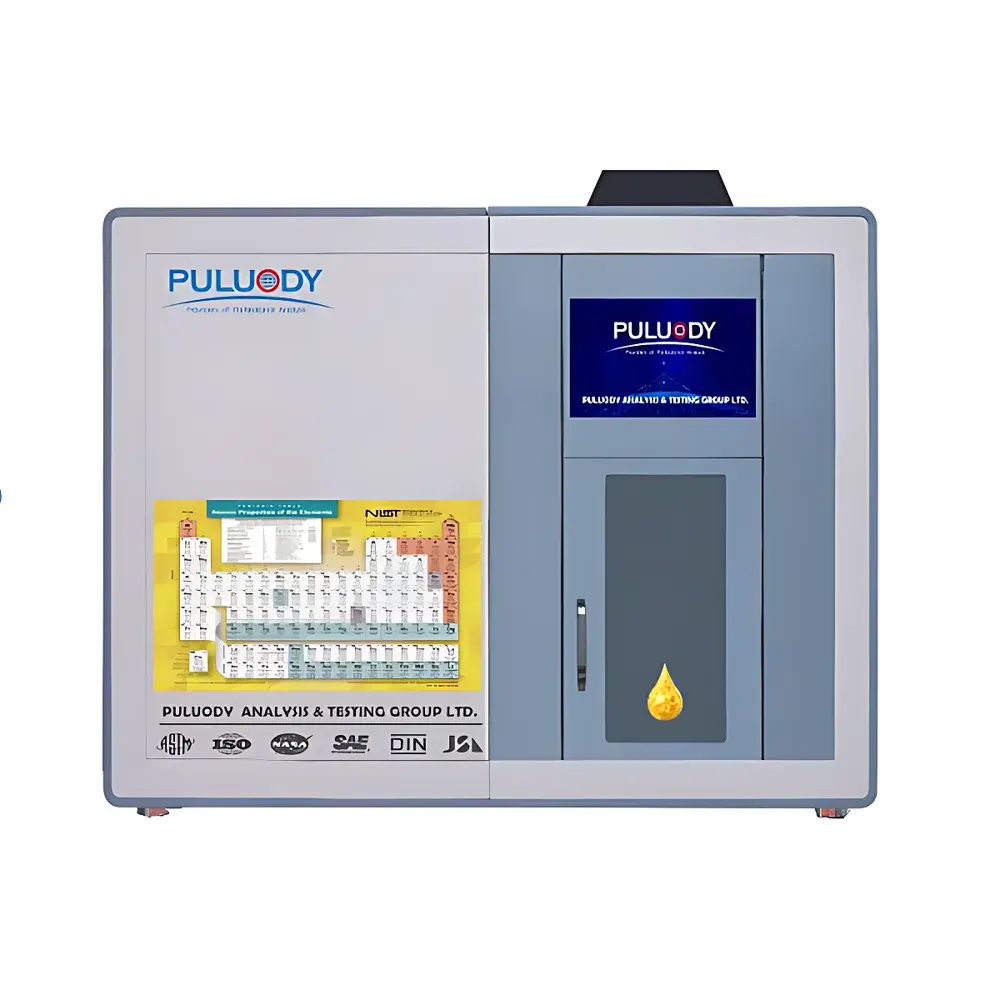
PULUODY P-ICP Rotating Disc Electrode Atomic Emission Spectrometer (RDE-AES) for Lubricant and Petroleum Fluid Elemental Analysis
| Brand | PULUODY |
|---|---|
| Origin | Shaanxi, China |
| Manufacturer Type | Direct Manufacturer |
| Regional Classification | Domestic (China) |
| Model | P-ICP |
| Product Category | Laboratory Instrument |
| Analytical Method | Rotating Disc Electrode Atomic Emission Spectrometry (RDE-AES) |
| Compliant Standards | ASTM D6595, ASTM D6728, NB/SH/T 0865, SN/T 1652, DL/T 1550, JJF (Defense) 1752018 |
| Customizable Detection Channels | 1000 channels |
Overview
The PULUODY P-ICP Rotating Disc Electrode Atomic Emission Spectrometer (RDE-AES) is a dedicated laboratory instrument engineered for rapid, multi-element quantitative analysis of metallic wear debris, additive elements, and contaminants in petroleum-based and synthetic lubricants, hydraulic fluids, transformer oils, turbine oils, fuels, and related organic liquid matrices. It operates on the principle of rotating disc electrode excitation—where a carbon or tungsten disc electrode is immersed in the oil sample and rotated at high speed (~300–600 rpm) while subjected to a high-frequency radiofrequency (RF) plasma arc (27.12 MHz). This process atomizes and excites elemental species in the sample, generating characteristic atomic emission lines across the UV–VIS spectral range (190–800 nm). The emitted light is dispersed via a high-resolution echelle grating (2400 L/mm, 80 × 110 mm ruled area) and detected using a seventh-generation PULUODY precision photodetector array. With detection limits reaching sub-ppb (≤1 µg/L) for over 61 elements—including Al, Fe, Cu, Cr, Pb, Zn, Ca, Mg, Si, Na, B, Mo, Ni, V, Sn, Ti, and trace additives such as Ba, P, Li, Sr, and Ce—the system enables condition monitoring of machinery health through elemental fingerprinting of used oils.
Key Features
- Multi-element simultaneous detection capability with up to 1000 programmable spectral channels, supporting customizable element prioritization and sequential reporting.
- High spectral resolution (≤0.015 nm) and broad linear dynamic range (>5 orders of magnitude), enabling accurate quantification of both trace wear metals (e.g., 0.01 ppm Fe) and high-concentration additives (e.g., 10,000 ppm Zn) in a single run.
- Analysis throughput of ≥4 elements per minute, optimized for routine laboratory workflows and high-volume oil-in-service (OIS) programs.
- Robust RF plasma source (800–1600 W output, stability ≤0.2%) with precise frequency control (27.12 MHz ±0.05%), ensuring consistent excitation energy and measurement reproducibility.
- Integrated RDE sample introduction requiring only >1 mL of unprocessed oil—no digestion, dilution, or solvent extraction required—minimizing preparation time and contamination risk.
- Thermal and humidity resilience: operational within ambient temperature (20–45 °C) and relative humidity (0–90% RH, non-condensing), suitable for industrial lab environments without climate-controlled rooms.
Sample Compatibility & Compliance
The P-ICP is validated for direct analysis of a wide range of hydrocarbon-based and polar fluid matrices, including but not limited to: mineral and synthetic lubricating oils, hydraulic fluids (HLP, HVLP), transformer oils (mineral insulation oils), turbine oils (ISO-L-TGA), gear oils, engine oils (SAE grades), aviation kerosene (Jet A-1), diesel fuel, antifreeze/coolants, and polymer solutions. It complies fully with ASTM D6595 (“Standard Test Method for Determination of Wear Metals and Contaminants in Used Lubricating Oils or Used Hydraulic Fluids by Rotating Disc Electrode Atomic Emission Spectrometry”) and ASTM D6728 (“Standard Test Method for Determination of Contaminants in Gas Turbine and Diesel Engine Fuel by RDE-AES”). Additional alignment includes NB/SH/T 0865 (China National Energy Administration), SN/T 1652 (Customs Testing Standard), DL/T 1550 (Power Industry Standard for Cu/Fe in transformer oil), and JJF (Defense) 1752018 (Calibration Specification for Oil Emission Spectrometers). All compliance documentation supports GLP and GMP-aligned data integrity requirements, including audit-ready calibration logs and traceable reference material usage.
Software & Data Management
The PICP-V2.1 analytical software platform—available in English, Chinese, Korean, and Japanese (export-configurable)—provides full method development, acquisition control, spectral deconvolution, and quantitative reporting. It incorporates over 30,000 certified emission lines from NIST, IUPAC, and ASTM spectral databases for robust peak identification and interference correction. Key functions include: automated background subtraction, internal standard normalization (e.g., C or Fe reference line), multi-point calibration curve generation (linear/logarithmic), statistical outlier rejection, RSD calculation (≤1.5% repeatability, ≤2% stability), and trend-based alarm thresholding per element. Data outputs conform to ISO/IEC 17025 documentation standards: reports include method ID, instrument model, element name, wavelength, net intensity, concentration (ppm or µg/L), RSD (%), unit, analyst ID, approval signature, and timestamp. Export formats include PDF, Excel (.xlsx), Word (.docx), and plain-text (.csv), all retaining full metadata for regulatory review. Software supports 21 CFR Part 11-compliant user access controls, electronic signatures, and immutable audit trails when deployed on validated Windows OS platforms (Windows 7–11, x64).
Applications
The P-ICP serves critical roles in predictive maintenance and fluid lifecycle management across aerospace, power generation, marine propulsion, rail transport, heavy equipment manufacturing, and semiconductor fabrication facilities. In turbine and gearbox monitoring, it detects early-stage bearing wear (Fe, Cr, Ni), gear pitting (Cu, Sn), and coolant ingress (Na, K, Si). For diesel and gas turbine engines, it quantifies fuel-borne contaminants (V, Na, Al) and lube degradation markers (P, Zn depletion; Ca/Ba additive burn-off). In transformer asset management, it tracks copper and iron corrosion products correlated with paper insulation aging and thermal faults. Beyond oil, the system analyzes aqueous coolants, glycol-based antifreezes, and acid wash solutions for metal leaching (e.g., Cu, Pb, Zn from heat exchangers). Its capacity for historical data aggregation enables longitudinal trending—supporting ISO 4406 particle count correlation, NAS 1638 classification, and root-cause failure analysis under FMEA frameworks.
FAQ
What sample preparation is required prior to analysis?
No chemical digestion or dilution is needed. Samples are introduced directly onto the rotating disc electrode after filtration (≤5 µm) to remove large particulates.
Can the P-ICP analyze water-based or acidic samples?
Yes—provided viscosity and conductivity fall within defined operational limits (e.g., aqueous coolants, inhibited glycols, and low-concentration organic acids); optional electrode material selection (tungsten vs. graphite) optimizes performance for corrosive matrices.
Is method validation support available for ISO/IEC 17025 accreditation?
Yes—PULUODY provides documented IQ/OQ/PQ protocols, certified reference materials (CRM) compatibility lists, uncertainty budgets, and traceable calibration certificates aligned with ISO/IEC 17025:2017 Clause 7.7.
How is spectral interference managed during multi-element analysis?
PICP-V2.1 employs iterative least-squares fitting with secondary line verification, built-in inter-element correction coefficients (IEC), and real-time continuum background modeling to resolve overlapping emissions (e.g., Fe 238.204 nm / Cr 238.203 nm).
Does the system support remote diagnostics and firmware updates?
Yes—via secure TLS-encrypted Ethernet connection; remote support includes live spectral view, parameter logging, and over-the-air firmware revision deployment (with version-controlled rollback capability).





