
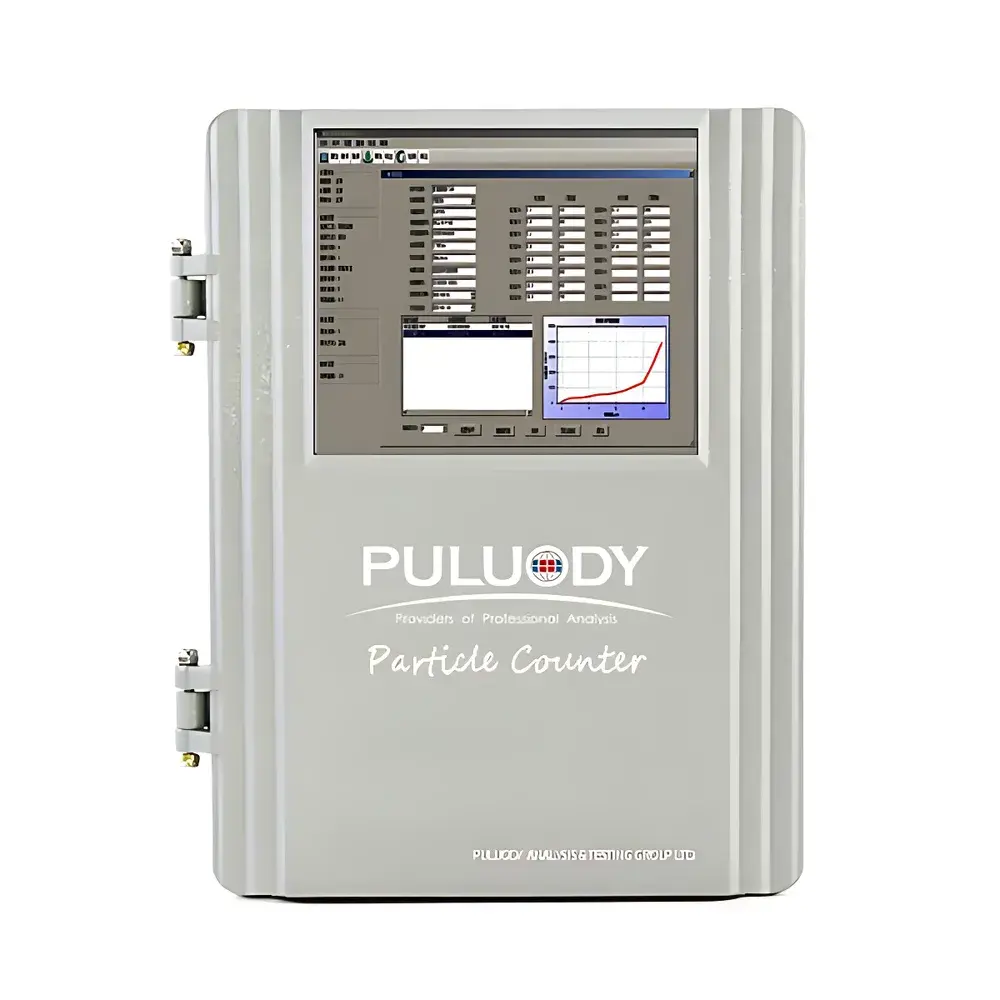
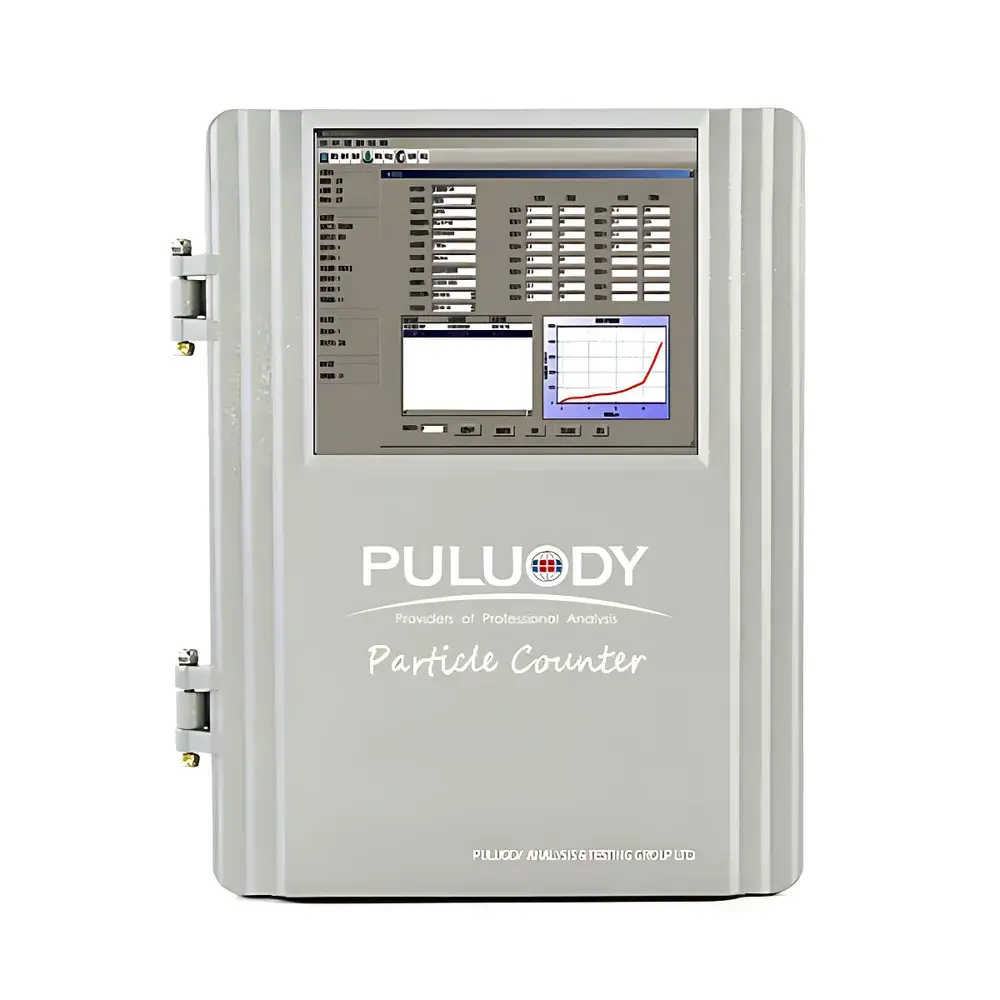
PULUODY OPC-2300 Online Waterborne Particle Counter
| Brand | PULUODY |
|---|---|
| Origin | Shaanxi, China |
| Manufacturer Type | Manufacturer |
| Product Category | Domestic |
| Model | OPC-2300 |
| Price | ¥98,000 |
| Dispersion Method | Dry/Wet Dispersion |
| Instrument Type | Online Laser Particle Size Analyzer |
| Measurement Range | 2–750 µm |
| Repeatability | ±5% |
| Measurement Time | 0.01 s |
Overview
The PULUODY OPC-2300 Online Waterborne Particle Counter is an industrial-grade, real-time particle monitoring system engineered for continuous, in-line analysis of suspended particulate matter in aqueous process streams. It operates on the principle of light extinction (also known as optical blockage or light obscuration), a standardized method defined in ISO 11171, ISO 4402 (replaced by ISO 11171 for calibration), and ASTM D6786. The instrument integrates PULUODY’s proprietary 7th-generation dual-laser narrow-beam sensing technology—designed to minimize signal noise, enhance optical resolution, and improve detection stability across dynamic flow conditions. Unlike benchtop laser diffraction systems optimized for batch analysis, the OPC-2300 is purpose-built for unattended, long-term deployment in water treatment infrastructure, beverage production lines, pharmaceutical water loops, and critical filtration validation processes. Its core function is not size distribution modeling per se, but high-fidelity particle counting and sizing within discrete, user-defined channels—enabling compliance-driven reporting of particle concentration (particles/mL) and ISO 4406 or NAS 1638 contamination codes.
Key Features
- Real-time, continuous sampling with configurable monitoring intervals (5 seconds to 9 hours)
- Dual-laser narrow-beam optical sensor architecture for improved signal-to-noise ratio and reduced coincidence error (≤5% at maximum rated concentration)
- Multi-range sensor compatibility: Standard K-sensor covers 2–750 µm; optional H-, I-, J-, L-, M-, and N-sensors extend detection down to 0.1 µm or up to 2000 µm
- High-resolution channel configuration: Up to 1000 user-selectable size bins; minimum bin width: 0.1 µm
- Robust process interface: Operating pressure range up to 31.5 MPa (with integrated pressure-reducing valve); fluid temperature tolerance from –10 °C to +80 °C
- Flexible connectivity: Analog 4–20 mA output, RS232/RS485 serial interface, and optional Modbus RTU protocol support for integration into DCS, SCADA, or PLC environments
- IP65-rated enclosure with corrosion-resistant housing suitable for harsh industrial environments including outdoor waterworks and high-humidity cleanrooms
- Onboard data logging with unlimited storage capacity and timestamped event tagging (e.g., alarm triggers, calibration events, flow anomalies)
Sample Compatibility & Compliance
The OPC-2300 is validated for use with potable water, ultrapure water (UPW), wastewater effluent, filtered process water, and low-viscosity aqueous solutions typical in food & beverage, pharmaceutical, and microelectronics manufacturing. It complies with key regulatory frameworks governing particle control in critical water systems—including USP and for injectable and ophthalmic preparations, EU Annex 1 requirements for sterile water systems, and ISO 8573-7 for compressed air-associated water quality. Calibration traceability follows ISO 17025-accredited protocols using NIST-traceable polystyrene latex (PSL) reference standards or Acrylic (AC) and Modified Tetraethyl Orthosilicate (MTD) suspensions. Optional firmware modules allow direct mapping to ISO 4406:2017 code generation and customizable pass/fail logic per particle size band.
Software & Data Management
The integrated control software provides local HMI operation via backlit LCD display and membrane keypad, supporting full parameter configuration without external PC dependency. For centralized oversight, the OPC-2300 supports secure remote access via Ethernet or serial gateway for data export in CSV, XML, or database-ready formats. Audit trails—including operator logins, calibration history, alarm acknowledgments, and firmware version logs—are maintained in accordance with FDA 21 CFR Part 11 requirements when deployed in GMP-regulated environments. Data integrity safeguards include write-protected memory partitions, cyclic redundancy check (CRC) validation on all stored records, and configurable auto-backup to network-attached storage (NAS) or cloud endpoints.
Applications
- Continuous integrity testing of membrane filters (RO, UF, MF) in municipal and industrial water treatment plants
- Early-warning monitoring of biofilm shedding or filter breakthrough in pharmaceutical purified water (PW) and water-for-injection (WFI) distribution loops
- Quantitative assessment of particulate removal efficiency across multi-stage filtration systems (e.g., multimedia, activated carbon, cartridge filters)
- Process validation and routine surveillance in breweries, soft drink bottling lines, and dairy processing facilities
- Supporting root-cause analysis of equipment wear in closed-loop cooling water or boiler feedwater systems via trending of coarse particle counts (>25 µm)
- Compliance documentation for ISO 22000, BRCGS, and SQF food safety management systems requiring objective particulate control evidence
FAQ
What particle detection principle does the OPC-2300 employ?
It uses light extinction (optical blockage), where particles passing through a focused laser beam attenuate transmitted light intensity proportionally to their cross-sectional area.
Can the OPC-2300 be calibrated against internationally recognized standards?
Yes—it supports calibration using ISO 11171-compliant PSL reference materials, as well as AC and MTD suspensions traceable to national metrology institutes.
Is the instrument suitable for high-pressure applications such as reverse osmosis monitoring?
Yes—when equipped with the optional pressure-reducing valve assembly, it operates continuously at pressures up to 31.5 MPa.
Does the system meet FDA 21 CFR Part 11 requirements for electronic records and signatures?
The firmware includes audit trail logging, user access controls, and electronic signature capability when configured with appropriate IT infrastructure and procedural controls.
How is particle concentration reported?
Results are delivered as absolute counts per milliliter (particles/mL) across user-defined size bands, plus optional ISO 4406 or NAS 1638 contamination codes.



