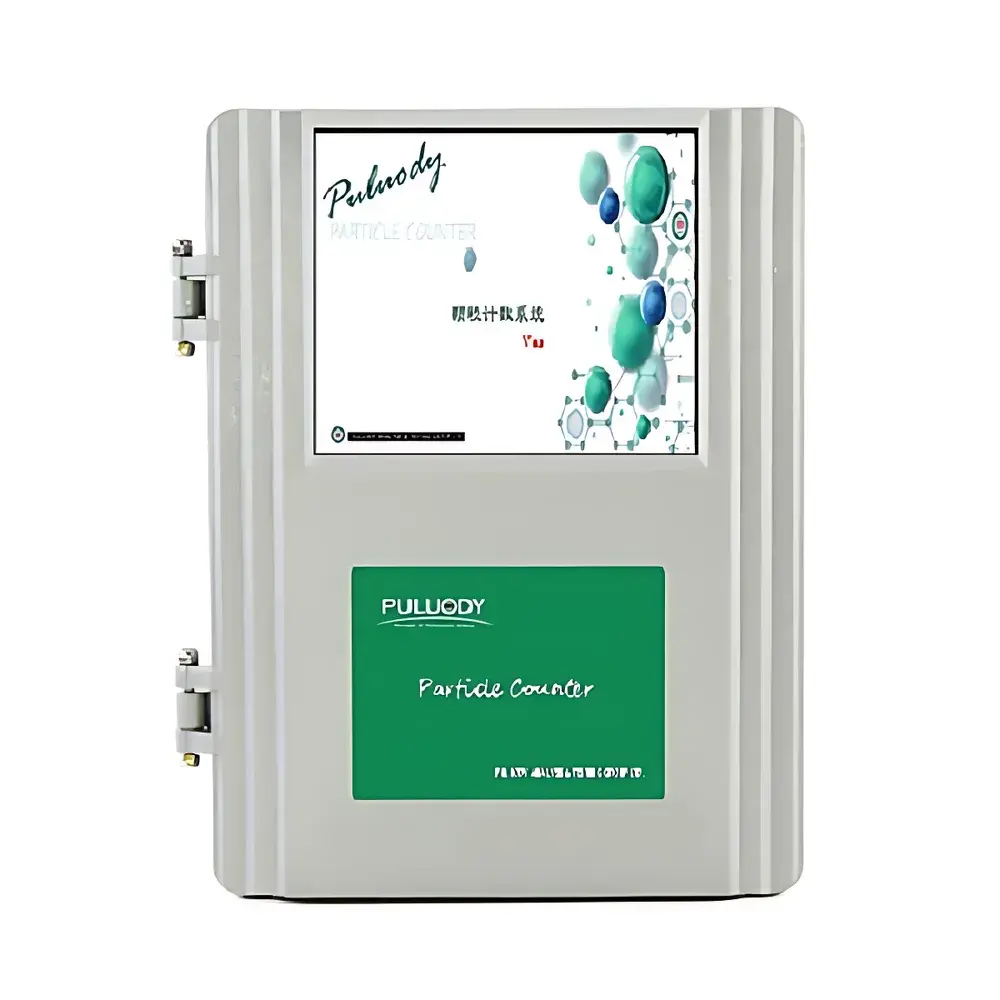
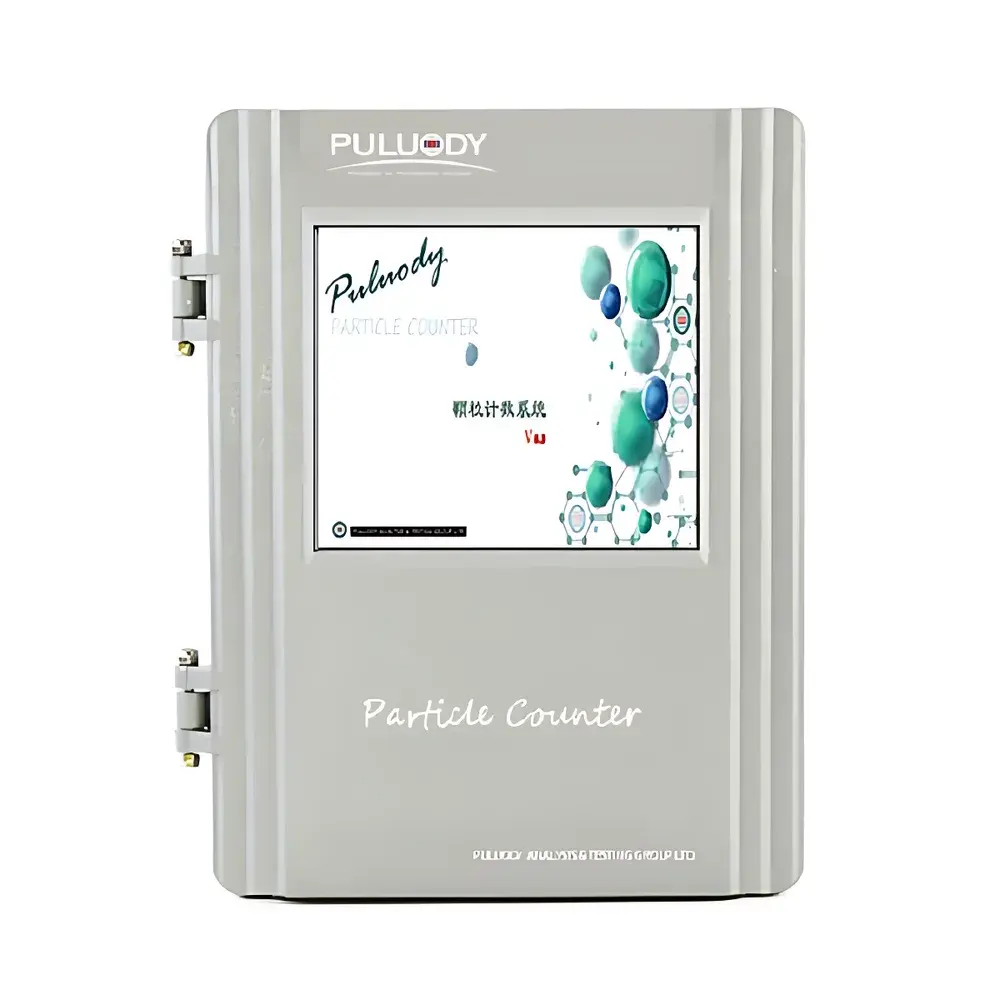
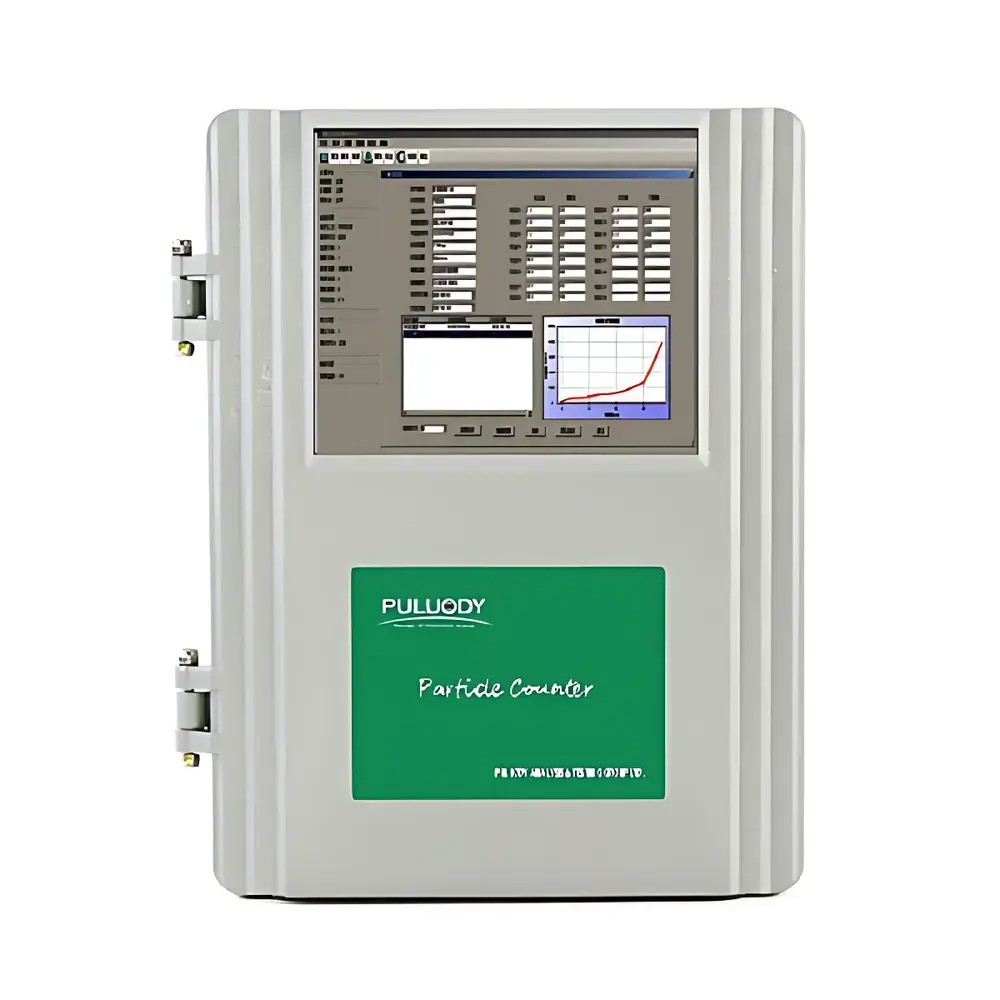
PULUODY OPC-2300F Online Liquid Particle Counter
| Brand | PULUODY |
|---|---|
| Origin | Shaanxi, China |
| Model | OPC-2300F |
| Detection Principle | Light Obscuration (LO) / Dual-Laser Narrow-Beam Optical Sensing |
| Sensor Options | A (2–100 µm), B (1–150 µm), C (1–450 µm), H (0.1–1.0 µm), I (0.2–2.0 µm), J (0.5–50.0 µm), K (2–750 µm / 2–800 µm / 5–1000 µm), L (40–1000 µm / 10–2000 µm), N (50–1000 µm), M (100–2000 µm) |
| Sizing Range | 1–100 µm, 2–125 µm, 2–250 µm, 5–500 µm (customizable) |
| Channel Resolution | 1000-channel arbitrary binning (e.g., 8/16/32 bins) |
| Resolution | 0.1 µm |
| Counting Accuracy | < ±3% typical |
| Coincidence Error | ≤5% |
| Maximum Detectable Concentration | 9,999,999 particles/mL |
| Sampling Interval | 5 s – 9 h |
| Calibration Standards | NIST-traceable latex spheres, AC fine test dust, MTD |
| Operating Pressure | 0–0.6 MPa (standard) |
| Flow Rate | 6–500 mL/min |
| Fluid Temperature Range | −10 °C to +80 °C |
| Output Interfaces | RS-232, 4–20 mA analog, optional Ethernet/Modbus TCP |
| Housing | IP65-rated stainless steel or industrial-grade polymer |
| Compliance | Supports ISO 4406, ISO 11171, ASTM D6786, USP <788>, EP 2.9.19, and custom regulatory logic per client requirement |
Overview
The PULUODY OPC-2300F Online Liquid Particle Counter is an industrial-grade, real-time particle monitoring system engineered for continuous, unattended measurement of suspended particulate contamination in aqueous process streams. It operates on the principle of light obscuration (also known as the optical blockage or photometric blocking method), where particles passing through a precisely collimated dual-laser narrow-beam sensing zone attenuate incident light proportionally to their cross-sectional area. This seventh-generation optical architecture—developed under license from PULUODY Analytical Testing Group (UK)—delivers enhanced signal stability, reduced noise floor, and improved detection fidelity across submicron to millimeter-scale particles. Unlike offline laboratory counters requiring manual sampling and preparation, the OPC-2300F integrates directly into pressurized water loops with minimal dead volume, enabling true in-line, non-invasive surveillance of filtration integrity, membrane performance, and microbial risk indicators without flow interruption or sample dilution.
Key Features
- Dual-laser narrow-beam optical sensor platform with configurable wavelength alignment for optimal sensitivity across multiple size ranges
- Modular sensor head options covering 0.1 µm to 2000 µm detection thresholds—selectable per application requirements (e.g., H-sensor for ultrafine colloids; L/M-sensors for coarse filter effluent)
- 1000-channel high-resolution pulse-height analysis with user-definable binning (8/16/32 arbitrary channels) for granular distribution profiling
- Real-time concentration reporting up to 9.99 million particles/mL with coincidence error compensation algorithm
- Wide operational envelope: −10 °C to +80 °C fluid temperature, 0–31.5 MPa line pressure (with integrated pressure regulation), and adjustable flow rates from 6 to 500 mL/min
- Robust industrial enclosure rated IP65 with corrosion-resistant wetted materials (316L SS, PEEK, FKM seals) suitable for municipal, pharmaceutical, and food-grade environments
- Multi-protocol digital output (RS-232, Modbus RTU/TCP) plus analog 4–20 mA loop for seamless integration into DCS, SCADA, and PLC-based control systems
Sample Compatibility & Compliance
The OPC-2300F is validated for use with clarified potable water, filtered process water, reverse osmosis permeate, ultrapure water (UPW), beverage base solutions, and low-viscosity cleaning agents (e.g., CIP formulations). It excludes opaque, highly turbid, or strongly fluorescent fluids that compromise optical path integrity. Regulatory alignment includes built-in support for ISO 4406:2017 (fluid cleanliness coding), ISO 11171:2010 (calibration standard traceability), ASTM D6786-22 (particle counting in water), and pharmacopeial methods including USP (particulate matter in injections) and European Pharmacopoeia EP 2.9.19 (subvisible particles). Optional firmware modules allow configurable pass/fail logic per customer-defined alert thresholds, with full audit trail logging compliant with FDA 21 CFR Part 11 requirements when paired with validated software platforms.
Software & Data Management
The integrated firmware supports local data storage (SD card or internal flash) with timestamped histograms, cumulative counts, and differential distribution curves. Remote access is enabled via optional web server module or OPC UA gateway, permitting live dashboard visualization and historical trend analysis. Export formats include CSV, PDF reports, and XML-compatible datasets compatible with LIMS and MES infrastructure. Calibration history—including date, operator ID, reference standard lot number, and deviation logs—is retained indefinitely with write-protected archival. All configuration changes trigger immutable event records with user attribution and UTC timestamps, satisfying GLP/GMP documentation rigor for quality-critical applications.
Applications
- Continuous integrity verification of microfiltration and ultrafiltration membranes in drinking water treatment plants
- Early-stage detection of biofilm shedding or cryptosporidium oocyst breakthrough in municipal distribution networks
- Quantitative assessment of cartridge filter efficiency decay during service life in pharmaceutical water-for-injection (WFI) systems
- Real-time validation of final rinse clarity in semiconductor tool cleaning stations and biopharma equipment sanitization cycles
- Process consistency monitoring in beverage bottling lines—detecting carbonation-induced nucleation, filler valve wear debris, or tank coating flaking
- Supporting root cause analysis in HVAC condensate monitoring and closed-loop cooling tower management
FAQ
What particle sizing standards does the OPC-2300F support?
It natively implements ISO 11171-compliant calibration protocols and allows user-defined sizing matrices aligned with ISO 4406, NAS 1638, or custom bin structures.
Can the OPC-2300F operate in high-pressure boiler feedwater systems?
Yes—when equipped with the high-pressure option (0–31.5 MPa), it interfaces directly with ASME B16.5 Class 1500 flanged piping using certified pressure-tight couplings.
Is offline calibration possible without interrupting production?
A dedicated bypass manifold kit enables hot-swappable sensor calibration using traceable reference suspensions while maintaining continuous online monitoring via redundant channel routing.
Does the device meet cybersecurity requirements for Industry 4.0 deployment?
Firmware v3.2+ includes TLS 1.2 encryption, role-based access control (RBAC), and secure boot verification—certified per IEC 62443-3-3 SL2 baseline.
How is temperature drift compensated during extended operation?
An embedded Pt1000 thermistor continuously feeds ambient and fluid temperature data to the signal processor, applying dynamic gain correction to maintain sizing accuracy across the full −10 °C to +80 °C range.
Related Products