
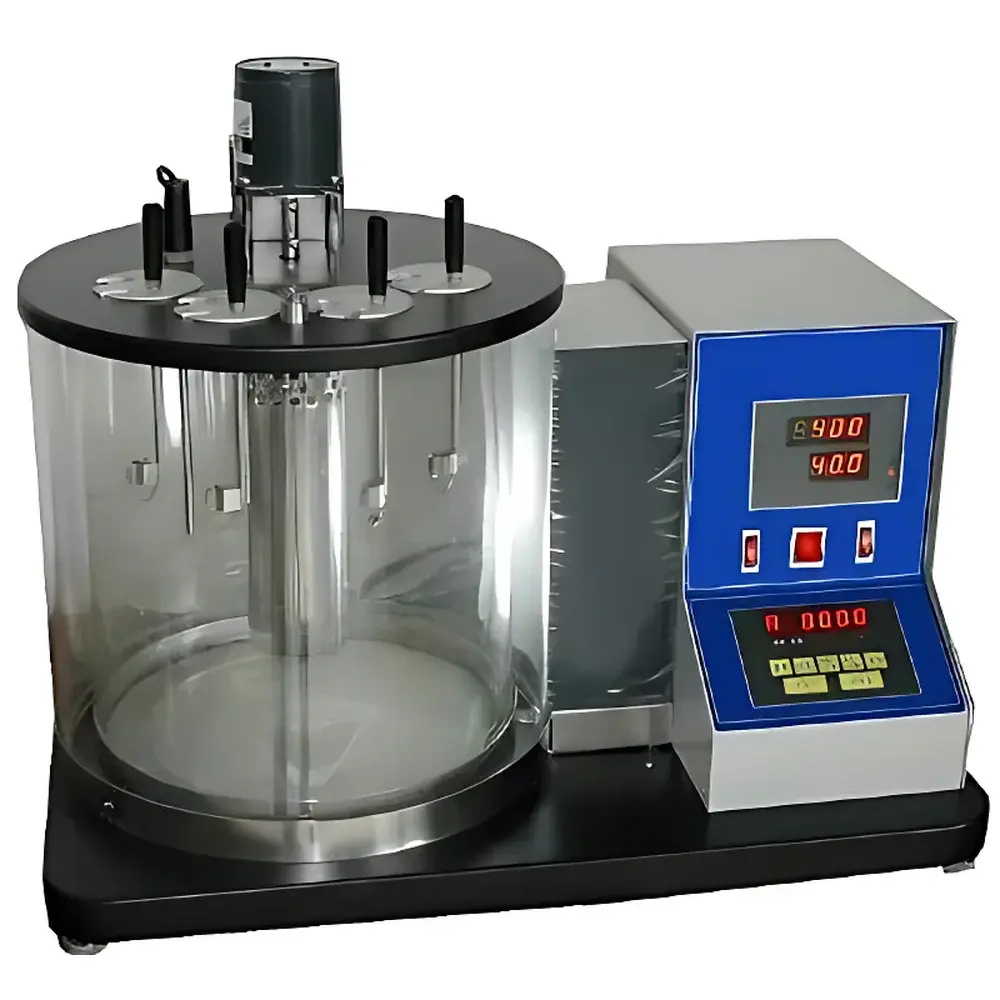
PULUODY PLD-265H Kinematic Viscosity Tester
| Brand | PULUODY |
|---|---|
| Origin | Shaanxi, China |
| Manufacturer Type | Direct Manufacturer |
| Region of Origin | Domestic (China) |
| Model | PLD-265H |
| Power Input | <1850 W |
| Supply Voltage | AC 220 V ±10%, 50 Hz |
| Main Heating Power | 1000 W |
| Auxiliary Heating Power | 800 W |
| Temperature Control Range | 40–100 °C |
| Temperature Stability | ±0.1 °C |
| Capillary Type | Ubbelohde (Ostwald-type) viscometer |
| Number of Capillary Holders | 4 |
| Compliance Standard | GB/T 265 |
Overview
The PULUODY PLD-265H Kinematic Viscosity Tester is a precision laboratory instrument engineered for the standardized determination of kinematic viscosity in liquid petroleum products—specifically Newtonian fluids—according to GB/T 265, the Chinese national standard equivalent to ISO 3104 and ASTM D445. It operates on the fundamental principle of gravity-driven capillary flow: a fixed volume of sample is drawn into a calibrated Ubbelohde (Ostwald-type) capillary viscometer, allowed to drain under gravity through a defined capillary section, and the efflux time is measured with high temporal resolution. Kinematic viscosity (ν), expressed in mm²/s (equivalent to centistokes, cSt), is calculated as the product of the capillary constant (K) and the average efflux time (t): ν = K × t. The instrument’s thermal architecture ensures strict adherence to standardized bath temperature conditions—critical for repeatability and inter-laboratory comparability—as viscosity exhibits strong thermosensitivity, particularly across the 40–100 °C operational range.
Key Features
- High-stability dual-zone heating system: 1000 W main heater + 800 W auxiliary heater enables rapid thermal equilibration and sustained uniformity across the entire bath volume.
- Digital PID temperature controller with ±0.1 °C stability over 40–100 °C, featuring real-time display of setpoint and actual bath temperature—facilitating traceable calibration verification and minor offset corrections.
- Four independently adjustable capillary holders, each equipped with three orthogonal positioning screws for precise vertical alignment of Ubbelohde viscometers—minimizing hydrostatic error and ensuring laminar flow geometry per ISO 3104 Annex A.
- Double-walled transparent borosilicate glass bath vessel: provides unobstructed 360° optical access for visual monitoring of meniscus movement, bubble formation, and flow interruption—essential for manual timing validation and outlier detection.
- Low thermal mass design and optimized fluid circulation path reduce temperature gradient deviation (<0.05 °C across working zone), supporting compliance with GB/T 265 Section 5.2 requirements for bath homogeneity.
Sample Compatibility & Compliance
The PLD-265H is validated for use with transparent, homogeneous, Newtonian liquid petroleum products—including base oils, diesel fuels, lubricants, and transformer oils—provided they are free of suspended particulates or volatile components that may evaporate during testing. It is not suitable for non-Newtonian fluids (e.g., polymer-thickened oils), opaque emulsions, or highly viscous residues requiring vacuum-assisted aspiration. The instrument conforms to the mechanical, thermal, and dimensional specifications outlined in GB/T 265, and its operational methodology aligns with the procedural rigor of ISO 3104 (Petroleum products — Determination of kinematic viscosity and calculation of dynamic viscosity) and ASTM D445 (Standard Test Method for Kinematic Viscosity of Transparent and Opaque Liquids). While not inherently 21 CFR Part 11 compliant, its analog/digital hybrid control architecture supports integration into GLP-compliant workflows when paired with documented SOPs, operator training records, and periodic thermometer/stopwatch calibration logs.
Software & Data Management
The PLD-265H operates as a standalone benchtop instrument without embedded software or digital data export. All timing measurements are performed manually using external certified stopwatches (traceable to NIM or NIST standards), and calculations are executed offline using laboratory worksheets or validated spreadsheets. This design prioritizes metrological transparency and eliminates firmware-related uncertainty—a critical consideration in third-party certification labs and refinery QC environments where audit trails must reflect human-observed, instrument-independent measurement events. Users are advised to maintain contemporaneous handwritten records including ambient temperature/humidity, bath calibration certificate number, capillary identification, replicate efflux times (minimum 3 per sample), and observed anomalies (e.g., air bubbles, wobbling meniscus), consistent with ISO/IEC 17025 Clause 7.7 requirements for result reporting.
Applications
- Refinery quality assurance: routine kinematic viscosity verification of distillate fuels (e.g., jet fuel JP-8, diesel EN 590) prior to blending or dispatch.
- Lubricant formulation R&D: screening of base stock viscosity indices and additive package compatibility under controlled thermal profiles.
- Transformer oil condition monitoring: trending of viscosity drift as an early indicator of oxidation or contamination in power generation assets.
- Educational laboratories: hands-on instruction in capillary rheometry fundamentals, temperature-dependent fluid behavior, and standardization principles per ISO/ASTM frameworks.
- Third-party testing laboratories accredited to CNAS (China National Accreditation Service) or equivalent bodies, where method-defined instrumentation is required for scope validation.
FAQ
What capillary viscometers are compatible with the PLD-265H?
The instrument accommodates standard Ubbelohde-type capillaries conforming to GB/T 265 Table 1 dimensions (e.g., Cannon-Fenske Routine, SUS No. 100–500). Each holder accepts capillaries with outer diameters of 12–15 mm and total lengths up to 350 mm.
Is automatic timing supported?
No—the PLD-265H does not include photometric sensors or electronic timing modules. Timing must be performed manually with a Class I stopwatch meeting JJG 237–2010 (Chinese metrological verification regulation) or ISO 9241-410 criteria.
Can the bath temperature be programmed for ramped profiles?
No—temperature control is static; users select and maintain a single setpoint within 40–100 °C. Multi-point viscosity vs. temperature studies require sequential manual reconfiguration.
Does the unit include calibration certificates?
The PLD-265H ships with a factory-verified temperature calibration report (traceable to Shaanxi Provincial Institute of Metrology). Capillary constants must be supplied separately by the viscometer manufacturer.
What maintenance is required for long-term accuracy?
Monthly verification of bath temperature uniformity using three calibrated PT100 probes at top/mid/bottom positions; biannual cleaning of glass bath with non-abrasive detergent; annual recalibration of digital temperature controller against a reference thermometer per JJF 1171–2019.





