
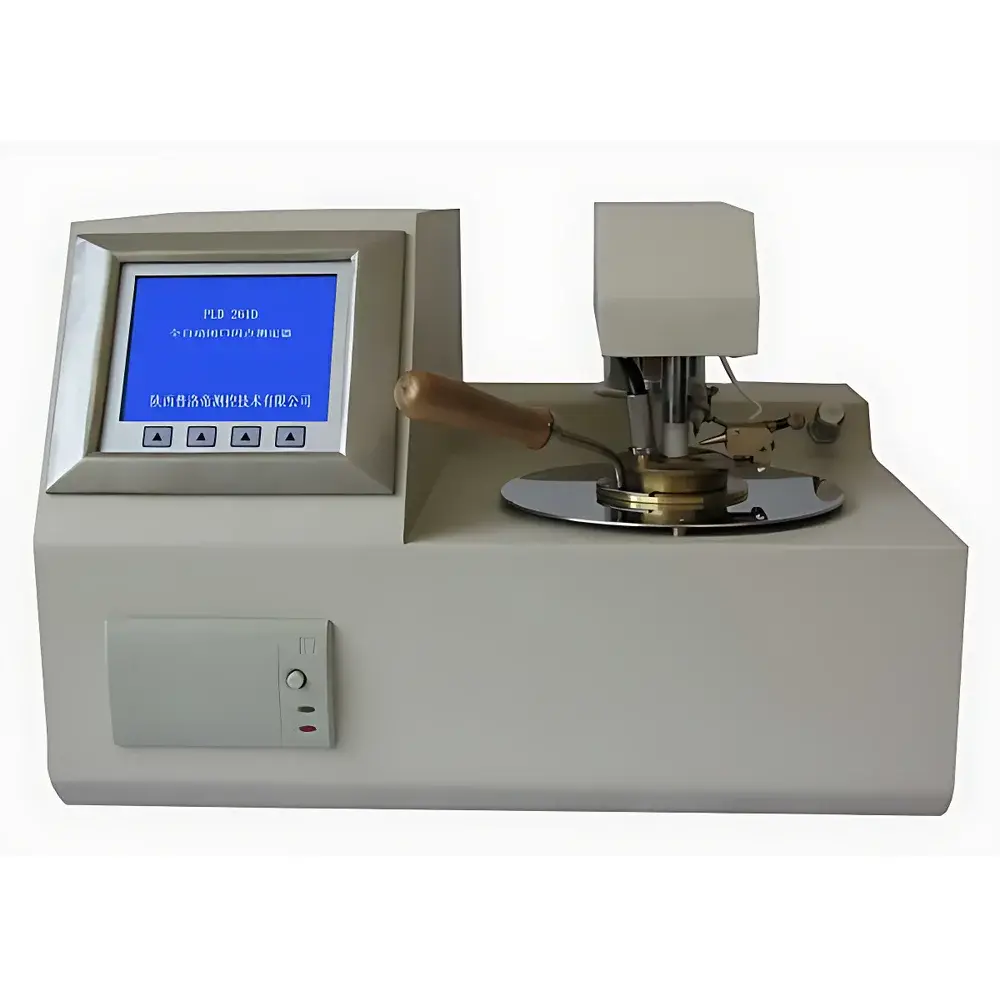
PULUODY PLD-3536D Automatic Cleveland Open-Cup Flash Point Tester
| Brand | PULUODY |
|---|---|
| Origin | Shaanxi, China |
| Manufacturer Type | Manufacturer |
| Country of Origin | China |
| Model | PLD-3536D |
| Detection Method | Cleveland Open-Cup (COC) |
| Standards Compliance | GB/T 3536–2008, ASTM D92, ISO 2592 |
| Temperature Range | Ambient to 400 °C |
| Ignition Modes | Dual-mode (electronic spark + gas flame, selectable individually or jointly) |
| Display | 4.0-inch TFT LCD with touch keypad |
| Cooling | Forced-air cooling |
| Atmospheric Pressure Compensation | Integrated digital barometric sensor with auto-calibration |
| Power Supply | AC 220 V ±20 V, 50 Hz ±5 Hz |
| Power Consumption | 500 W |
| Dimensions | 310 × 395 × 303 mm |
| Data Output | Thermal printer (built-in) |
| Control System | Dual-core microprocessor-based embedded controller |
| Software | PV Flash Point (Open) Test v8.0 |
| Safety Features | Auto-extinguishing after test completion, real-time fault diagnosis, overtemperature & flame-out protection, self-diagnostics |
Overview
The PULUODY PLD-3536D Automatic Cleveland Open-Cup Flash Point Tester is an engineered solution for precise, repeatable determination of flash point and fire point of petroleum products using the standardized Cleveland Open-Cup (COC) method. Based on the fundamental principle of thermal equilibrium and controlled vapor ignition, the instrument heats a sample in an open crucible while systematically introducing an ignition source at defined temperature intervals. Flash point is identified as the lowest temperature at which vapors above the sample surface ignite momentarily upon exposure to a test flame; fire point is recorded when sustained combustion persists for at least 5 seconds. Designed specifically for samples with expected flash points above 79 °C — excluding light distillates such as gasoline and kerosene (which require closed-cup methods per ASTM D56 or D93) — the PLD-3536D delivers high reproducibility under rigorous regulatory conditions. Its architecture adheres strictly to the procedural requirements of GB/T 3536–2008, ASTM D92, and ISO 2592, ensuring compatibility with international quality assurance frameworks including ISO/IEC 17025-accredited laboratories.
Key Features
- Dual-mode ignition system: Selectable electronic spark ignition and/or propane/gas flame ignition — configurable per test protocol or laboratory SOP to accommodate varying sample volatility and safety protocols.
- Fully automated thermal profiling: Programmable ramp rates and hold times ensure consistent heating kinetics across batches, minimizing operator influence on endpoint detection.
- Integrated atmospheric pressure compensation: Real-time barometric measurement enables automatic correction of flash point values per ASTM D92 Annex A1, critical for laboratories operating at non-standard elevations.
- Embedded dual-core control architecture: Ensures deterministic response during multi-stage testing sequences — including automatic crucible lifting, ignition timing synchronization, flame detection, and post-test cooling initiation.
- Comprehensive safety interlocks: Includes flame-out detection, overtemperature cutoff (>410 °C), automatic extinguishing post-test, and hardware-level fault isolation to meet IEC 61010-1 electrical safety requirements.
- Human-centered interface: 4.0-inch capacitive-touch LCD provides intuitive navigation, live temperature curve visualization, step-by-step procedural guidance, and immediate access to calibration menus and diagnostic logs.
Sample Compatibility & Compliance
The PLD-3536D is validated for use with lubricating oils, residual fuels, bitumens, biodiesel blends (B100–B20), transformer oils, and other mid-to-high-boiling hydrocarbon-based fluids. It excludes volatile solvents, aviation turbine fuels, and diesel fractions typically assessed via Pensky-Martens closed-cup (ASTM D93) or Tag closed-cup (ASTM D56) methodologies. All operational firmware and software modules are traceable to documented verification protocols aligned with GLP principles. The device supports audit-ready data integrity through timestamped test records, user-access logging, and non-modifiable result storage — facilitating compliance with FDA 21 CFR Part 11 where electronic records are subject to regulatory review.
Software & Data Management
PV Flash Point (Open) Test v8.0 serves as the primary instrument control and data acquisition platform. It provides full test sequencing automation, customizable report templates (PDF/CSV export), trend analysis across historical datasets, and configurable pass/fail thresholds based on specification limits. The software maintains a secure local database with role-based user permissions (administrator, technician, viewer), supports optional network connectivity for centralized lab data aggregation (via Ethernet), and includes built-in validation tools for IQ/OQ documentation. All raw thermal profiles, ignition events, and environmental metadata (ambient temp, pressure, humidity) are retained with each test record.
Applications
- Quality control of base oils and formulated lubricants in manufacturing facilities.
- Regulatory conformance testing for ASTM D92-compliant product certification.
- Research and development of alternative fuel formulations requiring flash/fire point benchmarking.
- Third-party testing laboratories performing accredited flash point analysis per ISO/IEC 17025 scope.
- Maintenance of transformer oil condition monitoring programs (IEC 60156 references COC methodology for certain aged-oil assessments).
- Technical support for customs clearance and import/export documentation where flash point classification governs hazard labeling (UN GHS Category 3/4).
FAQ
What standards does the PLD-3536D comply with?
It is fully compliant with GB/T 3536–2008, ASTM D92, and ISO 2592 for Cleveland Open-Cup flash and fire point determination.
Can the instrument be used for diesel or jet fuel testing?
No — those materials require closed-cup methods (e.g., ASTM D93 or D56) due to their low flash points and high volatility.
Is atmospheric pressure correction applied automatically during testing?
Yes — an integrated digital barometer continuously monitors ambient pressure and applies real-time corrections to reported flash point values.
Does the software support electronic signature and audit trail functions?
PV Flash Point v8.0 includes user authentication, immutable test logs, and configurable audit trail settings suitable for GLP/GMP environments.
What maintenance is required for long-term reliability?
Routine cleaning of the crucible, ignition probe, and sensor ports is recommended after every 20–30 tests; annual calibration verification against NIST-traceable reference standards is advised.





