
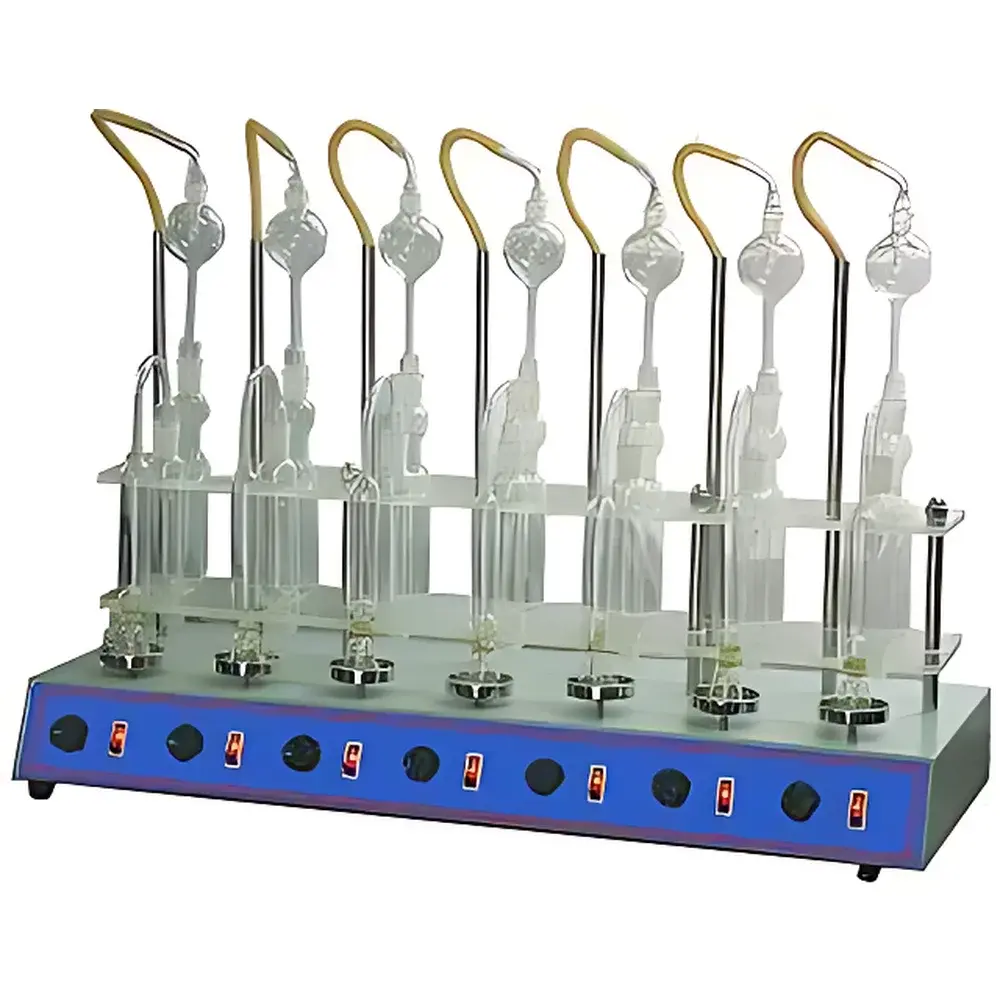
PULUODY PLD-380C Petroleum Product Sulfur Content Analyzer (Lamp Method)
| Brand | PULUODY |
|---|---|
| Origin | Shaanxi, China |
| Manufacturer Type | Original Equipment Manufacturer (OEM) |
| Regional Classification | Domestic (China) |
| Model | PLD-380C |
| Pricing | Upon Request |
| Standard Compliance | GB/T 380 |
| Sample Type | Light petroleum products with Reid Vapor Pressure ≤ 80 kPa |
| Lamp Holder Capacity | 7 parallel sample positions |
| Power Supply | AC 220 V ±10%, 50 Hz |
| Optical Viewing | Transparent acrylic mounting platform for unobstructed visual monitoring |
Overview
The PULUODY PLD-380C Petroleum Product Sulfur Content Analyzer (Lamp Method) is a dedicated benchtop instrument engineered for quantitative sulfur determination in light petroleum fractions—such as gasoline, naphtha, kerosene, and diesel distillates—according to the gravimetric lamp combustion principle specified in GB/T 380. This standardized method relies on controlled combustion of a precisely weighed sample in a calibrated wick lamp under regulated airflow, followed by absorption of evolved sulfur dioxide (SO₂) in a hydrogen peroxide (H₂O₂) solution to form sulfuric acid (H₂SO₄), which is then titrated with standard sodium hydroxide (NaOH) solution. The analyzer provides traceable, reproducible results aligned with classical wet-chemistry reference methodology, serving as a primary or confirmatory technique where instrumental methods such as UV fluorescence (ASTM D5453) or X-ray fluorescence (ASTM D2622) require validation or cross-checking.
Key Features
- Compliance-driven design: Fully conforms to GB/T 380–2022 “Petroleum Products—Determination of Sulfur Content—Lamp Method”, including lamp geometry, wick specifications, combustion chamber dimensions, and absorption train configuration.
- Seven-position parallel lamp holder: Enables simultaneous preparation and combustion of up to seven samples or replicates, improving throughput while maintaining consistent thermal and aerodynamic conditions across all units.
- Optically transparent acrylic support base: Provides full 360° line-of-sight access to flame stability, wick burn behavior, and absorption bottle integrity—critical for real-time procedural verification and operator training.
- Stable power interface: Integrated voltage regulation circuitry ensures operation within AC 220 V ±10% at 50 Hz, minimizing drift caused by grid fluctuations during extended titration sequences.
- Modular absorption train: Includes standardized glassware components—combustion lamp, chimney, absorption bulbs, and gas-washing bottles—designed for easy cleaning, calibration verification, and replacement per GB/T 380 Annex A requirements.
Sample Compatibility & Compliance
The PLD-380C is validated for use with light petroleum products exhibiting Reid Vapor Pressure (RVP) not exceeding 80 kPa, as defined in GB/T 8017. Typical applicable matrices include motor gasoline, aviation gasoline, straight-run naphthas, hydrotreated kerosenes, and low-viscosity distillate fuels. It is not intended for heavy fractions (e.g., fuel oils, lubricants), viscous residues, or oxygenated blends containing >10% ethanol or MTBE without prior method adaptation and validation. Instrument operation supports GLP-compliant workflows when paired with documented SOPs, analyst training records, and manual logbook entries. While GB/T 380 does not mandate electronic data capture, the system architecture permits integration into laboratory-wide audit trails when used alongside certified titration burettes and calibrated analytical balances meeting ISO/IEC 17025 metrological requirements.
Software & Data Management
The PLD-380C operates as a manual, non-automated analytical platform; no embedded firmware, touchscreen interface, or proprietary software is included. All calculations—including sulfur mass fraction (% m/m), blank correction, and repeatability assessment—are performed manually using standardized calculation formulas defined in GB/T 380 Section 8. Users are expected to maintain handwritten or electronically archived records (e.g., Excel worksheets, LIMS entries) that reflect raw titrant volumes, sample masses, reagent concentrations, and environmental conditions (ambient temperature/humidity). For laboratories subject to FDA 21 CFR Part 11 or ISO 17025 accreditation, supplementary documentation—such as instrument logbooks, calibration certificates for balances and burettes, and analyst competency assessments—must be retained separately to demonstrate method control and result traceability.
Applications
- Quality assurance testing of refinery off-gas condensates and reformulated gasoline streams prior to blending or dispatch.
- Regulatory compliance verification for national sulfur limits (e.g., China VI gasoline specification ≤10 mg/kg).
- Method validation studies comparing lamp-method results against ASTM D5453 (UVF) or ASTM D2622 (XRF) data.
- Educational laboratories teaching classical combustion analysis principles and stoichiometric titration fundamentals.
- Reference method application in interlaboratory comparison programs coordinated by CNAS or APIC.
FAQ
Does the PLD-380C comply with international standards such as ASTM or ISO?
No—it is specifically designed and verified for GB/T 380, a China National Standard. While technically analogous to older ASTM D129 (withdrawn in 2020), it is not certified to ASTM, ISO, or EN specifications.
Can the instrument be used for diesel fuel analysis?
Only if the diesel meets the RVP ≤80 kPa criterion (typically ultra-low-sulfur diesel, ULSD, with flash point >55°C and vapor pressure below threshold); high-cetane or biodiesel-blended fuels require alternative methods.
Is hydrogen peroxide solution supplied with the unit?
No—users must prepare and standardize 3% (v/v) H₂O₂ solution per GB/T 380 Section 5.3 using certified reagent-grade chemicals.
What maintenance is required for long-term reliability?
Daily cleaning of glass combustion and absorption components with deionized water; quarterly inspection of wick integrity and lamp alignment; annual verification of balance and burette calibration against NIST-traceable standards.
Does PULUODY provide method validation support or IQ/OQ documentation?
Yes—upon request, PULUODY supplies a basic Installation Qualification (IQ) checklist and Operational Qualification (OQ) test protocol aligned with GB/T 380 performance criteria, including repeatability assessment and blank recovery verification.





