
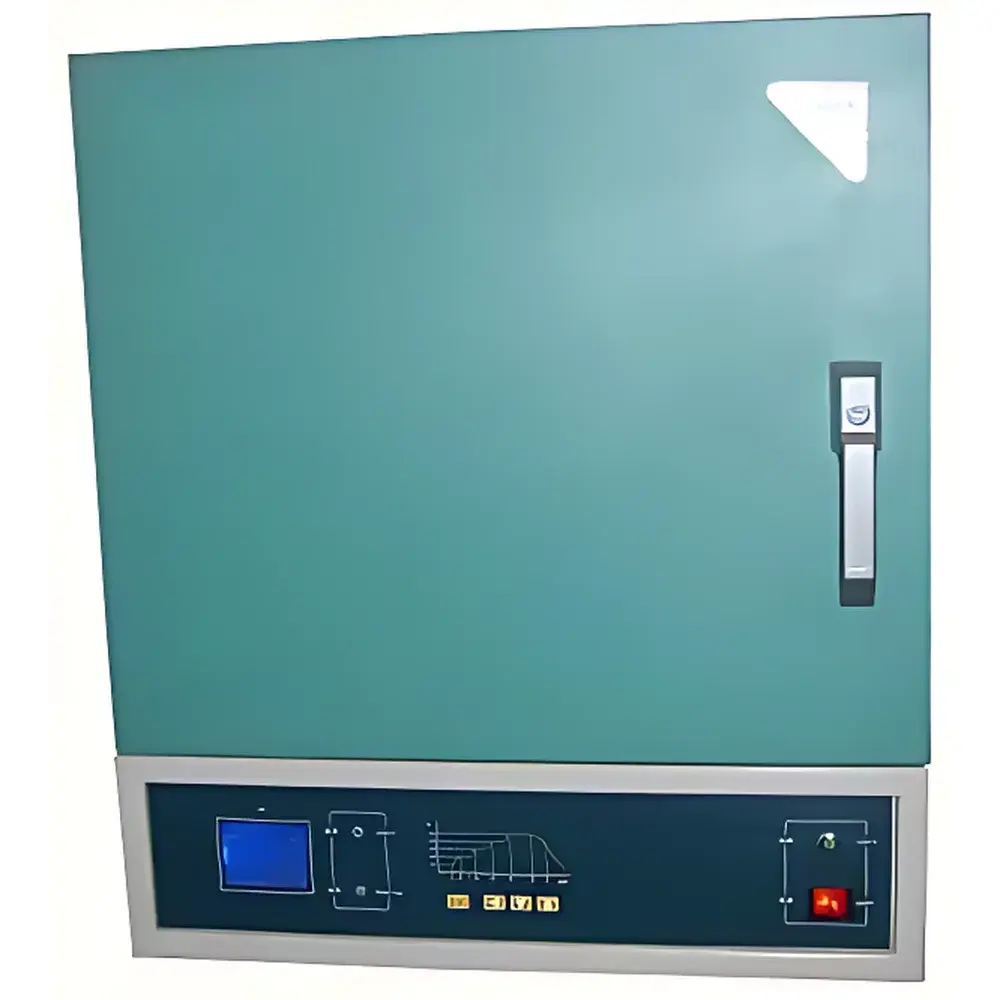
PULUODY PLD-508A Petroleum Product Ash Content Tester
| Brand | PULUODY |
|---|---|
| Origin | Shaanxi, China |
| Manufacturer Type | Direct Manufacturer |
| Country of Origin | China |
| Model | PLD-508A |
| Heating Power | 4000 W |
| Rated Voltage | AC 220 V / 50 Hz |
| Furnace Chamber Dimensions | 300 × 200 × 120 mm |
| Filter Paper Diameter | 9 cm |
| Porcelain Crucible Capacity | 50 mL |
| Temperature Range | Ambient to 1000 °C |
| Control Method | Analog Pointer-Based Temperature Controller with Integrated Ammeter |
Overview
The PULUODY PLD-508A Petroleum Product Ash Content Tester is a dedicated laboratory instrument engineered for the quantitative determination of ash content in petroleum products—including lubricating oils, fuel oils, diesel, and residual fuels—according to standardized gravimetric methodology. It operates on the principle defined in GB/T 2433 (equivalent to ASTM D482 and ISO 6245), wherein a precisely weighed sample is combusted in a porcelain crucible using an ashless filter paper wick, followed by controlled high-temperature incineration at 775 °C ± 25 °C to oxidize all carbonaceous residue. The resulting inorganic oxide residue—commonly composed of metal sulfates, oxides, and silicates—is cooled in a desiccator and gravimetrically quantified as percent ash by mass. This method provides trace-level mineral content assessment critical for evaluating additive package integrity, catalyst contamination risk, and compliance with engine oil specifications (e.g., API SP, ACEA C5) and refinery process control limits.
Key Features
- High-power resistive heating system (4000 W) enables rapid ramp-up to operational temperatures up to 1000 °C, ensuring consistent thermal stability during prolonged ashing cycles.
- Analog temperature controller with dual-scale pointer display and integrated ammeter offers real-time power draw monitoring and intuitive manual setpoint adjustment—optimized for routine QC labs requiring robust, low-maintenance operation without software dependency.
- Refractory ceramic furnace chamber (300 × 200 × 120 mm internal dimensions) provides uniform radial and axial temperature distribution across crucible placement zones, minimizing thermal gradients that could affect residue homogeneity.
- Comprehensive accessory suite includes 50 mL porcelain crucibles (Al₂O₃–SiO₂ composition, ≤0.001 % ash blank), 9 cm diameter ashless quantitative filter paper (Whatman Grade 41 equivalent), stainless steel tongs, desiccator with silica gel indicator, and calibrated analytical balance support fixtures.
- Front-access door with ceramic fiber gasket ensures safe hot-zone containment while allowing visual monitoring of combustion progression without compromising thermal integrity or operator safety.
Sample Compatibility & Compliance
The PLD-508A accommodates liquid petroleum samples ranging from low-volatility base oils to high-viscosity residual fuels, provided they meet the viscosity and volatility constraints outlined in GB/T 2433 (e.g., flash point > 60 °C; distillation end point < 400 °C). Solid or semi-solid samples (e.g., greases) require prior solvent dilution and evaporation per ASTM D874. Instrument design conforms to IEC 61010-1:2010 safety requirements for electrical laboratory equipment. Test procedures are fully aligned with GB/T 2433–2022, ASTM D482–22, ISO 6245:2021, and IP 104/82. Data recording workflows support GLP-compliant documentation when paired with certified analytical balances and audit-trail-enabled lab notebooks.
Software & Data Management
The PLD-508A operates as a standalone hardware platform with no embedded firmware or digital interface. Temperature regulation and timing are manually executed via analog controls; therefore, data acquisition relies on external instrumentation—such as Class I analytical balances (e.g., METTLER TOLEDO XSR series) and validated electronic lab notebooks (ELN). Users may integrate results into LIMS environments via CSV export from balance memory or manual entry. While the unit itself does not support 21 CFR Part 11 electronic signatures, its procedural transparency, defined SOP execution sequence, and physical record retention (crucible ID logs, furnace calibration certificates, blank correction sheets) satisfy core GMP/GLP documentation expectations for regulated testing laboratories.
Applications
- Quality assurance of finished lubricants against ash limits specified in OEM approvals (e.g., GM dexos1, Ford WSS-M2C946-A).
- Monitoring catalyst carryover in fluid catalytic cracking (FCC) feedstocks and slurry oils.
- Evaluation of detergent/dispersant package degradation during engine oil oxidation studies.
- Refinery crude assay validation—correlating ash content with sediment, metals (Ni, V, Na), and total acid number (TAN).
- Regulatory compliance testing for marine fuel (ISO 8217:2024 Annex A) and biodiesel blends (ASTM D6751).
FAQ
What standards does the PLD-508A comply with for ash content testing?
It supports GB/T 2433, ASTM D482, ISO 6245, and IP 104—covering both routine QC and regulatory submission requirements.
Can the instrument be used for determining sulfated ash in engine oils?
No—sulfated ash (ASTM D892) requires sulfuric acid addition prior to ignition; the PLD-508A is configured exclusively for unsulfated ash per GB/T 2433.
Is furnace temperature calibration traceable to national standards?
Yes—users must perform periodic verification using NIST-traceable thermocouples (Type S or R) and document calibration against accredited reference sources per ISO/IEC 17025.
What maintenance is required for long-term accuracy?
Annual inspection of heating element continuity, thermocouple drift verification, crucible blank revalidation (≤0.001 % ash), and gasket replacement if sealing integrity degrades.
Does the unit include temperature ramp rate programming?
No—ramp control is manual via power adjustment; users follow standard heating profiles described in GB/T 2433 Section 7.2 (e.g., 30 min at 500 °C, then 30 min at 775 °C).






