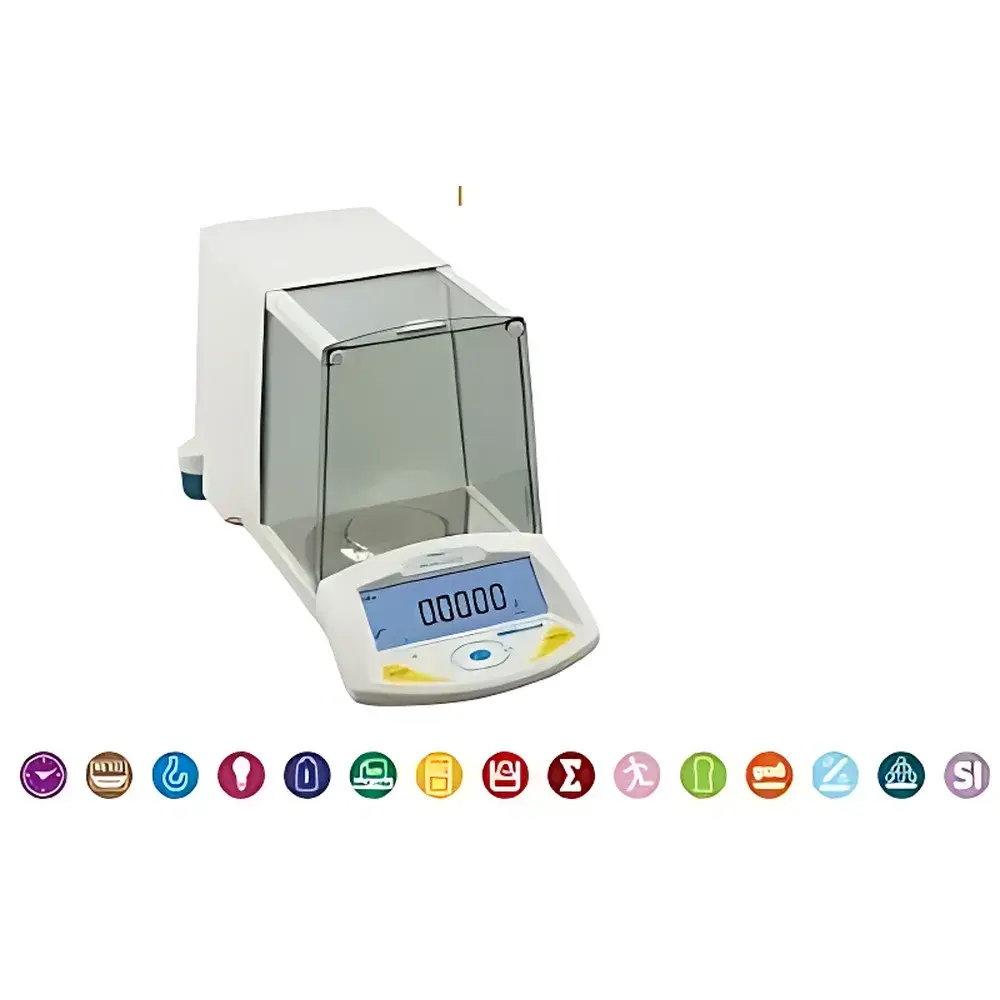
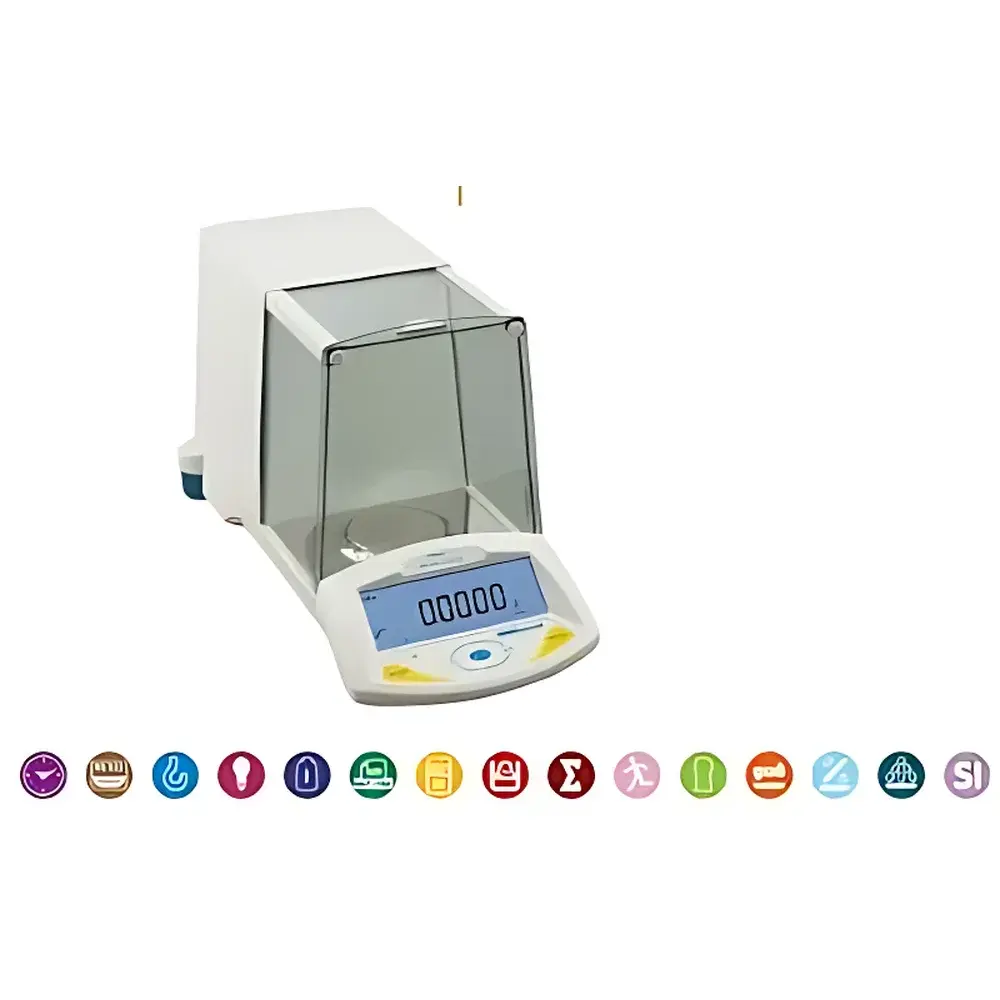
PWC184 Precision Analytical Balance with Internal Calibration – UK-Made Laboratory Balance
| Origin | United Kingdom |
|---|---|
| Type | Analytical Balance |
| Maximum Capacity | 180 g |
| Readability | 0.0001 g |
| Repeatability | ±0.0002 g |
| Linearity Error | ±0.0002 g |
| Pan Diameter | 90 mm |
| Operating Temperature Range | 10–40 °C |
| Power Supply | 15 VDC, 100–240 VAC, 50/60 Hz |
| Interface | RS-232 (bidirectional) |
| Display | Dual-line backlit LCD with range-tracking indicator |
| Housing | Die-cast aluminum chassis with transparent glass draft shield |
| Dimensions (W×D×H) | 256 × 524 × 275 mm |
| Net Weight | 12 kg |
| Calibration | Motor-driven internal calibration system with temperature-triggered and time-scheduled auto-calibration |
Overview
The PWC184 Precision Analytical Balance is a high-accuracy, UK-engineered laboratory balance designed for demanding quantitative applications in regulated research, quality control, and analytical chemistry environments. Built upon the proven principles of electromagnetic force compensation (EMFC), the PWC184 delivers stable, drift-resistant measurements at 0.1 mg readability across its full 180 g capacity. Its internal motorized calibration mechanism—activated automatically in response to ambient temperature fluctuations or user-defined time intervals—ensures continuous traceability without manual intervention, meeting the operational rigor expected in GLP-compliant laboratories and ISO/IEC 17025-accredited testing facilities. The balance features a rigid die-cast aluminum base and precision-machined load-receiving assembly, minimizing mechanical hysteresis and thermal expansion effects. All critical electronics are thermally stabilized and isolated from vibration sources via integrated damping mounts, supporting long-term stability under routine benchtop conditions.
Key Features
- Internal motor-driven calibration system compliant with ISO 9001 and ASTM E899–21 guidelines for periodic verification of weighing performance.
- Dual-line backlit LCD display with real-time range-tracking functionality—visually indicates remaining capacity relative to current tare weight, reducing operator error during multi-step weighing protocols.
- RS-232 bidirectional communication port enabling seamless integration with LIMS, ELN, and statistical process control (SPC) software; supports ASCII and MODBUS RTU protocols out-of-the-box.
- Configurable user access levels with password protection (up to 4-tier permission matrix) and optional hardware lock interface for external PC security modules.
- Pre-programmed application modes including parts counting, percentage weighing, density determination (for solids and liquids), dynamic/animal weighing, and net/gross/tare tracking with configurable thresholds.
- Full-range tare function with automatic zero-tracking compensation, eliminating manual re-zeroing during sequential sample additions.
- Comprehensive environmental monitoring: built-in temperature sensor triggers recalibration when ΔT exceeds ±1.5 °C from last calibration event—critical for labs lacking climate-controlled rooms.
Sample Compatibility & Compliance
The PWC184 accommodates standard laboratory sample containers—including crucibles, weighing boats, and volumetric flasks—within its 90 mm diameter stainless-steel weighing pan. Its enclosed glass draft shield (202 × 158 × 215 mm) meets ISO 17025 Annex A.3 requirements for airborne particulate mitigation during low-mass measurements. The balance complies with international metrological standards EN 45501 (formerly OIML R76-1), and its firmware architecture supports audit trail generation per FDA 21 CFR Part 11 when paired with validated third-party data acquisition software. It is routinely deployed in pharmaceutical QC labs performing USP repeatability testing and EP 2.1.6 linearity verification procedures.
Software & Data Management
Data export follows NIST-traceable formatting conventions: timestamps include UTC offset, mass values retain four decimal places with uncertainty notation (e.g., “12.3456 g ±0.0002 g”), and metadata fields capture operator ID, calibration status, ambient temperature, and balance serial number. Optional firmware upgrade enables CSV/Excel-compatible batch export and configurable delimiter settings. All calibration events—including initiation source (manual, timer, or thermal trigger)—are logged with digital signatures and immutable timestamps, satisfying GMP documentation requirements for instrument qualification (IQ/OQ/PQ).
Applications
The PWC184 serves as a primary reference instrument in applications requiring certified mass accuracy: formulation of reference standards per ISO Guide 35, gravimetric preparation of calibration solutions for ICP-MS and HPLC, residual solvent analysis per USP , active pharmaceutical ingredient (API) assay validation, catalyst loading in heterogeneous catalysis studies, and microgram-level stoichiometric synthesis in organometallic chemistry. Its dynamic weighing mode supports live biomass monitoring in bioreactor feed control systems, while density calculation routines adhere to ASTM D792 and ISO 1183 methodologies.
FAQ
Does the PWC184 support external calibration with certified weights?
Yes—external calibration is fully supported via the front-panel menu; the balance recognizes Class E2 or better weights per ISO 9001 Annex B and stores calibration coefficients separately from internal calibration parameters.
Is the RS-232 interface compatible with modern Windows/macOS systems?
Yes—when used with a USB-to-RS-232 adapter (FCC/CE-certified), the interface operates reliably with native COM port drivers; no proprietary software installation is required for basic data streaming.
Can the internal calibration be disabled for audit purposes?
Yes—calibration scheduling can be set to “manual only” mode, and all auto-calibration logs remain visible in the service history menu for regulatory review.
What is the warranty coverage and service support structure?
The PWC184 includes a three-year limited warranty covering parts and labor; UK-based technical support provides remote diagnostics and on-site service through ISO 13485-certified field engineers.
Does the balance meet requirements for pharmacopeial testing?
Yes—it satisfies USP repeatability criteria (n ≥ 10, SD ≤ 0.41 × readability) and EP 2.1.6 linearity tolerance (±0.0002 g across full range) when operated within specified environmental conditions.