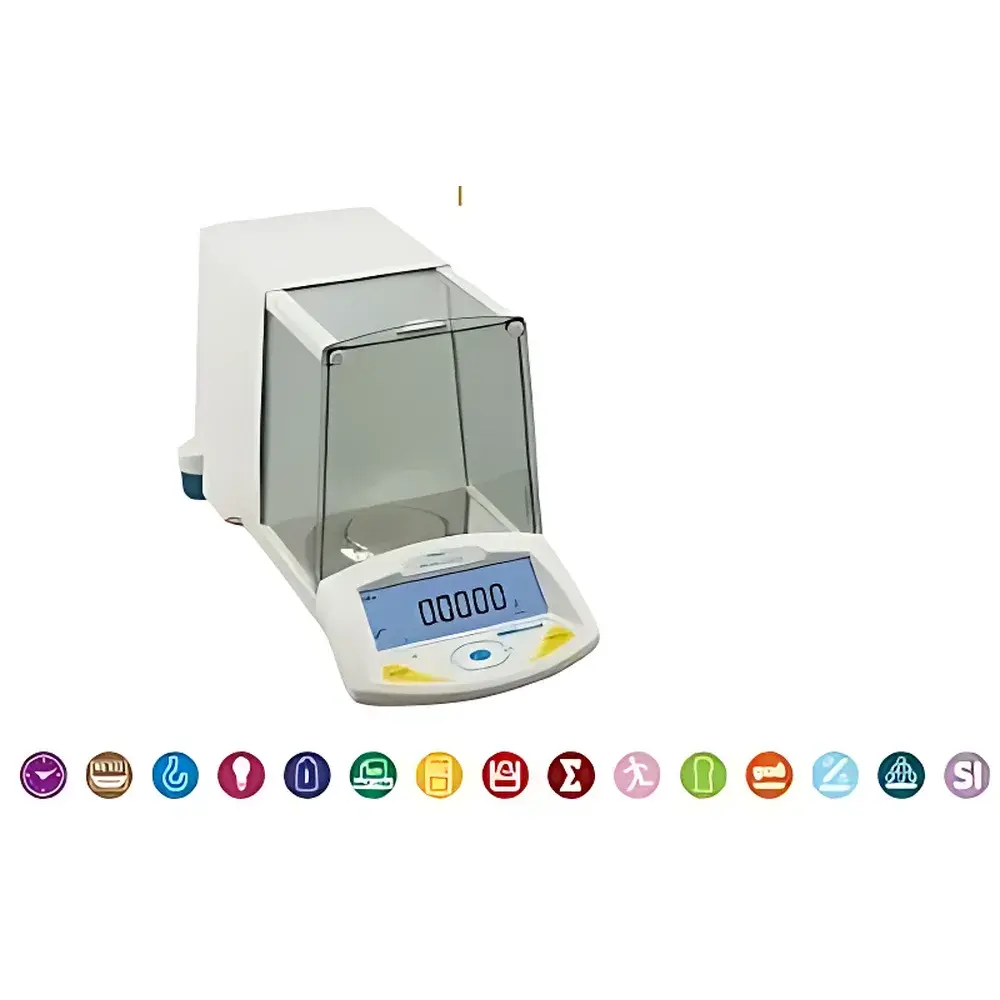
PWC214 Internal Calibration Analytical Balance (0.1 mg Readability)
| Maximum Capacity | 210 g |
|---|---|
| Readability | 0.0001 g |
| Repeatability | ±0.0002 g |
| Linearity Error | ±0.0002 g |
| Pan Diameter | 90 mm |
| Operating Temperature Range | 10–40 °C |
| Power Supply | 15 VDC, 800 mA (Input: 100–240 VAC, 50/60 Hz) |
| Interface | RS-232 bidirectional |
| Display | Dual-line backlit LCD with range tracking |
| Dimensions (W×D×H) | 256 × 524 × 275 mm |
| Net Weight | 12 kg |
| Construction | Die-cast aluminum housing with transparent glass draft shield |
| Draft Shield Dimensions | 202 × 158 × 215 mm |
Overview
The PWC214 Internal Calibration Analytical Balance is a high-precision laboratory weighing instrument engineered for reproducible mass measurement at 0.1 mg readability (100 µg). Designed in accordance with ISO/IEC 17025 and GLP-compliant workflows, it employs electromagnetic force compensation (EMFC) transduction technology—ensuring stable, drift-resistant performance across variable ambient conditions. Its integrated internal calibration mechanism automatically compensates for thermal drift and temporal drift without requiring external weights, satisfying routine verification requirements per USP , ASTM E898, and ISO 9001 traceability protocols. The balance is optimized for use in quality control laboratories, pharmaceutical R&D, academic research, and materials science applications where regulatory documentation, audit readiness, and measurement integrity are non-negotiable.
Key Features
- Internal motor-driven calibration system activated manually or scheduled automatically—eliminates dependency on certified reference masses and reduces operator error.
- Dual-line backlit LCD display with real-time range tracking: visually indicates remaining capacity relative to current load, enhancing operational safety and preventing overload incidents.
- Full tare range and advanced weighing modes including parts counting, percentage weighing, density determination (for solids and liquids), animal/dynamic weighing, and user-defined custom functions.
- RS-232 bidirectional serial interface compliant with standard laboratory data acquisition systems; supports direct connection to PCs, label printers, and LIMS without protocol conversion hardware.
- Multi-level access control: password-protected software configuration prevents unauthorized parameter modification; optional hardware lock interface available for physical PC port security.
- Robust die-cast aluminum chassis with vibration-damped base and precision-machined glass draft shield (202 × 158 × 215 mm) minimizes environmental interference from air currents and mechanical resonance.
- Comprehensive unit support—including metric (g, mg), troy (ozt), apothecary (dwt), and SI-derived units (N)—enables seamless integration into international method SOPs.
Sample Compatibility & Compliance
The PWC214 accommodates samples up to 210 g on its 90 mm Ø stainless-steel weighing pan. Its design conforms to Class I accuracy requirements under OIML R 76-1 and meets the essential performance criteria for analytical balances defined in USP (repeatability ≥ 0.1 RSD at 5% of max capacity) and EURAMET cg-18. The instrument supports GLP/GMP environments through configurable audit trail logging (when connected to compliant software), automatic timestamping of all critical events (calibration, tare, print), and full traceability of operator IDs. It operates reliably within 10–40 °C and ≤ 80% RH (non-condensing), making it suitable for standard ISO Class 5–7 laboratory environments.
Software & Data Management
The embedded firmware provides intuitive menu navigation with context-sensitive prompts and multilingual UI support (English, Spanish, French, German, Chinese). All weighing data—including raw values, tare offsets, statistical summaries (mean, SD, CV%), and time-stamped logs—can be exported via RS-232 using ASCII or SICS protocols. When integrated with validated third-party software (e.g., LabX, BalanceLink), the PWC214 supports 21 CFR Part 11 compliance features including electronic signatures, role-based permissions, and immutable audit trails. Firmware updates are performed via serial interface, ensuring long-term compatibility with evolving regulatory expectations.
Applications
- Pharmaceutical formulation: active ingredient dispensing, excipient ratio verification, and stability study sample preparation per ICH Q5C.
- Chemical synthesis: stoichiometric reagent dosing, catalyst loading, and yield calculation with traceable uncertainty budgets.
- Materials testing: powder density profiling, coating weight analysis, and particulate mass distribution studies.
- Food & beverage QA: nutritional labeling verification, moisture content assessment (via loss-on-drying workflows), and batch homogeneity validation.
- Academic teaching labs: fundamental metrology instruction, uncertainty propagation exercises, and ISO/IEC 17025 accreditation training modules.
FAQ
Does the PWC214 meet ISO/IEC 17025 calibration requirements?
Yes—the internal calibration system, combined with documented verification procedures and traceable reference standards, satisfies Clause 6.5.2 of ISO/IEC 17025:2017 for in-house calibration capability.
Can the balance be connected to a networked LIMS?
It supports RS-232 communication; integration with Ethernet-based LIMS requires an RS-232-to-TCP/IP converter or middleware software compliant with ASTM E1384 or HL7 standards.
What is the recommended recalibration interval?
Per manufacturer guidance and risk-based assessment (e.g., ISO/IEC 17025 Annex A.3), internal calibration should be performed before each critical weighing session, and external verification with Class E2 weights is advised at least daily or per shift in regulated environments.
Is the draft shield removable for cleaning?
Yes—the transparent glass shield is tool-free detachable and compatible with IPA-based disinfection protocols without compromising optical clarity or structural integrity.
Does the balance support dynamic (animal) weighing?
Yes—it includes a dedicated dynamic mode with adjustable damping and averaging time (1–10 s), enabling stable mass acquisition for live specimens or unstable samples on vibration-prone surfaces.