
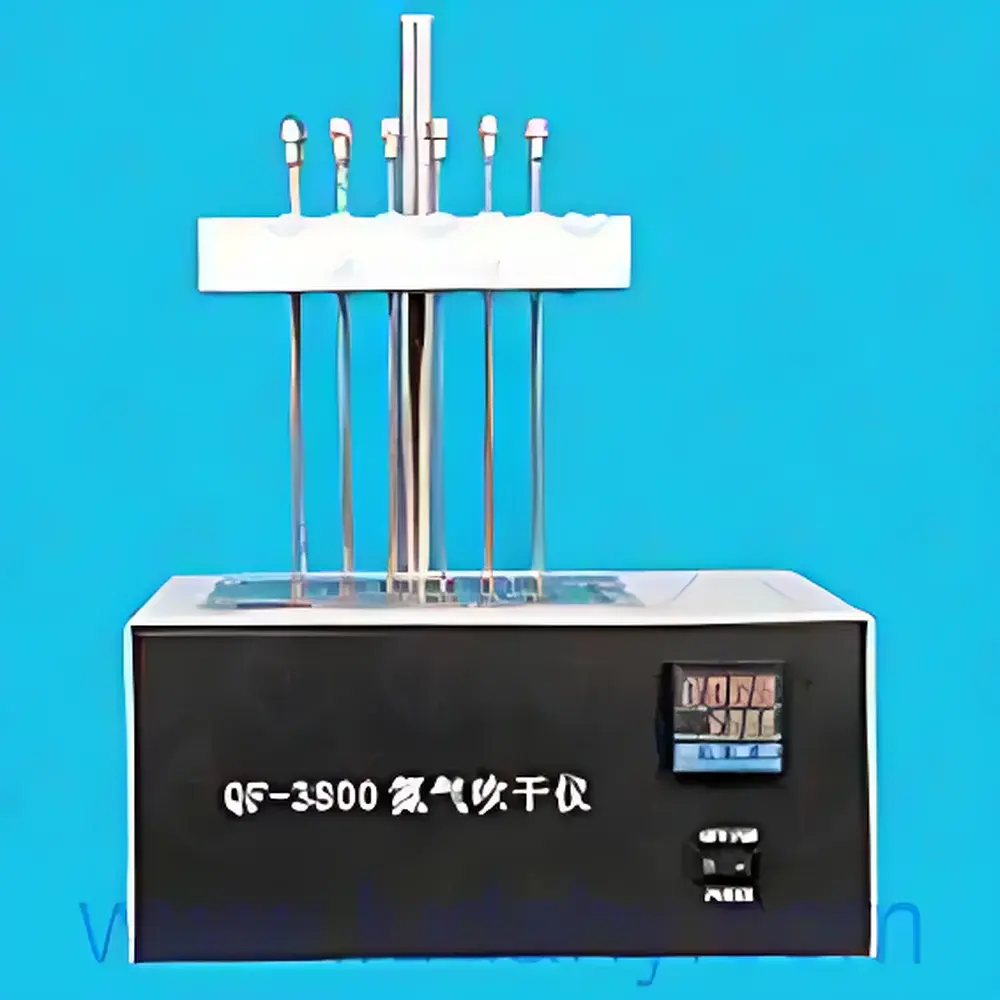
QF-3800 Nitrogen Evaporator System
| Origin | Tianjin, China |
|---|---|
| Manufacturer Type | Authorized Distributor |
| Origin Category | Domestic (PRC) |
| Model | QF-3800 |
| Pricing | Available Upon Request |
| Temperature Range | Ambient +5°C to 100°C |
| Temperature Control Accuracy | ±0.1°C |
| Over-Temperature Cutoff | 100°C |
| Deviation Alarm Threshold | ±5°C from Setpoint |
| Heating Block Configurations | 12-well or 24-well |
| Heating Power | 350 W |
| Input Voltage | 220 V AC, 50 Hz |
| Independent Gas Channels | Yes |
| Integrated Drip Tray | Yes |
| Dual Digital Displays (Setpoint & Actual Temp) | Yes |
| Thermal Uniformity | Optimized via Aluminum Block Geometry and Embedded Sensor Placement |
Overview
The QF-3800 Nitrogen Evaporator System is an engineered solution for controlled, inert-gas-assisted solvent removal in analytical and preparative laboratories. It operates on the principle of gentle nitrogen gas flow directed perpendicularly onto the surface of liquid samples contained in standard test tubes or vials, accelerating solvent evaporation while minimizing thermal degradation, oxidation, and analyte loss. Unlike vacuum-based concentrators, the QF-3800 maintains atmospheric pressure during operation—eliminating foaming, bumping, or sample splashing commonly observed with volatile or heat-sensitive compounds. Its aluminum heating block provides rapid thermal response and high spatial uniformity across all wells, ensuring consistent evaporation kinetics across multi-sample batches. Designed for integration into regulated workflows—including those aligned with ISO/IEC 17025, GLP, and USP method development protocols—the system supports reproducible concentration endpoints critical for LC-MS, GC-MS, pesticide residue analysis, environmental testing, and clinical toxicology sample preparation.
Key Features
- Aluminum heating block with optimized thermal mass and geometry for rapid equilibration and ±0.1°C temperature stability across the entire working range (ambient +5°C to 100°C)
- Individually controllable nitrogen delivery channels—each fitted with precision flow-regulating valves—to prevent cross-contamination between samples
- Dual independent digital LED displays showing both user-defined setpoint temperature and real-time measured block temperature
- Integrated drip tray beneath the heating block captures accidental spills, protecting internal electronics and enhancing long-term operational reliability
- Configurable well layouts: interchangeable 12-well and 24-well aluminum blocks compatible with common 10–15 mL conical tubes and 1.5 mL microcentrifuge vials
- Programmable safety logic including hardware-based overtemperature cutoff at 100°C and software-triggered deviation alarm if actual temperature deviates by >±5°C from setpoint
- Robust mechanical architecture rated for continuous operation at elevated temperatures, supporting unattended overnight runs under supervised laboratory conditions
Sample Compatibility & Compliance
The QF-3800 accommodates a broad spectrum of sample matrices—including aqueous extracts, organic solvent solutions (e.g., ethyl acetate, hexane, acetonitrile), and biological fluids—without requiring specialized consumables beyond standard labware. Its inert nitrogen environment preserves redox-labile analytes such as catecholamines, prostaglandins, and certain mycotoxins. From a compliance perspective, the system’s deterministic temperature control, audit-ready parameter logging (when paired with optional RS-232 or USB data export), and physical design support adherence to FDA 21 CFR Part 11 requirements when deployed within validated SOPs. It meets essential electrical safety standards per GB 4793.1 (equivalent to IEC 61010-1) and is suitable for use in ISO Class 5–7 cleanrooms when operated with filtered nitrogen supply.
Software & Data Management
While the QF-3800 operates as a standalone benchtop instrument with intuitive front-panel controls, it supports external data capture via analog voltage output (0–5 V corresponding to 0–100°C) or optional digital interface modules (RS-232 or USB-to-serial). When integrated with laboratory information management systems (LIMS) or electronic lab notebooks (ELN), temperature profiles and run timestamps can be archived for traceability. All configuration changes—including setpoint adjustments and alarm threshold modifications—are timestamped internally. For GMP environments, users may implement procedural controls to document instrument calibration history, preventive maintenance logs, and daily performance verification using NIST-traceable thermocouple probes.
Applications
- Pre-concentration of environmental water samples prior to GC-ECD analysis of organochlorine pesticides
- Final solvent removal in solid-phase extraction (SPE) eluates for pharmaceutical impurity profiling
- Sample cleanup and volume reduction in veterinary drug residue testing (e.g., sulfonamides in milk)
- Preparation of calibration standards and QC reference materials requiring precise final volumes
- Routine evaporation of derivatized amino acid solutions in clinical chemistry workflows
- High-throughput sample prep for metabolomics studies involving polar and semi-polar small molecules
FAQ
What nitrogen pressure and flow rate are recommended for optimal performance?
A regulated inlet pressure of 0.1–0.2 MPa (1–2 bar) with individual channel flow rates of 0.5–2.0 L/min—adjustable via needle valves—is typical for most applications. Flow optimization should prioritize laminar surface agitation without vortex formation.
Can the QF-3800 be used with gases other than nitrogen?
Yes—argon or helium may be substituted where enhanced inertness or faster heat transfer is required; however, nitrogen remains the default due to cost-effectiveness and regulatory acceptance in most pharmacopeial methods.
Is routine calibration required, and how is it performed?
Annual calibration against a NIST-traceable reference thermometer is recommended. Users perform verification using a calibrated immersion probe inserted into a representative well while the block is stabilized at 40°C, 60°C, and 80°C.
Does the unit support programmable ramp-and-hold temperature profiles?
No—the QF-3800 maintains a fixed setpoint temperature during operation. For multi-stage evaporation protocols, manual intervention or external timer-based control is required.
What maintenance is necessary to ensure long-term reliability?
Monthly inspection of gas tubing integrity, quarterly cleaning of the drip tray and ventilation grilles, and annual verification of heater resistance and sensor continuity using a multimeter are advised.



