
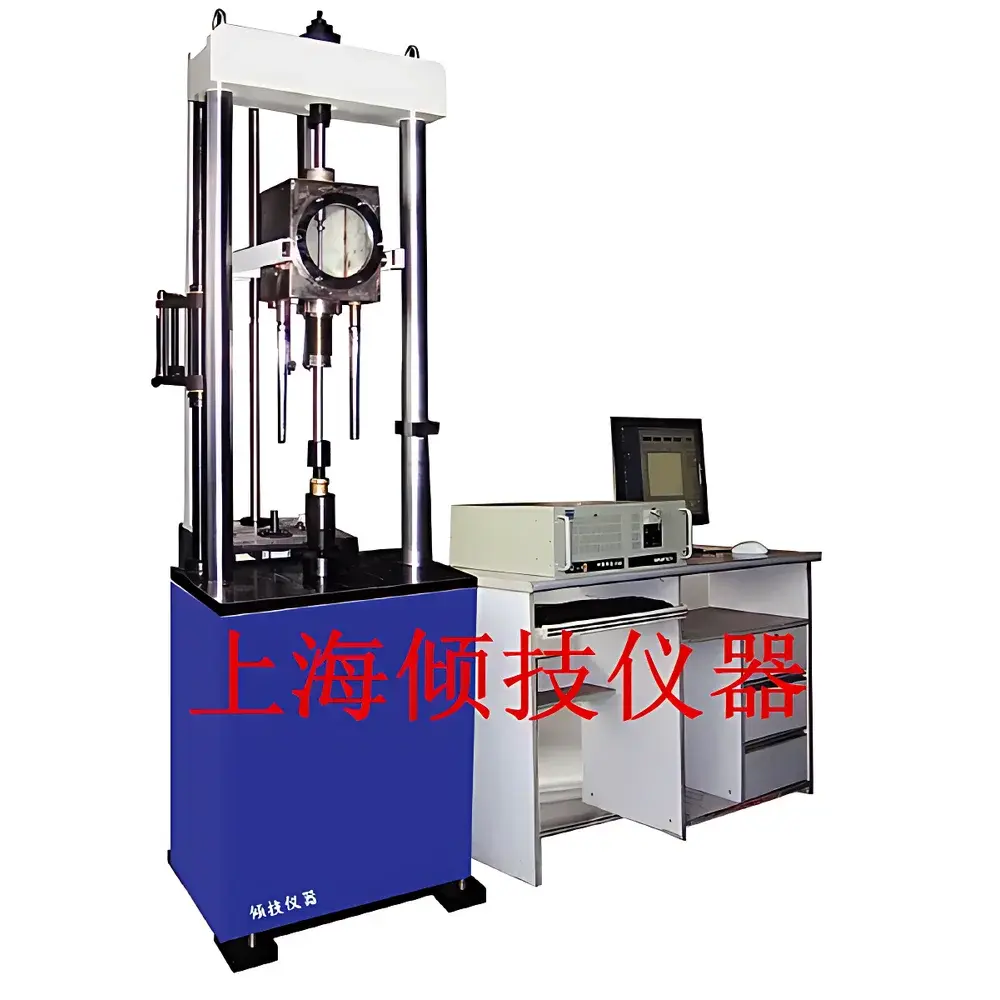
Qingji QJBV212P Electronic Environmental Stress Corrosion Testing Machine
| Brand | Qingji |
|---|---|
| Origin | Shanghai, China |
| Manufacturer Type | Authorized Distributor |
| Country of Origin | China |
| Model | QJBV212P |
| Load Capacity | 100 kN |
| Force Measurement Range | 1–99.99% FS |
| Force Accuracy | ≤ ±0.5% FS |
| Force Stability | ≤ ±0.5% (of reading) |
| Alignment (Coaxiality) | ≤ 8% |
| Crosshead Speed | 0.01–60 mm/min |
| Stroke (Lower Rod) | ≥ 80 mm |
| Strain Rate Range | 10⁻⁶ – 1 mm/s |
| Specimen Geometry | Ø10 × 180 mm (30 mm gauge length) |
| Operating Temperature Range | RT + 10 °C to 60 °C |
| Temperature Uniformity | ≤ ±2 °C |
| Corrosive Medium Volume | ≥ 400 mL |
| Communication Interface | Ethernet (TCP/IP) |
| Control Architecture | Dual-ARM Digital Controller with Decoupled Measurement & Processing |
| Compliance | GB/T 15970.7–2000, HB 7235–1995 |
Overview
The Qingji QJBV212P Electronic Environmental Stress Corrosion Testing Machine is a precision-engineered static loading system designed for evaluating the susceptibility of metallic materials and components to stress corrosion cracking (SCC) under controlled electrochemical and mechanical conditions. It operates on the principle of applying sustained uniaxial tensile load—either constant load or constant extension rate—to specimens immersed in aggressive chemical environments (e.g., chloride-containing aqueous solutions, acidic or alkaline media), while monitoring time-to-failure, crack initiation, and propagation behavior. This methodology aligns with internationally recognized slow strain rate testing (SSRT) and static load SCC protocols defined in GB/T 15970.7–2000 and HB 7235–1995. The system integrates high-stiffness mechanical architecture, thermally stabilized environmental chambers, and real-time digital force/displacement feedback control to ensure metrological integrity across long-duration tests lasting hours to weeks.
Key Features
- Monolithic cast-steel load frame eliminates residual welding stresses and minimizes frame deformation under full 100 kN load—ensuring mechanical stability and measurement fidelity over extended test durations.
- Dual-ARM microcontroller architecture separates real-time data acquisition from computational processing, enabling concurrent execution of PID-controlled actuation, thermal regulation, and synchronized data logging without latency or jitter.
- Adaptive PID control algorithm automatically optimizes servo response for diverse material systems (e.g., stainless steels, aluminum alloys, titanium grades) without manual parameter tuning—maintaining force deviation ≤ ±0.5% of setpoint throughout test cycles.
- Integrated touchscreen HMI supports local configuration of load profiles, temperature ramps, dwell periods, and safety thresholds; dual hardware limit switches provide redundant mechanical protection against overtravel.
- Environmental chamber features precise ±2 °C temperature regulation within a 400 mL minimum corrosion cell volume, accommodating standardized cylindrical specimens (Ø10 × 180 mm, 30 mm gauge length) and optional auxiliary electrodes for potentiostatic control.
- Ethernet-based TCP/IP communication enables seamless integration into distributed control systems (DCS), supporting remote monitoring, centralized data archiving, and audit-ready event logging compliant with GLP/GMP documentation requirements.
Sample Compatibility & Compliance
The QJBV212P accommodates standard ASTM E8/E8M-compliant round tensile specimens and custom geometries up to 10 mm diameter and 180 mm total length. Its corrosion cell design permits direct immersion in electrolytes including NaCl, MgCl₂, NH₄OH, and H₂SO₄ solutions at temperatures from ambient +10 °C to 60 °C. The system satisfies mechanical and procedural requirements of GB/T 15970.7–2000 (equivalent to ISO 7539-7) for slow strain rate testing and HB 7235–1995 for static-load SCC evaluation. Force transducer calibration traceability follows ISO/IEC 17025 standards, and all firmware timestamps are synchronized to UTC via NTP for regulatory audit trails.
Software & Data Management
Proprietary Qingji SCC TestSuite software provides ISO 17025-aligned test sequencing, real-time visualization of load–displacement–time–temperature curves, and automated generation of summary reports per GB/T 15970.7 Annex B. Raw data export supports CSV, XML, and HDF5 formats for post-processing in MATLAB, Python (Pandas), or commercial fracture mechanics packages. Role-based user accounts enforce access control, while electronic signatures and immutable audit logs comply with FDA 21 CFR Part 11 requirements for regulated laboratories conducting materials qualification under ASME BPVC Section II or NACE TM0177.
Applications
- Qualification of pipeline steels and weldments for sour service (H₂S-containing environments) per NACE MR0175/ISO 15156.
- Evaluation of aerospace aluminum alloys (e.g., 7075-T6, 2024-T3) exposed to marine atmospheres.
- Corrosion resistance benchmarking of additively manufactured Ti-6Al-4V components under simulated physiological conditions.
- Long-term durability assessment of nuclear fuel cladding materials (Zircaloy-4, M5®) in high-temperature water loops.
- Research into hydrogen embrittlement mechanisms in high-strength fasteners used in offshore wind turbine foundations.
FAQ
Does the QJBV212P support potentiostatic polarization during SCC testing?
Yes—optional integration with third-party potentiostats enables simultaneous electrochemical control (e.g., applied potential, current density) alongside mechanical loading.
Can test data be exported in formats compatible with statistical process control (SPC) platforms?
Yes—CSV and XML exports include metadata headers required for direct ingestion into JMP, Minitab, or custom SPC dashboards.
Is the system validated for use in ISO 17025-accredited laboratories?
Yes—full validation documentation (IQ/OQ/PQ protocols, uncertainty budgets, and calibration certificates) is provided upon request.
What maintenance intervals are recommended for long-term reliability?
Biannual verification of force transducer linearity and annual recalibration of temperature sensors are advised; consumables (seals, O-rings, electrolyte containers) are supplied with lifetime technical support.





