
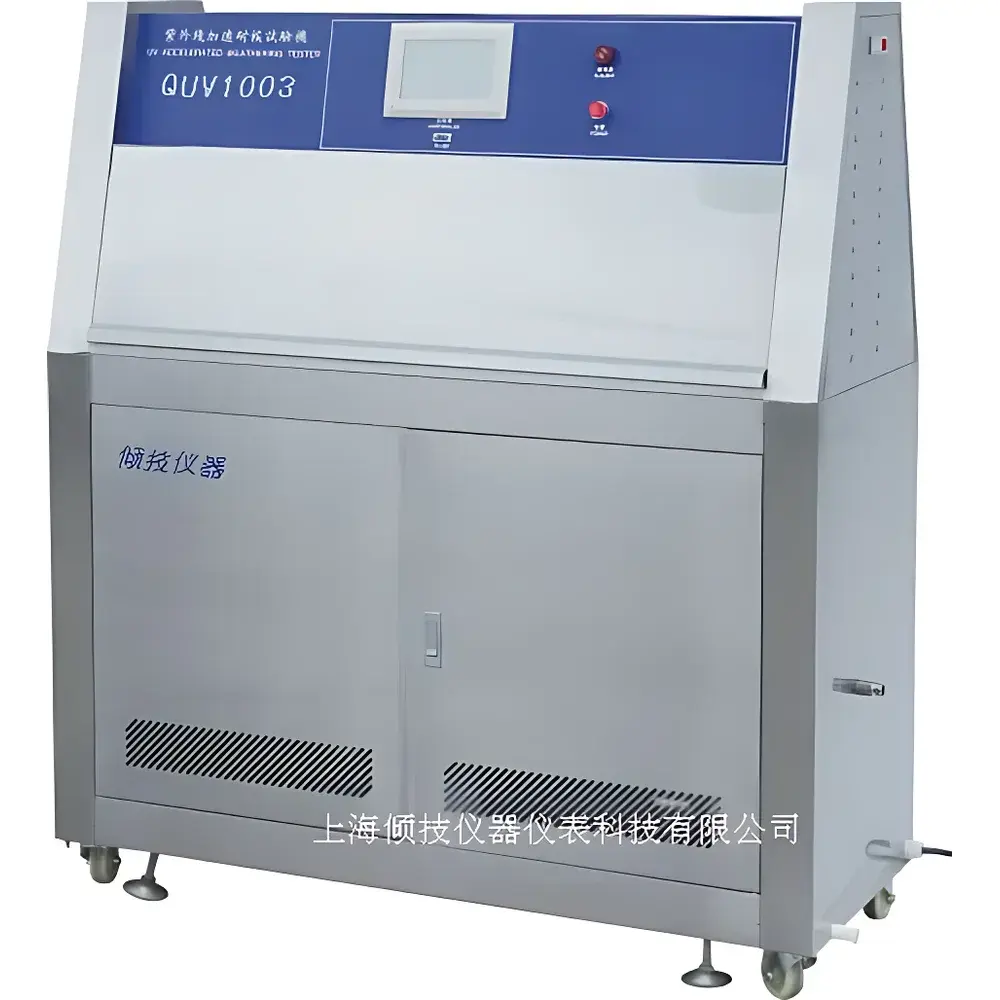
Qingji QUV1003 UV Aging Test Chamber
| Brand | Qingji |
|---|---|
| Origin | Shanghai, China |
| Model | QUV1003 (Spray-Type) |
| Temperature Range | RT+10°C to 70°C |
| Temperature Uniformity | ±3°C |
| Humidity Range | ≥75% RH |
| Irradiation Cycle Options | 4h UV / 4h Condensation or 8h UV / 4h Condensation |
| UV Lamp Type | UV-B (280–315 nm) |
| Lamp Center-to-Center Spacing | 65–70 mm |
| Sample-to-Lamp Distance | 55 mm |
| Standard Specimen Size | 75 × 150 mm |
| Water Consumption | 8 L/day (deionized or distilled water required) |
| Internal Chamber Dimensions (D×W×H) | 450 × 1165 × 500 mm |
| Overall Dimensions (D×W×H) | 600 × 1325 × 1480 mm |
| Compliance | GB/T 14522–1993 |
Overview
The Qingji QUV1003 UV Aging Test Chamber is an engineered environmental test system designed to accelerate the degradation of organic coatings—including architectural paints, automotive topcoats, industrial primers, and protective polymer finishes—under controlled ultraviolet radiation, thermal cycling, and moisture condensation. It operates on the principle of accelerated photochemical aging using fluorescent UV-B lamps (280–315 nm), replicating the most damaging portion of terrestrial solar spectrum while eliminating non-germane infrared heat load. The chamber integrates three synchronized stress factors: UV irradiation (simulating sunlight-induced photolysis and free-radical oxidation), elevated temperature (during irradiation phases), and high-humidity condensation (mimicking nocturnal dew formation). This multi-stress protocol enables rapid assessment of surface-level degradation mechanisms such as chalking, gloss loss, color shift (ΔE), microcracking, blistering, and interfacial delamination—phenomena directly linked to real-world outdoor exposure performance per ISO 4892-3 and ASTM G154.
Key Features
- UV-B fluorescent lamp array with spectral output calibrated to match the critical short-wavelength region of natural sunlight (280–315 nm), ensuring relevance to polymer bond scission and chromophore degradation.
- Dual-phase programmable cycle control: configurable UV irradiation (at 50°C, 60°C, or 70°C; ±3°C uniformity) followed by condensation phase (50°C, ±3°C), supporting both 4h/4h and 8h/4h UV/condensation sequences per ISO 4892-3 Annex A.
- Integrated spray function for optional wetting simulation during UV exposure, enabling evaluation of hydrolytic stability and wash-off resistance in architectural and marine coatings.
- Precision-engineered chamber geometry ensures consistent irradiance distribution across the 75 × 150 mm specimen plane, with lamp-to-sample distance fixed at 55 mm and lamp center spacing maintained at 65–70 mm to minimize edge effects and shadowing.
- Stainless steel inner chamber (450 × 1165 × 500 mm) resists corrosion from condensate and UV byproducts; external housing constructed for structural rigidity and thermal isolation.
- Real-time monitoring of chamber temperature and relative humidity (≥75% RH during condensation) via calibrated PT100 sensors and capacitive RH transducers, logged with timestamped metadata.
Sample Compatibility & Compliance
The QUV1003 accommodates standard flat-panel specimens (75 × 150 mm) mounted vertically on stainless steel racks, compatible with ASTM D6695, ISO 4892-3, and GB/T 14522–1993 test protocols. It supports comparative aging studies across coating formulations, pigment systems, and resin chemistries—including acrylics, polyurethanes, epoxies, and fluoropolymers. All operational parameters are traceable to national metrological standards. While not inherently 21 CFR Part 11 compliant, the system’s data logging architecture supports integration with validated third-party software for GLP/GMP environments requiring audit trails and electronic signatures.
Software & Data Management
The controller features a touchscreen HMI with embedded cycle programming, real-time parameter display, and event-triggered alarm logging (e.g., lamp failure, water shortage, temperature excursion). Test profiles—including UV intensity setpoints, temperature ramps, condensation duration, and spray timing—are stored in non-volatile memory. Raw sensor data (temperature, RH, elapsed time) is exportable via USB to CSV format for post-test statistical analysis (e.g., ANOVA of gloss retention vs. exposure dose). Optional RS485 interface enables centralized lab network integration for remote status monitoring and batch reporting.
Applications
- Accelerated weathering validation of OEM automotive clearcoats under cyclic UV/condensation stress.
- Formulation screening of UV absorbers and HALS stabilizers in architectural latex paints.
- Correlation studies between QUV exposure hours and field exposure months for predictive service life modeling.
- Quality control release testing of batch-coated metal substrates prior to shipment.
- Failure analysis of coating adhesion loss on composite substrates subjected to thermal-moisture cycling.
FAQ
What UV spectrum does the QUV1003 emit, and why is UV-B selected?
The system uses fluorescent UV-B lamps emitting primarily between 280–315 nm—a range proven to drive photooxidative chain scission in C–C and C–H bonds of organic polymers, accelerating degradation more effectively than full-spectrum or UV-A-only sources.
Is distilled water mandatory for condensation and spray functions?
Yes. Deionized or distilled water is required to prevent mineral deposition on lamps and specimen surfaces, which would otherwise attenuate UV transmission and introduce artifacts in colorimetric or gloss measurements.
Can the QUV1003 be used for ISO 4892-3 Cycle 1 (UV-A only) testing?
No. The QUV1003 is configured exclusively with UV-B lamps and does not support UV-A (315–400 nm) spectral output; users requiring UV-A compliance must select alternative lamp configurations or instrument models.
What maintenance intervals are recommended for optimal irradiance stability?
UV lamps should be replaced every 1,600 hours of operation or annually—whichever occurs first—to maintain spectral consistency and irradiance output within ±10% of initial calibration. Chamber gaskets and water reservoir seals require biannual inspection.
Does the system include calibration certification?
A factory-issued calibration report covering temperature uniformity, humidity accuracy, and lamp irradiance (measured at specimen plane with NIST-traceable UV radiometer) is provided with each unit. On-site recalibration services are available upon request.



