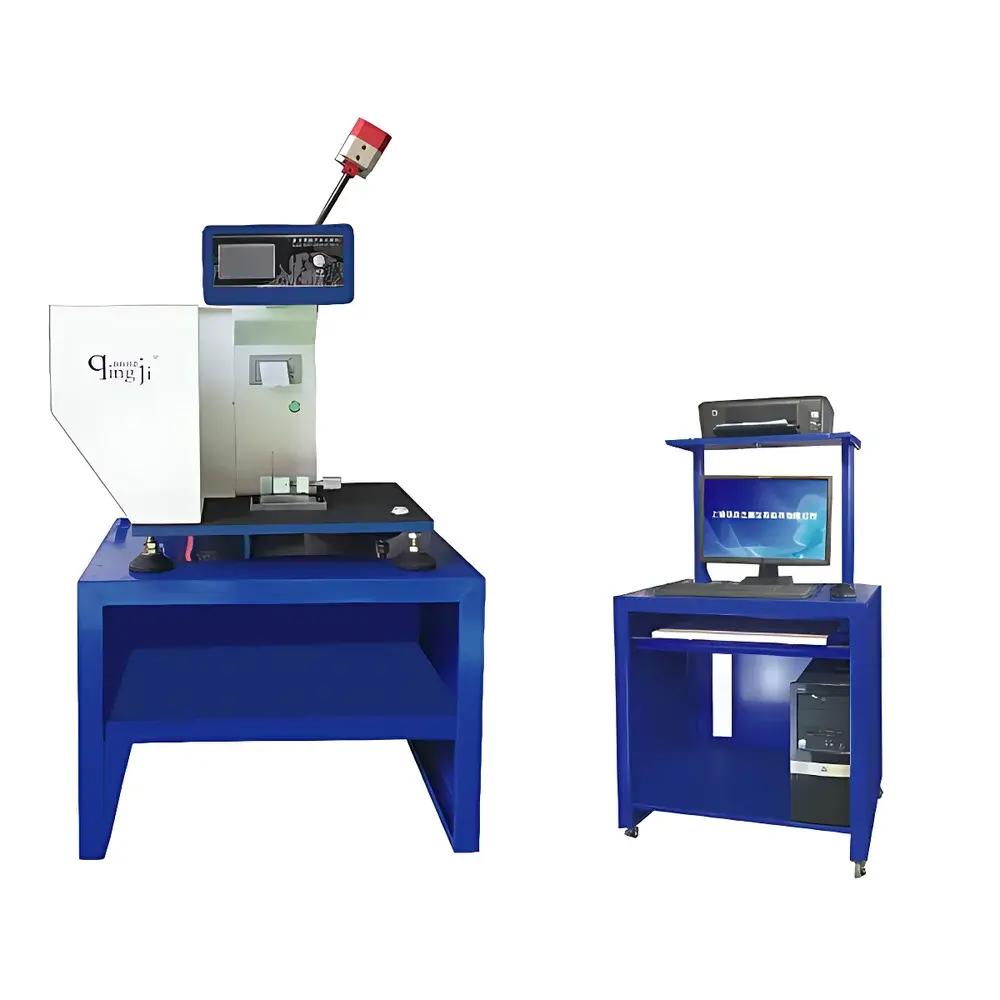
Qinji QJBCX Cantilever Beam Impact Tester for Rigid Plastics
| Brand | Qinji |
|---|---|
| Origin | Shanghai, China |
| Model | QJBCX |
| Impact Energies | 1 J, 2.75 J, 5.5 J, 11 J, 22 J, 50 J |
| Impact Velocity | 3.5 m/s |
| Pendulum Pre-lift Angle | 150° |
| Distance from Pivot to Impact Center | 322 mm |
| Notch Radius (Striker Radius) | R 0.8 mm |
| Dimensions (L×W×H) | 550 mm × 300 mm × 900 mm |
| Power Supply | 220 V ±10%, 50 Hz |
| Net Weight | ~85 kg |
| Compliance | GB/T 1843, ISO 180, GB/T 2611, JB/T 8761 |
Overview
The Qinji QJBCX Cantilever Beam Impact Tester is a precision mechanical testing instrument engineered for the quantitative determination of impact toughness in rigid non-metallic materials under standardized cantilever beam loading conditions. It operates on the classical pendulum impact principle: a calibrated pendulum is raised to a defined pre-lift angle (150°), released, and strikes a notched specimen clamped at one end in a fixed cantilever configuration. The energy absorbed during fracture—calculated from the difference between initial potential energy and residual swing energy—is reported as impact strength in kJ/m². This method directly measures the material’s resistance to sudden brittle or ductile fracture under high-strain-rate, uniaxial bending stress. Designed in strict accordance with GB/T 1843 (equivalent to ISO 180) and supporting standards including GB/T 2611 (general requirements for testing machines) and JB/T 8761 (technical specifications for pendulum impact testers), the QJBCX delivers repeatable, traceable results suitable for quality control, material development, and regulatory documentation in regulated environments.
Key Features
- Multi-range calibrated pendulum system offering six selectable nominal impact energies: 1 J, 2.75 J, 5.5 J, 11 J, 22 J, and 50 J—enabling precise matching to specimen geometry and expected toughness levels.
- Fixed impact velocity of 3.5 m/s ensures consistent strain-rate conditions across tests, critical for inter-laboratory comparability and compliance with ISO 180 Annex A.
- Optimized impact center distance of 322 mm guarantees accurate energy transfer and minimizes rotational error per ISO 180 Clause 6.3.
- Standardized striker nose radius of R 0.8 mm conforms to ISO 180:2019 requirements for Type A pendulums used with notched specimens.
- Rugged cast-iron base and precision-machined frame provide dimensional stability and vibration damping during impact event, contributing to measurement reproducibility.
- Manual release mechanism with angular scale and vernier-assisted pre-lift verification supports operator-controlled test initiation without electronic dependency—enhancing reliability in environments with electromagnetic interference or power instability.
Sample Compatibility & Compliance
The QJBCX accommodates standard rectangular bars per ISO 180 and GB/T 1843, typically 80 mm × 10 mm × 4 mm (length × width × thickness), with machined U- or V-notches. It is validated for use with rigid thermoplastics (e.g., ABS, PC, POM), fiber-reinforced composites (glass-fiber nylon, carbon-fiber epoxy), ceramic tiles and substrates, cast stone, electrical insulating laminates (e.g., phenolic resin boards), and advanced polymer-ceramic hybrids. All test procedures and calibration protocols align with national and international regulatory expectations: results generated on this system satisfy reporting requirements under ISO/IEC 17025-accredited laboratories, support GLP-compliant material qualification dossiers, and are accepted in technical submissions to Chinese NMPA (for medical device polymers) and CNCA (for CCC-certified electrical components). The mechanical design inherently meets GB/T 2611 Class 2 accuracy criteria for force and energy measurement uncertainty.
Software & Data Management
The QJBCX is a manually operated, analog-readout instrument with no embedded microprocessor or digital interface. Energy values are determined via direct mechanical scale reading of pendulum deflection angle post-impact, converted using pre-calibrated energy-angle coefficients supplied in the factory certificate of calibration. While no proprietary software is included, raw angular displacement data can be recorded manually and processed in external statistical packages (e.g., Minitab, JMP, or Python pandas) for SPC charting, capability analysis (Cpk), and audit-ready reporting. For laboratories operating under FDA 21 CFR Part 11 or ISO 13485, users may integrate manual readings into validated LIMS workflows using documented SOPs for observer training, dual-signature recording, and controlled logbook archiving. Calibration certificates—including traceability to NIM (National Institute of Metrology, China) standards—are provided with each unit and updated annually per ISO/IEC 17025 clause 6.6.
Applications
- Quality assurance of injection-molded automotive interior trim, where notch sensitivity must be verified against OEM material specifications (e.g., VW TL 52287).
- Comparative evaluation of UV-stabilized vs. non-stabilized polypropylene compounds in solar panel junction box housings (IEC 61215 compliance support).
- Batch release testing of alumina ceramic substrates for high-voltage insulators in smart grid infrastructure.
- Research into toughening mechanisms in bio-based polyesters, measured across aging cycles per ASTM D3045.
- Third-party certification testing for GB/T 33281-compliant zinc-coated steel sheet polymer coatings in construction applications.
- Teaching laboratories in materials science curricula—demonstrating fundamental relationships between molecular structure, crystallinity, and impact resistance in thermosets versus thermoplastics.
FAQ
Does the QJBCX comply with ISO 180:2019 for Type A pendulum testing?
Yes. Its impact velocity (3.5 m/s), striker radius (R 0.8 mm), and impact center distance (322 mm) fully satisfy the dimensional and kinematic requirements for Type A pendulums specified in ISO 180:2019 Annex A.
Is calibration traceable to national metrology institutes?
Each unit ships with a factory calibration certificate traceable to NIM (China National Institute of Metrology), including uncertainty budgets per ISO/IEC 17025. On-site recalibration services are available through authorized Qinji service partners.
Can the tester accommodate specimens thicker than 4 mm?
No. The clamping mechanism and anvil geometry are designed exclusively for specimens conforming to ISO 180 standard dimensions (typically 4 mm thick). Non-standard thicknesses require custom fixtures not supplied with the base system.
What maintenance is required to sustain measurement accuracy?
Bi-weekly visual inspection of pendulum bearing play, monthly cleaning of scale graduations and striker edge, and annual verification of pivot friction torque per JB/T 8761 Section 7.2 are recommended. Replacement strikers and anvils are stocked globally.
Is electrical safety certification provided for export markets?
The unit carries CE marking per Machinery Directive 2006/42/EC and EMC Directive 2014/30/EU, with test reports available upon request. UL/cUL listing is not included but can be pursued via third-party certification bodies for North American deployment.