
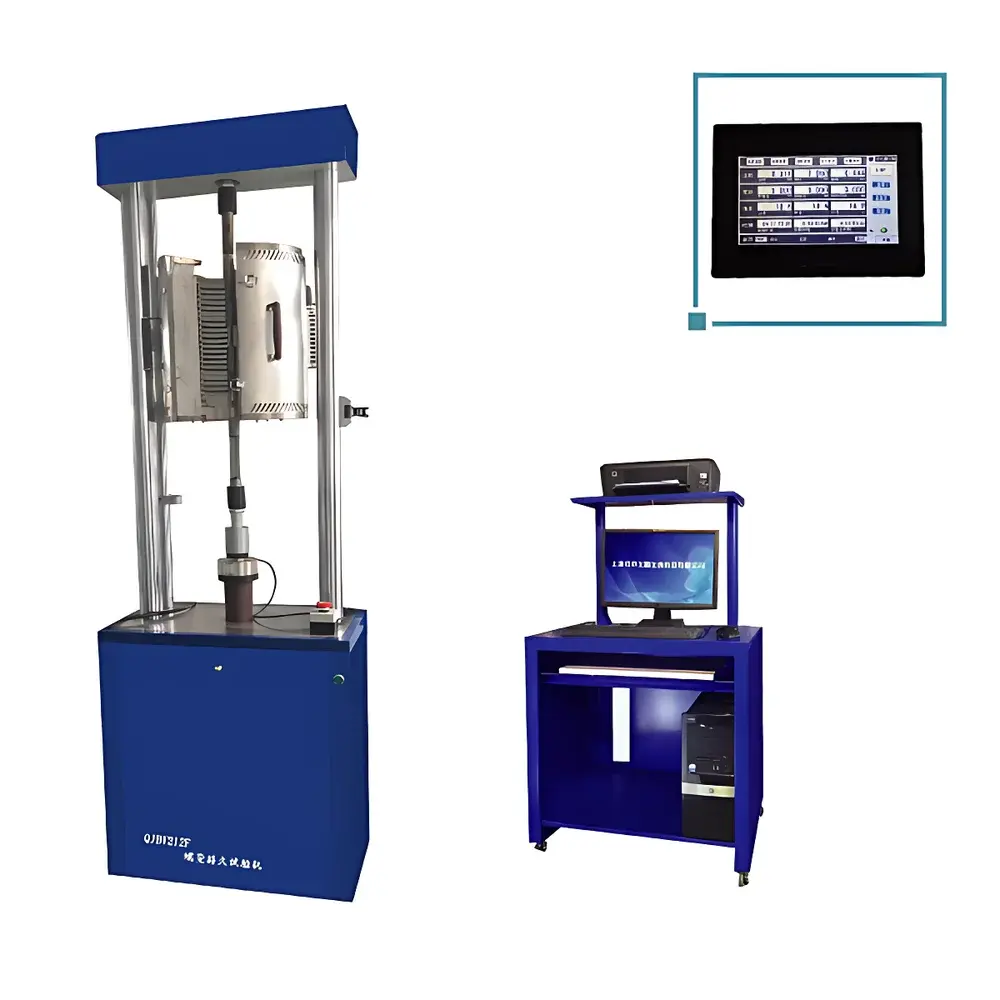
Qinji QJBV212F High-Temperature Creep and Stress-Rupture Testing Machine
| Origin | Shanghai, China |
|---|---|
| Manufacturer Type | Authorized Distributor |
| Origin Category | Domestic (China) |
| Model | QJBV212F |
| Price | USD 9,500 (FOB Shanghai) |
| Max Test Load | 10–100 kN (selectable) |
| Load Accuracy | ±0.5% of reading (≥1% FS) |
| Load Stability | ±1% of reading |
| Crosshead Speed | 0.01–180 mm/min |
| Stroke | 200 mm |
| Strain Measurement | High-precision rotary encoder |
| Strain Range | Up to 25 mm |
| Strain Accuracy | ±0.5% |
| Furnace ID | Ø50 mm |
| Furnace Length | 450 mm |
| Temp Range | RT to 1200 °C |
| Temp Uniformity | ±0.5 °C |
| Temp Resolution | 0.1 °C |
| Hot Zone Length | >150 mm |
| Load Control | Servo-driven, continuous adjustable (0–100 kN) |
| Load Resolution | 0.1 N |
| Power Supply | 3 kW |
| Weight | 850 kg |
Overview
The Qinji QJBV212F High-Temperature Creep and Stress-Rupture Testing Machine is a precision-engineered mechanical testing system designed for the quantitative evaluation of time-dependent deformation and rupture behavior of metallic and alloy materials under sustained uniaxial tensile loading at elevated temperatures. It operates on the fundamental principles of creep mechanics—specifically primary, secondary (steady-state), and tertiary creep regimes—as defined in ASTM E139, ISO 204, and GB/T 2039. The system integrates a high-stability electromechanical actuation train with a programmable high-temperature tubular furnace and closed-loop load/strain control architecture, enabling compliance with national and international standards including JJG 276–1988, HB 5150–1996, and HB 5151–1996. Its modular design supports reproducible long-duration tests—spanning hours to thousands of hours—at temperatures up to 1200 °C, making it suitable for qualification testing in mission-critical sectors such as aerospace turbine component development, power generation metallurgy, and nuclear structural material certification.
Key Features
- Multi-range selectable load capacity: 10 kN, 20 kN, 30 kN, 50 kN, and 100 kN configurations—each calibrated per ISO 7500-1 Class 0.5 requirements
- High-fidelity load control via industrial-grade servo motor and precision ball-screw transmission, achieving ±1% control accuracy and 0.1 N resolution
- Optimized high-temperature furnace with axial hot-zone uniformity >150 mm and temperature stability ±0.5 °C over full operating range (RT to 1200 °C)
- Non-contact or direct-coupled strain measurement using imported rotary encoders, supporting up to 25 mm travel with ±0.5% linearity error
- Programmable crosshead speed from 0.01 to 180 mm/min, enabling both slow creep rate monitoring and rapid pre-load application
- Rigid, vibration-damped base frame (850 kg total mass) minimizing environmental interference during ultra-long-term tests
- Compliance-ready hardware architecture—including isolated analog signal paths and timestamped digital I/O—for future integration into GLP/GMP audit environments
Sample Compatibility & Compliance
The QJBV212F accommodates standard cylindrical or flat-bar specimens conforming to ASTM E139 gauge lengths (e.g., 25 mm or 50 mm), with furnace-compatible specimen diameters ≤12 mm. It supports testing of ferrous alloys (e.g., stainless steels, Ni-based superalloys), non-ferrous metals (Ti-6Al-4V, Inconel 718), and advanced intermetallics. All mechanical and thermal subsystems are validated against JJG 276–1988 verification protocols, while data acquisition meets minimum requirements for traceability under ISO/IEC 17025. Optional calibration certificates (NIST-traceable load cells and thermocouples) and furnace mapping reports are available upon request to support regulatory submissions.
Software & Data Management
The system operates under Qinji’s proprietary TMS-Creep v3.2 software platform, a Windows-based application supporting real-time dual-channel acquisition (load + extension), multi-step thermal ramping, and automatic hold/soak sequencing. Raw data is stored in ASCII-delimited .csv format with embedded metadata (test ID, operator, timestamp, furnace zone thermocouple IDs). Audit trail functionality records all parameter changes, user logins, and calibration events—aligned with FDA 21 CFR Part 11 foundational expectations. Export modules support direct import into MATLAB, Python (Pandas), and commercial fatigue analysis suites (nCode DesignLife, FE-SAFE). Remote monitoring via Ethernet TCP/IP is supported; no cloud dependency or third-party SaaS components are embedded.
Applications
- Stress-rupture life prediction for gas turbine disk and blade alloys under service-representative thermal-mechanical loads
- Creep ductility assessment of welded joints in high-temperature piping systems (ASME BPVC Section III, Case N-758)
- Time-to-rupture benchmarking of additively manufactured Inconel 625 under static load at 750 °C
- Secondary creep rate derivation (dε/dt)ss for constitutive modeling (e.g., Norton-Bailey law fitting)
- Interlaboratory round-robin validation per ISO 204 Annex B protocols
- Accelerated aging studies of structural materials in concentrated solar power receiver tubes
FAQ
What standards does the QJBV212F comply with for creep testing?
It satisfies JJG 276–1988, GB/T 2039–1997, HB 5150–1996, HB 5151–1996, and is operationally aligned with ASTM E139 and ISO 204 requirements.
Can the system perform interrupted creep tests with intermediate unloading and microstructural analysis?
Yes—programmable pause/resume functionality allows controlled unloading at user-defined time points; specimens may be extracted for SEM/TEM post-test without system recalibration.
Is furnace temperature uniformity verified across the hot zone?
Each unit undergoes mandatory hot-zone mapping using five calibrated Type K thermocouples; a report documenting axial/radial gradients is provided with delivery.
What maintenance intervals are recommended for long-term reliability?
Furnace insulation inspection every 500 operational hours; load cell and encoder recalibration annually or after 10,000 test cycles—whichever occurs first.
Does the system support automated data archiving to network drives or LIMS integration?
Yes—via configurable UNC path mapping and optional OPC UA server add-on for bidirectional communication with laboratory information management systems.



