
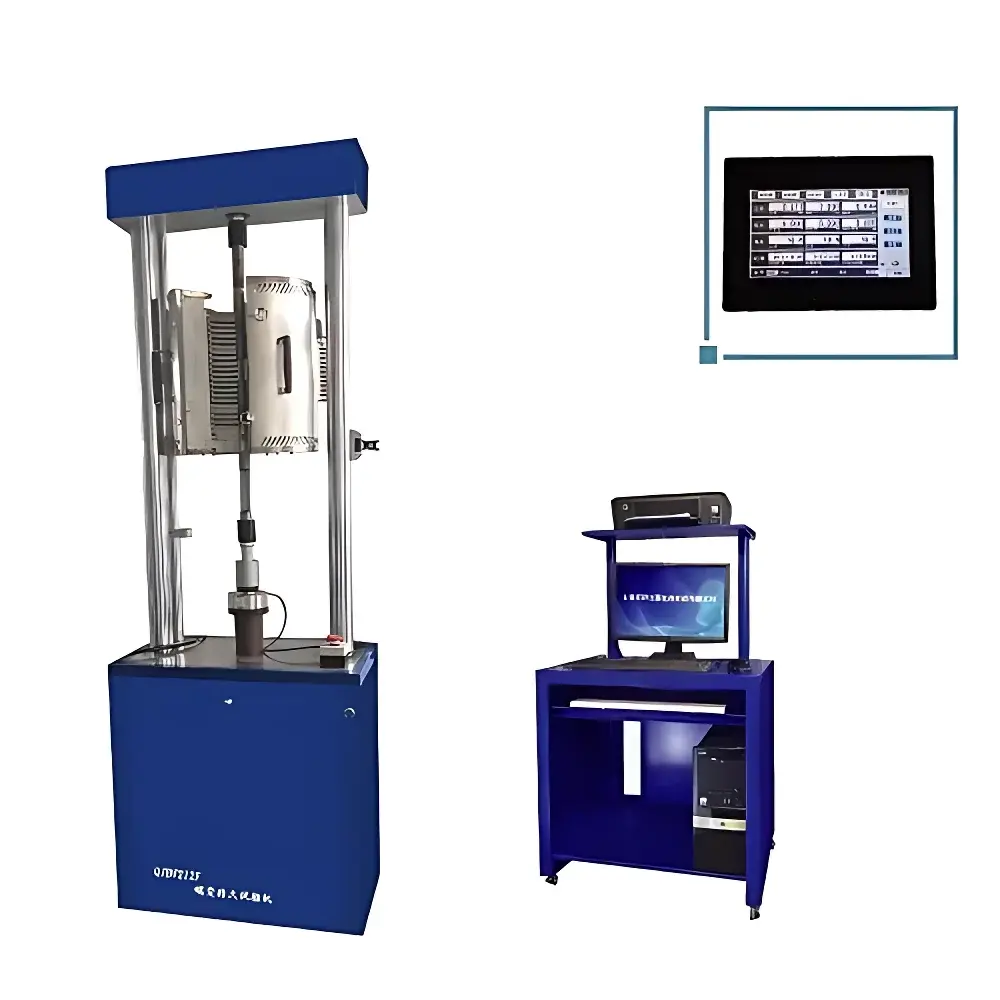
Qinji QJBV212F Metal Creep and Stress-Rupture Testing System
| Origin | Shanghai, China |
|---|---|
| Manufacturer Type | Authorized Distributor |
| Origin Category | Domestic (PRC) |
| Model | QJBV212F |
| Price | USD 8,600 (FOB Shanghai) |
| Max Test Load | 10–100 kN (selectable) |
| Temperature Range | Ambient to 1200 °C |
| Furnace Bore | Ø50 mm |
| Effective Hot Zone Length | >150 mm |
| Load Control Accuracy | ±1% of setpoint |
| Load Measurement Accuracy | ±0.5% of reading (≥1% FS) |
| Displacement Rate | 0.01–180 mm/min |
| Extensometer Resolution | 0.1 µm (encoder-based) |
| Temperature Stability | ±0.5 °C |
| Temp. Resolution | 0.1 °C |
| Power Supply | 3 kW, 3-phase 380 VAC |
| Net Weight | 850 kg |
Overview
The Qinji QJBV212F Metal Creep and Stress-Rupture Testing System is a precision-engineered, high-temperature mechanical testing platform designed for standardized evaluation of time-dependent deformation and rupture behavior in metallic materials under sustained uniaxial tensile loading. Operating on the fundamental principles of solid-state creep mechanics—namely primary (transient), secondary (steady-state), and tertiary (accelerated) creep stages—the system enables rigorous determination of creep strain rate, time-to-rupture, minimum creep rate, and stress-rupture life across extended durations (up to 10,000 hours). It complies fully with internationally referenced test standards including ASTM E139, ISO 204, GB/T 2039–2012 (revised edition of GB/T 2039–1997), JJG 276–2015 (replacing JJG 276–88), HB 5150–2018 and HB 5151–2018 (successors to HB5150-1996/HB5151-1996), ensuring data integrity for certification, qualification, and regulatory submission workflows in aerospace, power generation, and nuclear component development.
Key Features
- Modular load frame architecture supporting five selectable maximum capacities: 10 kN, 20 kN, 30 kN, 50 kN, and 100 kN—each calibrated and verified per ISO 7500-1 Class 0.5 requirements
- High-stability resistive tube furnace with axial hot-zone uniformity exceeding 150 mm at ±0.5 °C, featuring dual-zone PID control and thermocouple feedback (Type S or K, user-selectable)
- Precision servo-driven loading system with closed-loop force regulation, enabling continuous load adjustment from 0 to full scale with ±1% control accuracy and 0.1 N resolution
- Non-contact or contact extensometry options: factory-integrated high-resolution rotary encoder (±0.5% error, 25 mm range standard; optional 50/100 mm ranges available) with thermal compensation algorithms
- Robust mechanical design incorporating rigid C-frame construction, low-thermal-drift load cell mounting, and vibration-damped base assembly (850 kg total mass enhances operational stability)
- Integrated safety interlocks: over-temperature cutoff, load-cell overload protection, furnace door open detection, and emergency stop compliant with IEC 60204-1
Sample Compatibility & Compliance
The QJBV212F accommodates standard cylindrical or dog-bone-shaped specimens per ASTM E8/E21, ISO 6892-2, and GB/T 228.2 specifications, with gauge lengths from 10 to 50 mm and diameters up to Ø12 mm (compatible with Ø50 mm furnace bore). It supports testing of ferrous alloys (e.g., carbon steels, Cr-Mo steels, stainless grades), non-ferrous metals (Ti-6Al-4V, Inconel 600/718, Hastelloy X), and intermetallic compounds. All hardware and firmware configurations meet traceability requirements under ISO/IEC 17025:2017 for accredited laboratories. The system’s measurement uncertainty budget is documented per GUM (JCGM 100:2008) and supports audit readiness for AS9100, NADCAP AC7101, and nuclear QA programs (10 CFR 50 Appendix B).
Software & Data Management
Control and acquisition are executed via Qinji’s proprietary CreepTest Pro v4.2 software, running on Windows 10 IoT Enterprise. The application provides real-time plotting of load, displacement, temperature, and calculated strain; automated hold-step sequencing; and customizable test profiles (ramp-hold, multi-step load, temperature cycling). Raw data is stored in HDF5 format with embedded metadata (operator ID, calibration certificates, environmental logs). Audit trail functionality satisfies FDA 21 CFR Part 11 requirements, including electronic signatures, immutable event logging, and role-based access control. Export modules support CSV, XML, and ASTM E1431-compliant ASCII formats for integration with LIMS (e.g., LabWare, Thermo SampleManager) and statistical analysis platforms (Minitab, JMP).
Applications
- Qualification of turbine disk and blade alloys under simulated service conditions (e.g., 700 °C / 150 MPa for 5,000 h)
- Development of constitutive models (e.g., Norton-Bailey, Garofalo equations) for finite element simulation of component life
- Comparative assessment of grain boundary strengthening mechanisms in directionally solidified superalloys
- Validation of heat treatment effects on creep resistance in welded joints (e.g., P91 pipe girth welds)
- Long-term reliability testing of fasteners and structural bolts in petrochemical reactors
- Supporting material submittals for ASME BPVC Section II, Part D and EN 1591-1 flange design calculations
FAQ
What standards does the QJBV212F formally comply with?
It meets the metrological and procedural requirements of JJG 276–2015, GB/T 2039–2012, HB 5150–2018, HB 5151–2018, ASTM E139, ISO 204, and ISO 6892-2.
Can the system perform both creep and stress-rupture tests simultaneously?
No—it operates in dedicated test modes; however, a single specimen can be subjected to sequential creep (strain-controlled hold) and stress-rupture (load-controlled until failure) protocols within one campaign using saved configuration templates.
Is third-party calibration certification included?
Yes—each unit ships with a factory calibration certificate traceable to NIM (National Institute of Metrology, China) and includes load cell, furnace thermocouple, and encoder verification reports.
What maintenance intervals are recommended for sustained operation?
Furnace insulation inspection every 500 operating hours; load cell zero-check monthly; encoder alignment verification quarterly; full system recalibration annually or after any mechanical impact or relocation.
Does the system support remote monitoring and diagnostics?
Yes—via secure TLS-encrypted Ethernet connection; optional VPN integration allows off-site technical support with operator consent and session logging.



