
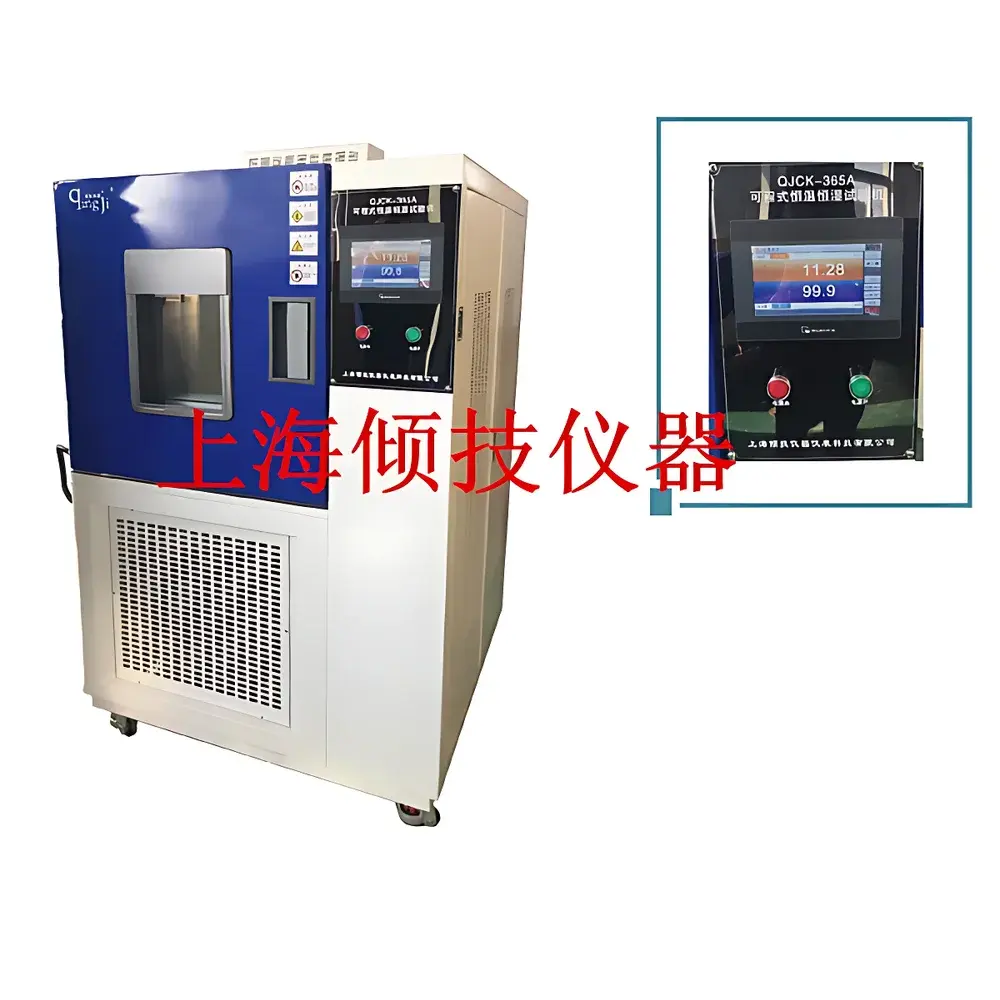
Qinji QJCK-350 Series Environmental Chamber
| Brand | Qinji |
|---|---|
| Origin | Shanghai, China |
| Model | QJCK-350 |
| Temperature Range | −40 °C to +150 °C |
| Humidity Range | 10 %RH to 99.9 %RH |
| Temperature Resolution | 0.01 °C |
| Humidity Resolution | 0.01 %RH |
| Temperature Uniformity | ±2.0 °C |
| Humidity Uniformity | ±3.0 %RH |
| Temperature Accuracy | ±0.5 °C |
| Humidity Accuracy | ±2.5 %RH |
| Programmable Steps | 120 programs / 1200 segments |
| Internal Dimensions (H×W×D) | 450 × 400 × 350 mm |
| External Dimensions (H×W×D) | 1550 × 920 × 820 mm |
| Power Supply | 220 V AC |
| Rated Power | 2.0 kW |
| Net Weight | ~180 kg |
Overview
The Qinji QJCK-350 Series Environmental Chamber is a precision-engineered climatic test system designed to replicate controlled temperature and humidity conditions for accelerated environmental stress testing of materials and finished products. Based on dual-refrigeration and steam-humidification architecture with PID-controlled air circulation, the chamber maintains stable thermal-hygrometric profiles across its full operational range. It complies with fundamental test methodology standards including IEC 60068-2-1 (cold), IEC 60068-2-2 (dry heat), IEC 60068-2-30 (damp heat, cyclic), and ASTM D4332 for conditioning of plastic specimens prior to mechanical or electrical evaluation. Its robust stainless-steel interior, double-wall insulation, and leak-tested sealed construction ensure long-term stability and minimal drift—critical for repeatable qualification testing in R&D, quality assurance, and production validation environments.
Key Features
- Wide operational envelope: −40 °C to +150 °C temperature range and 10–99.9 %RH humidity range, enabling both extreme low-temperature dry storage and high-humidity aging simulations.
- High-resolution digital control: 0.01 °C temperature resolution and 0.01 %RH humidity resolution support fine-grained parameter definition for compliance-critical test protocols.
- Programmable multi-segment logic: Supports up to 120 independent test programs, each containing up to 100 steps (1200 total segments), with ramp/soak scheduling, loop repetition, and pause/resume functionality.
- Thermal-hygrometric uniformity verified per IEC 60068-3-5: ±2.0 °C temperature uniformity and ±3.0 %RH humidity uniformity across the working volume (450 × 400 × 350 mm).
- Dual-sensor monitoring: Independent platinum resistance thermometers (PT100) and capacitive humidity sensors provide redundant feedback for closed-loop control and real-time deviation logging.
- Energy-efficient design: Optimized refrigerant circuitry (R404A/R23 cascade system) and insulated double-glass observation window minimize thermal load and power consumption (rated at 2.0 kW).
Sample Compatibility & Compliance
The QJCK-350 accommodates samples up to 30 kg distributed across its internal chamber, with standard 2–4 adjustable stainless-steel shelves (load-rated to 15 kg/shelf). Its chamber geometry and airflow pattern are validated for uniform exposure of electronic assemblies, polymer components, pharmaceutical packaging, and coated metal substrates. The unit supports test execution in accordance with ISO 17025-accredited laboratories’ requirements when paired with external calibration records traceable to NIM (National Institute of Metrology, China) or equivalent national metrology institutes. While not inherently 21 CFR Part 11 compliant, audit-ready data export (CSV/TXT) and optional timestamped event logs enable integration into GLP/GMP workflows where electronic record retention is mandated.
Software & Data Management
The embedded controller features an intuitive 7-inch TFT touchscreen interface with multilingual support (English, Chinese, Spanish). Real-time trend graphs display temperature/humidity trajectories against setpoints; deviation alerts trigger visual and relay-based notifications. All test data—including setpoint history, actual chamber readings, alarm timestamps, and program execution status—are stored internally (≥30 days at 1-min intervals) and exportable via USB flash drive. Optional Ethernet connectivity enables remote monitoring and integration with enterprise MES or LIMS platforms using Modbus TCP protocol. No proprietary software installation is required for basic operation or data retrieval.
Applications
- Electronics reliability: Thermal cycling (−40 °C ↔ +85 °C) and damp heat (85 °C/85 %RH) testing per JEDEC JESD22-A104 and A110.
- Automotive component validation: Climate endurance of infotainment displays, sensors, and wiring harnesses under ISO 16750-4.
- Pharmaceutical packaging: Accelerated stability studies of blister packs and HDPE containers per ICH Q1A(R2) guidelines.
- Polymer aging: UV-free thermal-oxidative degradation assessment of elastomers and adhesives under controlled humidity.
- Calibration lab support: Conditioning reference standards and test specimens prior to dimensional or electrical measurement.
FAQ
What is the recommended calibration interval for this chamber?
We recommend annual calibration of temperature and humidity sensors using NIST-traceable reference standards, with interim verification checks performed before critical test runs.
Can the chamber operate continuously at −40 °C and 10 %RH?
Yes—the refrigeration and dehumidification systems are rated for uninterrupted operation across the full specified range, provided ambient room temperature remains ≤30 °C and relative humidity ≤70 %RH.
Is third-party validation documentation available?
Factory-issued IQ/OQ documentation templates are provided; final PQ must be executed by the end user or authorized service partner using site-specific acceptance criteria.
Does the unit include over-temperature or over-humidity safety cutoffs?
Yes—hardware-independent safety limit controllers (separate from the main PID) interrupt power to heating/humidifying elements if chamber readings exceed user-defined thresholds by >5 °C or >10 %RH.
What maintenance is required beyond routine cleaning?
Quarterly inspection of condensate drain lines, annual replacement of humidifier water filter (if used with tap water), and biannual verification of door gasket integrity are advised to maintain performance specifications.



