
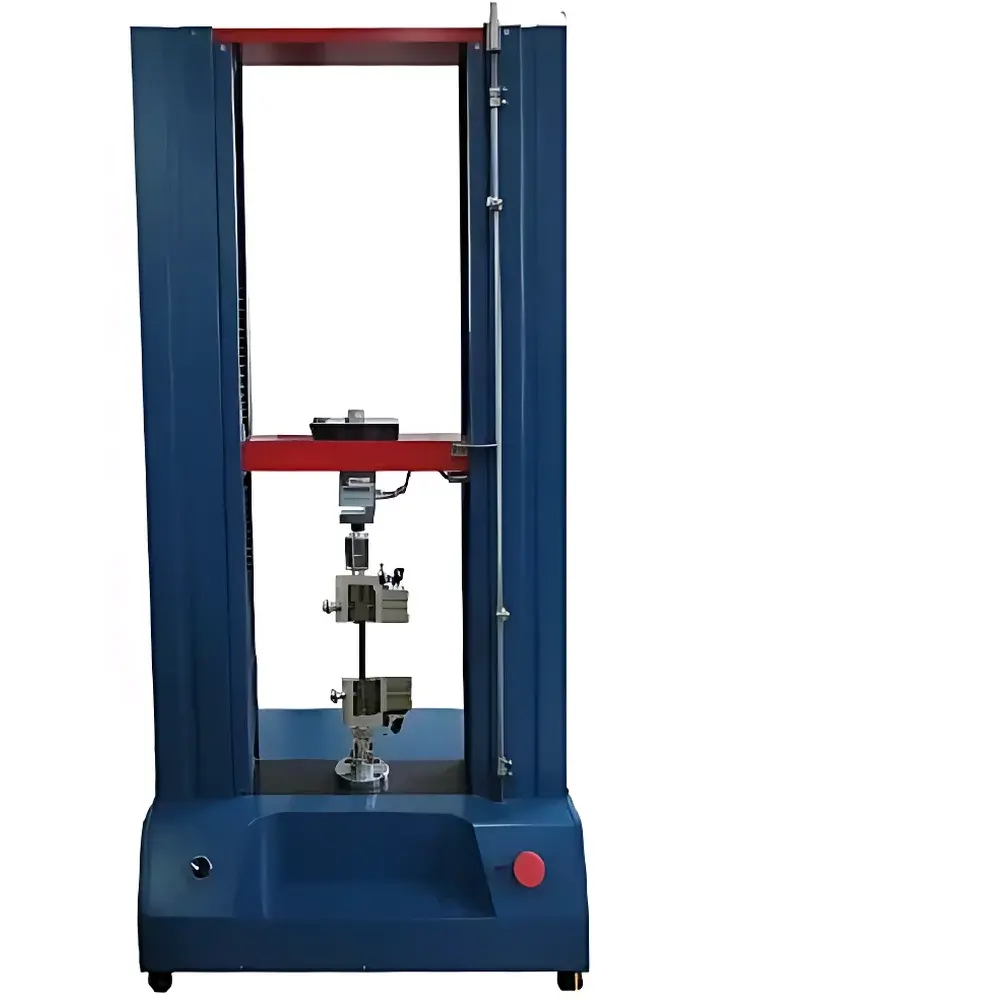
Qinsun QJ211S Four-Point Bending Tester for Smartphone Glass
| Brand | Qinsun |
|---|---|
| Origin | Shanghai, China |
| Model | QJ211S |
| Maximum Load Capacity | 10 kN |
| Accuracy Class | 0.5 |
| Effective Test Width | 320 mm |
| Stroke (Tensile Space) | 500 mm (optional 800 mm) |
| Test Speed Range | 0.01–300 mm/min |
| Speed Accuracy | ±0.5% of indicated value |
| Force Resolution | 500,000 counts (full-scale, no range switching) |
| Displacement & Strain Measurement Accuracy | ±0.5% of indicated value |
| Load Cell | High-precision U.S.-sourced sensor |
| Controller | Panasonic全digital AC servo controller |
| Control System | Full-digital closed-loop system supporting constant stress, constant strain, and constant displacement modes |
| Safety Protection | Software-based overload diagnosis, electronic travel limit, auto-return function, and 110% over-load hardware cutoff |
| Compliance Standards | GB, ISO 178, ASTM C1499, JIS R3206, DIN 52345, EN 1288-3 |
Overview
The Qinsun QJ211S Four-Point Bending Tester is a precision universal testing machine engineered specifically for mechanical characterization of brittle transparent materials—particularly chemically strengthened aluminosilicate glass used in smartphone front panels, foldable displays, and cover lenses. Unlike three-point bending, which induces high localized stress beneath the central loading nose, four-point bending generates a uniform moment region between the two inner loading points, enabling accurate determination of flexural strength, modulus of rupture (MOR), and fracture toughness without edge-effect artifacts. This configuration is mandated by ASTM C1499 and ISO 178 for standardized evaluation of thin, flat glass substrates where surface flaw sensitivity dominates failure behavior. The QJ211S integrates a rigid dual-column frame, high-resolution force and displacement feedback loops, and a thermally stable load train to ensure repeatable results across production QA batches and R&D validation cycles.
Key Features
- High-fidelity four-point bending fixture assembly with adjustable span ratios (typically 16:1 or 20:1 per ASTM C1499) and hardened steel rollers to minimize indentation damage during loading;
- 0.5-class accuracy certified force measurement system with 500,000-count resolution across full 10 kN range—no auto-ranging required, eliminating step-change errors;
- Panasonic digital AC servo motor and controller delivering precise speed control from 0.01 to 300 mm/min (±0.5% tolerance), critical for quasi-static fracture initiation studies;
- Full-closed-loop control architecture supporting user-defined test profiles: constant crosshead speed, constant loading rate, or displacement-controlled ramp-hold sequences;
- Dual-mode positioning: rapid coarse adjustment (up to 200 mm/min) and fine micro-stepping (0.01 mm increments) for optimal specimen alignment and pre-load establishment;
- Integrated safety interlocks including software-based travel limits, real-time overload detection (>110% F.S.), and automatic emergency stop upon signal anomaly;
- Modular tooling interface compatible with standardized glass support blocks (e.g., 50 × 50 mm, 100 × 100 mm), as well as optional fixtures for tensile, compression, peel, and shear testing up to 10 kN.
Sample Compatibility & Compliance
The QJ211S accommodates flat glass specimens ranging from 30 × 30 mm to 120 × 120 mm in planar dimension and thicknesses from 0.3 mm to 2.0 mm—covering Gorilla Glass, Dragon Trail, Xensation, and custom OEM formulations. Its 320 mm effective test width and 500 mm (extendable to 800 mm) vertical stroke allow integration of environmental chambers or optical extensometers for in-situ deformation monitoring. The system complies with key international standards governing glass mechanical testing, including ASTM C1499 (Standard Test Method for Monotonic Quasi-Static Strength of Advanced Ceramics at Ambient Temperature), ISO 178 (Plastics — Determination of Flexural Properties), and EN 1288-3 (Glass in Building — Determination of the Bending Strength of Glass — Part 3: Testing of Annealed and Heat Strengthened Glass). Data acquisition meets GLP audit requirements with time-stamped, operator-logged test records traceable to NIST-traceable calibration certificates.
Software & Data Management
Control and analysis are executed via Qinsun’s Windows-based TestMaster Pro software—a validated platform supporting 21 CFR Part 11 compliance when configured with electronic signatures, audit trails, and role-based access control. Real-time plotting displays load–deflection, stress–strain, and modulus vs. displacement curves synchronized with video capture (when interfaced with optional high-speed camera). All raw data (1 kHz sampling rate) are stored in ASCII-compatible .csv format with metadata headers—including test parameters, calibration IDs, environmental conditions, and operator credentials. Post-test operations include curve smoothing (Savitzky-Golay), peak detection (for first-crack load), linear regression on elastic region (for flexural modulus), and statistical batch reporting (mean, SD, CV%, Weibull modulus). Export options include PDF reports compliant with ISO/IEC 17025 laboratory documentation templates.
Applications
- Quality assurance of tempered and ion-exchanged display glass prior to module lamination;
- Comparative evaluation of edge strength vs. center strength in asymmetrically strengthened substrates;
- Correlation of bending strength with surface roughness (Ra), residual stress (via photoelasticity), and laser etch depth;
- Accelerated durability screening under cyclic four-point bending (low-cycle fatigue mode);
- Validation of anti-shatter film adhesion performance under controlled delamination onset;
- Supporting material qualification per IEC 60950-1 (safety of IT equipment) and MIL-STD-810H mechanical shock protocols.
FAQ
What standards does the QJ211S support for smartphone glass testing?
ASTM C1499, ISO 178, EN 1288-3, JIS R3206, and GB/T 10700 are natively implemented in the test method library—with preconfigured parameter sets and report templates.
Can the system perform both three-point and four-point bending?
Yes—the base frame accepts interchangeable fixture kits; the four-point configuration is standard, while three-point adapters are available as optional accessories.
Is calibration traceable to national metrology institutes?
All load cells and displacement transducers ship with factory calibration certificates traceable to NIST or CNAS-accredited labs, and annual recalibration services are available under ISO/IEC 17025 scope.
Does the software support automated pass/fail decision logic?
Yes—users can define acceptance thresholds (e.g., “flexural strength ≥ 520 MPa”) and configure the system to flag outliers, generate non-conformance logs, and trigger email alerts via SMTP integration.
What maintenance is required for long-term accuracy stability?
Biannual verification of force and displacement linearity, annual recalibration, and routine cleaning of guide rails and roller surfaces using isopropyl alcohol—no lubrication required due to self-lubricating polymer bushings.
Related Products



